Vai al contenuto principale

← Torna al post

Newsletter: The supposedly “unprecedented” ethics restrictions in the industry-written Clarity Act exempt Trump’s crypto businesses and leave enforcement to his loyalists. Senators must vote no on cloture tomorrow.

https://www.citationneeded.news/clarity-act-ethics-charade/

#uspol #uspolitics #crypto #cryptocurrency #citationneedednewsletter #clarityact

83

Caricamento...

5
112

Caricamento...

Republican negotiators claim the new draft gives state attorneys general a “meaningful role” in enforcement. It doesn’t: AGs can’t sue Trump or other officials directly — they can only sue tthe Attorney General for an injunction. And a Trump-appointed ethics office can shut that down too.

Republican negotiators claim the new draft gives state attorneys general a “meaningful role” in enforcement.1 It does not. State attorneys general still can’t bring enforcement actions against the president or other officials who violate the prohibitions — under the new draft, they can only bring action against the Attorney General to try to obtain injunctive relief.2 And if the Office of Government Ethics — led by Trump loyalist Keith Sonderling — decides the activity is not prohibited, that’s the end of the state AGs’ ability to intervene.

Blockquote: (A) ISSUANCE; SPONSORSHIP.—No action may be brought under paragraph (1)(A) if the supervising ethics office, with respect to a potential violation of paragraph (1) or (2) of section 13152(a), provides a legal opinion that an activity is not prohibited.
Clarity Act, p. 631
0

Most enforcement instead falls to the Attorney General himself — currently Todd Blanche, Trump’s own former personal lawyer. Blanche already dismantled DOJ’s crypto enforcement team and told prosecutors to stand down on crypto crimes.

Most enforcement falls to the Attorney General3 — currently Todd Blanche, a former personal lawyer to Trump. In April 2025, Blanche dismantled the Department of Justice’s National Cryptocurrency Enforcement Team, directed the agency’s Market Integrity and Major Frauds Unit to “cease cryptocurrency enforcement”, and directed prosecutors not to charge various crimes in crypto cases [I81].
0

Corey Frayer, former SEC crypto adviser on how carefully definitions were drafted to miss Trump’s actual businesses: “whoever wrote it knows Trump’s crypto businesses inside and out. And then they made sure Trump’s crypto businesses would remain outside and not in.” (That’s via https://eyeontech.substack.com/p/clarity-act-update-ethics-schmethics)

As for what’s prohibited: “covered individuals”, including the president,4 will be barred from issuing or sponsoring digital assets, or “maintain[ing] a significant financial interest” in cryptocurrency companies.5 While this sounds like it should apply Trump’s multitudinous crypto ventures, the definitions are carefully drafted — almost as if to intentionally exclude the president’s ventures. Corey Frayer, the Director of Investor Protection at the Consumer Federation of America and former crypto adviser at the SEC during the Biden administration, wrote: “The way this section is written makes it clear that whoever wrote it knows Trump’s crypto businesses inside and out. And then they made sure Trump’s crypto businesses would remain outside and not in.”6
0

The bill bans “sponsorship” deals, which at first glance appears like it could apply to Trump’s businesses. But later text clarifies this is only for tokens issued after the bill takes effect — carving out protections for Trump’s World Liberty Financial and $​TRUMP memecoin.

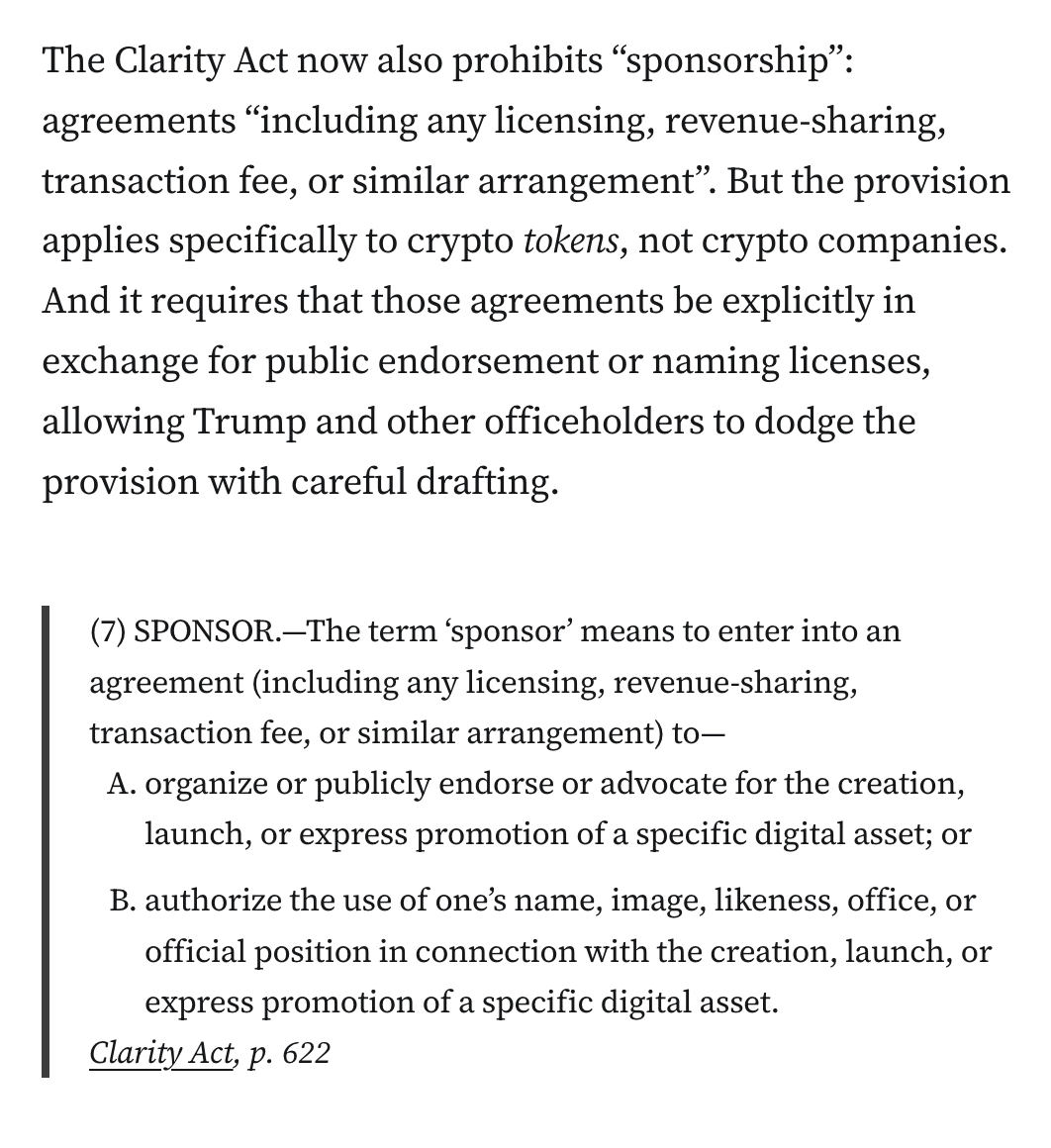
The Clarity Act now also prohibits “sponsorship”: agreements “including any licensing, revenue-sharing, transaction fee, or similar arrangement”. But the provision applies specifically to crypto tokens, not crypto companies. And it requires that those agreements be explicitly in exchange for public endorsement or naming licenses, allowing Trump and other officeholders to dodge the provision with careful drafting.

Blockquote: (7) SPONSOR.—The term ‘sponsor’ means to enter into an agreement (including any licensing, revenue-sharing, transaction fee, or similar arrangement) to—
organize or publicly endorse or advocate for the creation, launch, or express promotion of a specific digital asset; or
authorize the use of one’s name, image, likeness, office, or official position in connection with the creation, launch, or express promotion of a specific digital asset.
Clarity Act, p. 622 A later provision makes the carveout for Trump’s ventures explicit. The sponsorship prohibition applies only to digital assets issued or sponsored “after the effective date of this division” — anywhere from two months to a year after the bill is passed.7 Trump’s revenue sharing arrangement with World Liberty and his licensing agreement with the $TRUMP memecoin are grandfathered in. (That memecoin earned Trump more than $635 million last year, as investors lost billions [I109].)
0

The crypto industry has spent hundreds of millions of dollars lobbying for the Clarity Act, which they pitch as “clear rules of the road”.

In reality, it’s industry capture, deregulation, and legitimization of the most brazen self-dealing in presidential history. Senators must vote no.

The bill’s proponents describe the Clarity Act as providing “clear rules of the road” for digital assets, painting Democrats who oppose to a bill as inexplicably standing in the way of clear guardrails for crypto. “A no vote tomorrow kills the toughest ethics reform this country has ever put on the books, kills consumer protections for every American holding digital assets, and hands the future of this industry to our foreign competitors,” threatened Senator Lummis on Twitter.11

But regulations were previously, if belatedly, being enforced in the crypto sector by the SEC, which applied laws that cover a broad range of financial assets that fit the definition of an investment contract. Courts repeatedly upheld this application to the crypto sector — much to the chagrin of deep-pocketed crypto firms like Coinbase, Ripple, and Gemini, who responded with hundreds of millions in lobbying and saw their cases dropped under Trump [Quid pro quo]. Facing what they viewed as an existential threa Democrats considering a vote for cloture should understand what they’re endorsing: a bill that grandfathers in the crypto ventures that netted Trump $1.4 billion as investors were ruined, and leaves enforcement to Trump loyalists who have already dismantled crypto oversight and enabled some of the president’s worst abuses.

The crypto industry spent $130 million in 2024 installing lawmakers who would let them write their own rules. They’ve poured hundreds of millions more into lobbying for the Clarity Act and installing even more pro-crypto members of Congress in the midterms. Republicans are trying to disguise this industry capture and deregulation as consumer protection, painting Democrats who oppose the bill as anti-innovation obstructionists. Democrats should not give them the bipartisan cover they seek.

A vote for cloture tomorrow by any Senator — Democrat or Republican — is a vote to legitimize the most brazen self-dealing in presidential history and pave the road for yet more future abuses.
0

I dig through these 600+ page bills so you don’t have to. If you find that valuable, Citation Needed is 100% reader-funded, and you can support my work with a pay-what-you-want subscription.

https://www.citationneeded.news/signup

0