Vai al contenuto principale

← Torna al post

Newsletter: Regulators race to reassure the crypto industry as the its flagship Clarity Act legislation collapses, SBF tries his luck with the Supreme Court, and crypto PACs unleash $30 million against Sherrod Brown.

https://www.citationneeded.news/issue-110/

#uspol #uspolitics #crypto #cryptocurrency #citationneedednewsletter

71

Caricamento...

3
73

Caricamento...

After years of political pressure and hundreds of millions of dollars in campaign funds and lobbying, the Clarity Act collapsed at the eleventh hour. This is good news — the Clarity Act isn’t about “clarity” in crypto regulations any more than the PATRIOT Act is about patriotism.

After years of political pressure, hundreds of millions of dollars to fund the campaigns of pro-crypto politicians, and at least $8 million in lobbying,1 the Clarity Act collapsed at the eleventh hour when a procedural vote to advance the broad-ranging cryptocurrency market structure bill fell far short of the 60 votes it needed. While the crypto lobby had a long wishlist for Trump’s presidency — and has already secured wins such as the Genius Act stablecoin bill and regulatory capture at the CFTC and SEC — broad legislation that would cement the deregulation of the crypto sector while giving it a veneer of legitimacy was their top priority. This is good news. The Clarity Act isn’t about “clarity” any more than the PATRIOT Act is about patriotism. It promised regulatory structure but would have carved out crypto from the scrutiny applied to similar financial products, instead building a custom regime to allow it to operate without meaningful oversight. Trump has already dismantled the agencies that should police the sector, replacing bipartisan commissions with a handful of loyalists who have dismissed the majority of crypto enforcement actions and investigations. But those are changes can be reversed when Trump leaves office. Legislation is far more durable — which is why the crypto industry so desperately wanted the Clarity Act to lock in deregulation. Rebuilding from Trump’s devastation won’t be easy, but today we can be grateful there won’t be additional bad legislation blocking the way.
0

Republicans are pointing fingers at the Democrats, some Democrats are pointing fingers at Republicans. And some blame Coinbase, which used its effective veto power to stall the bill in January — a delay that left time for Trump’s financial disclosure to make the bill into a political lightning rod.

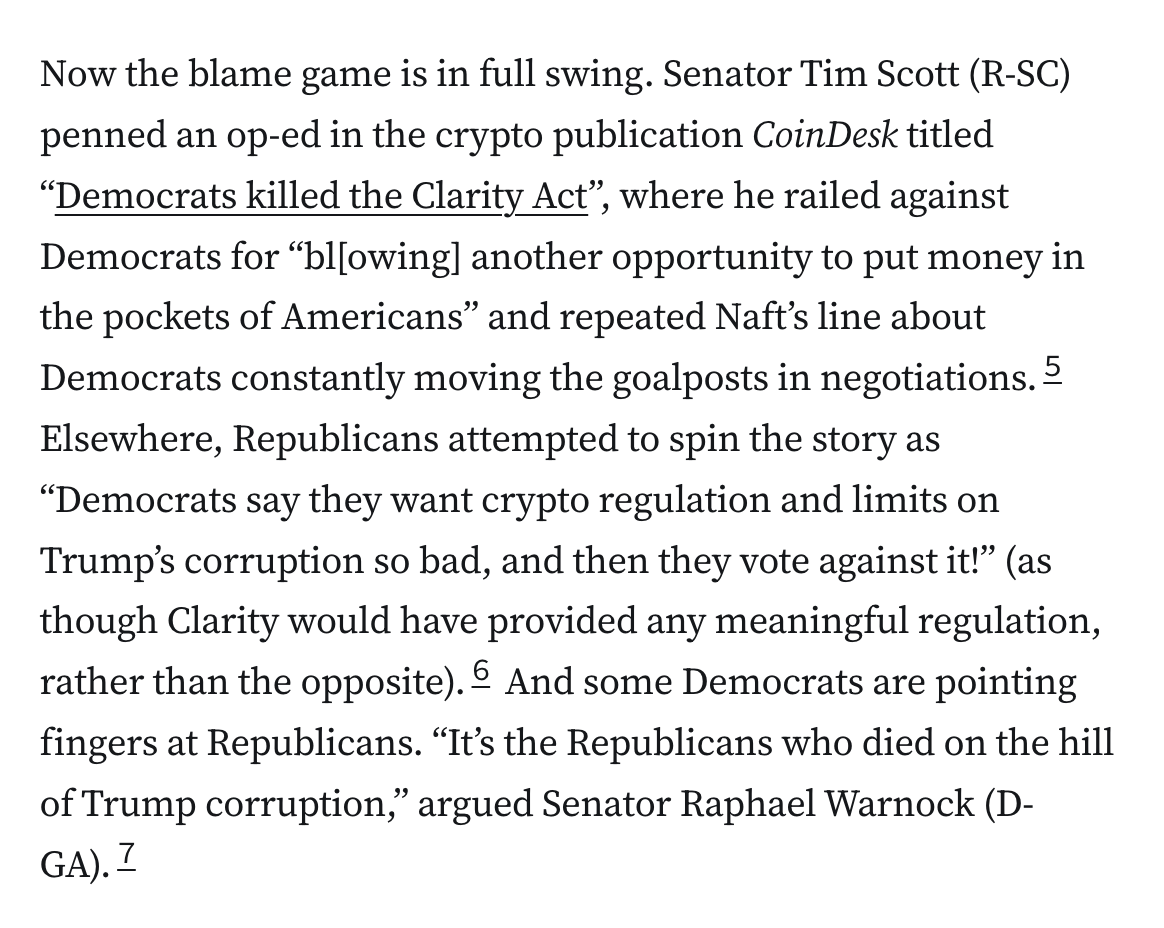
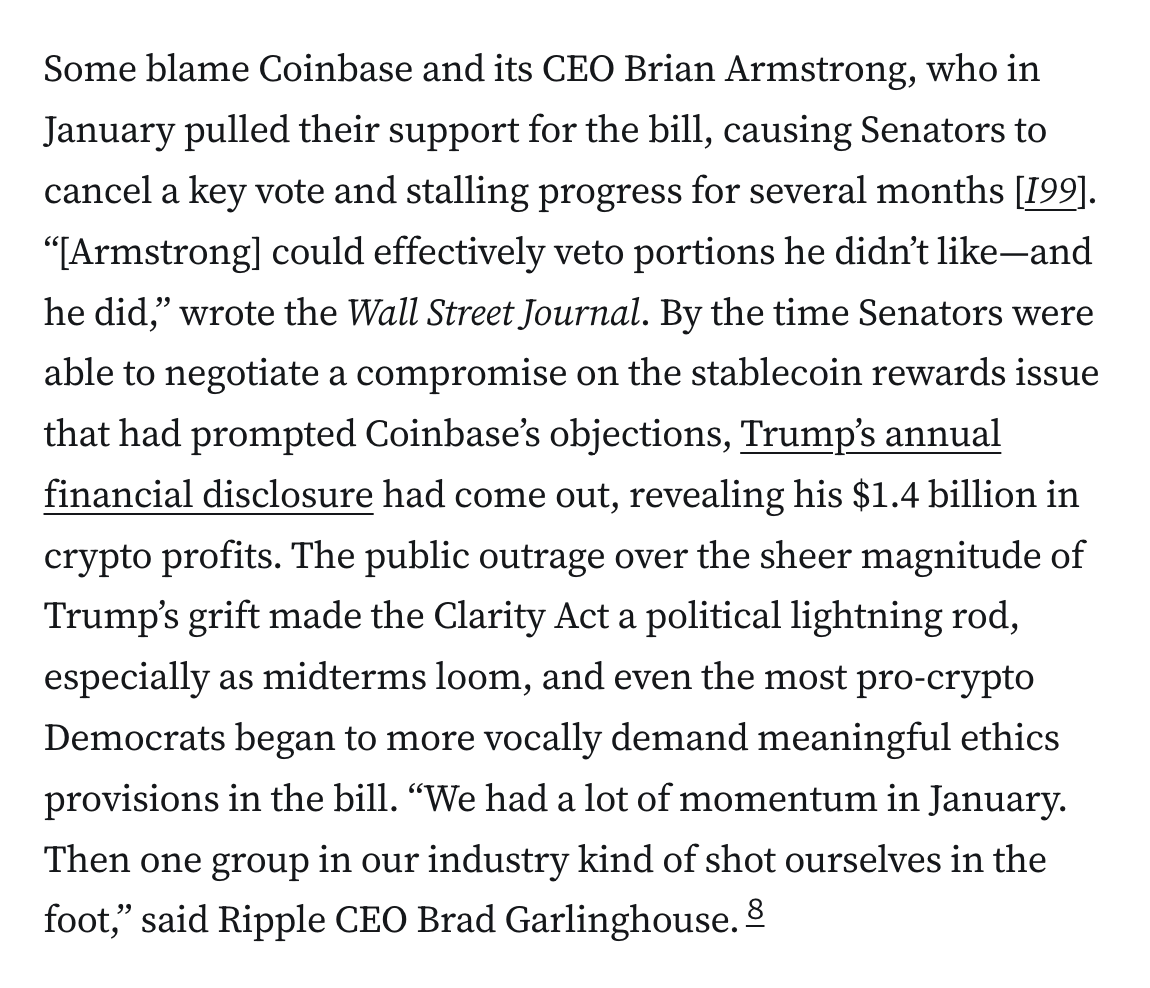
Now the blame game is in full swing. Senator Tim Scott (R-SC) penned an op-ed in the crypto publication CoinDesk titled “Democrats killed the Clarity Act”, where he railed against Democrats for “bl[owing] another opportunity to put money in the pockets of Americans” and repeated Naft’s line about Democrats constantly moving the goalposts in negotiations.5 Elsewhere, Republicans attempted to spin the story as “Democrats say they want crypto regulation and limits on Trump’s corruption so bad, and then they vote against it!” (as though Clarity would have provided any meaningful regulation, rather than the opposite).6 And some Democrats are pointing fingers at Republicans. “It’s the Republicans who died on the hill of Trump corruption,” argued Senator Raphael Warnock (D-GA).7 Some blame Coinbase and its CEO Brian Armstrong, who in January pulled their support for the bill, causing Senators to cancel a key vote and stalling progress for several months [I99]. “[Armstrong] could effectively veto portions he didn’t like—and he did,” wrote the Wall Street Journal. By the time Senators were able to negotiate a compromise on the stablecoin rewards issue that had prompted Coinbase’s objections, Trump’s annual financial disclosure had come out, revealing his $1.4 billion in crypto profits. The public outrage over the sheer magnitude of Trump’s grift made the Clarity Act a political lightning rod, especially as midterms loom, and even the most pro-crypto Democrats began to more vocally demand meaningful ethics provisions in the bill. “We had a lot of momentum in January. Then one group in our industry kind of shot ourselves in the foot,” said Ripple CEO Brad Garlinghouse.8
0

As the Clarity Act collapsed, commissioners at the CFTC and SEC raced to reassure the crypto industry that they will still deliver a friendly regulatory environment. The SEC has just dropped an “Innovation Exemption” that essentially removes issuers of tokenized stocks from securities oversight.

In regulators
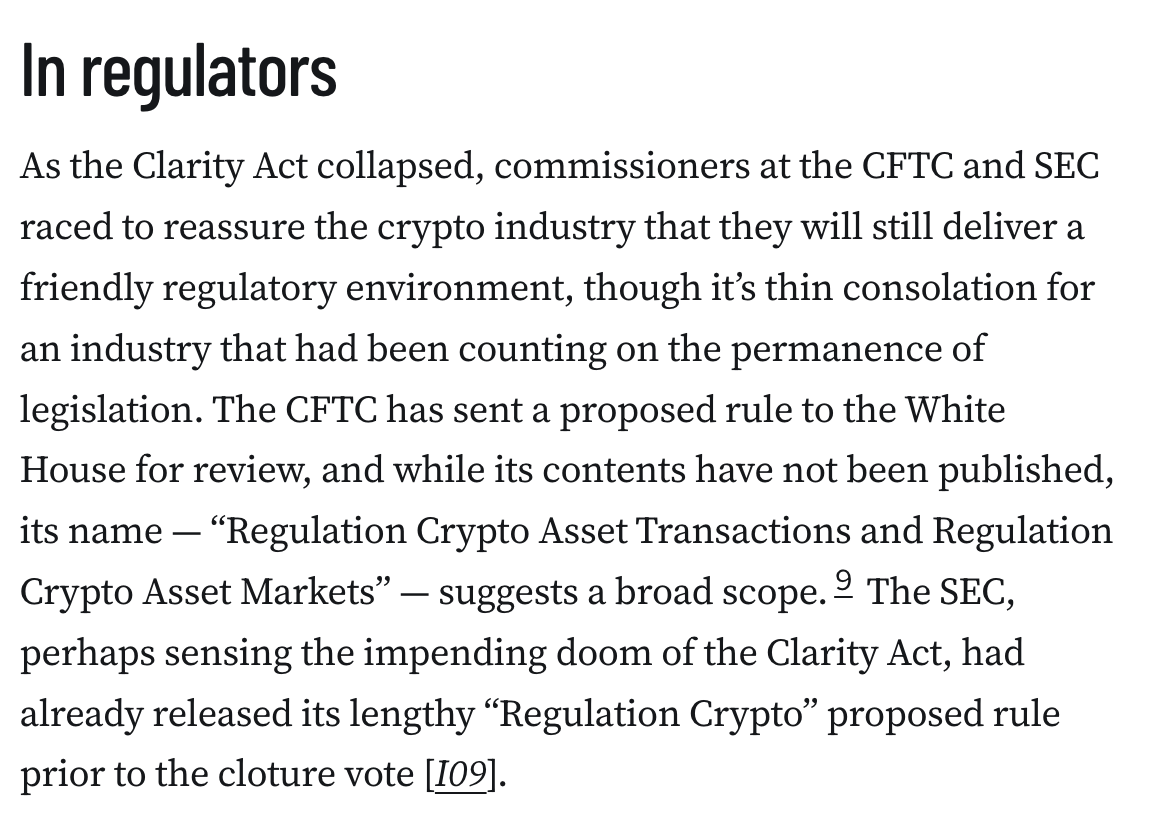
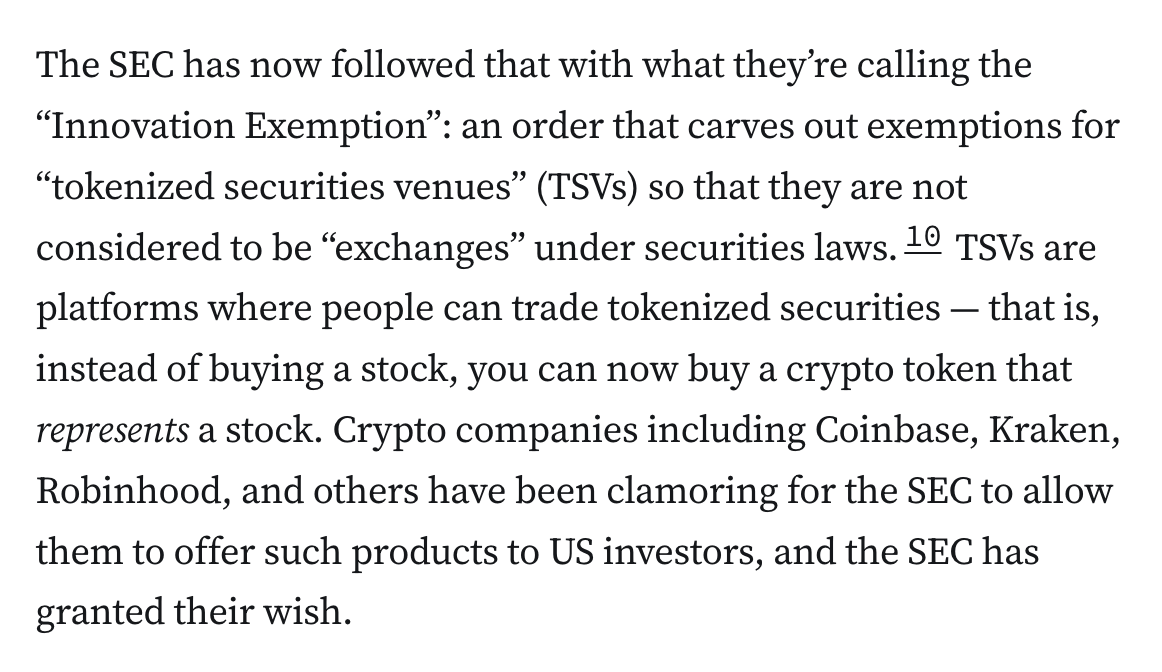
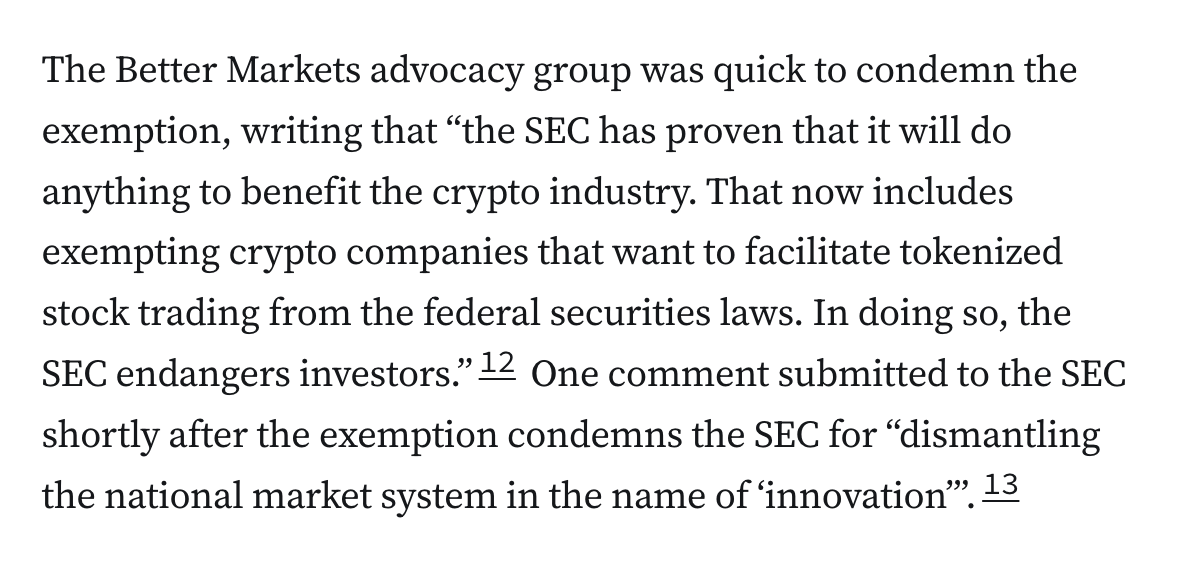
As the Clarity Act collapsed, commissioners at the CFTC and SEC raced to reassure the crypto industry that they will still deliver a friendly regulatory environment, though it’s thin consolation for an industry that had been counting on the permanence of legislation. The CFTC has sent a proposed rule to the White House for review, and while its contents have not been published, its name — “Regulation Crypto Asset Transactions and Regulation Crypto Asset Markets” — suggests a broad scope.9 The SEC, perhaps sensing the impending doom of the Clarity Act, had already released its lengthy “Regulation Crypto” proposed rule prior to the cloture vote [I09]. The SEC has now followed that with what they’re calling the “Innovation Exemption”: an order that carves out exemptions for “tokenized securities venues” (TSVs) so that they are not considered to be “exchanges” under securities laws.10 TSVs are platforms where people can trade tokenized securities — that is, instead of buying a stock, you can now buy a crypto token that represents a stock. Crypto companies including Coinbase, Kraken, Robinhood, and others have been clamoring for the SEC to allow them to offer such products to US investors, and the SEC has granted their wish. While the SEC has in the past exempted smaller operators from the types of onerous regulations and requirements that apply to stock exchanges like the Nasdaq or New York Stock Exchange, this exemption is a shocking departure. The most comparable historical exemption is Regulation ATS, applying to “alternative trading systems”, which was issued amid the surge in electronic trading in the late nineties.11 However, that rule was made after several years of observation of various ATSes that were operating under no-action letters, and with the experience gleaned from that period — not as the first step. It was also created via the full notice-and-comment rulemaking process, unlike this exemption, which is an exemptive order the agency says was necessary in order to “address the immediate concerns” of the crypto industry. Finally, while Regulation ATS exempts ATSes from the definition of exchange, it also installs a separate set of conditions and registration requirements for ATSes, which re The Better Markets advocacy group was quick to condemn the exemption, writing that “the SEC has proven that it will do anything to benefit the crypto industry. That now includes exempting crypto companies that want to facilitate tokenized stock trading from the federal securities laws. In doing so, the SEC endangers investors.”12 One comment submitted to the SEC shortly after the exemption condemns the SEC for “dismantling the national market system in the name of ‘innovation’”.13
0

The exemption for “tokenized securities venues” (TSVs) is a huge overreach, but it may go unchallenged. A challenge would normally come from competitors (i.e., registered exchanges), but tokenized stocks are of dubious appeal. Exchanges may not see TSVs as likely to gain any real traction.

It remains to be seen whether anyone will take the SEC to task over this brazen overstep. A legal challenge might normally come from competitors — in this case, the stock exchanges that do have to comply with onerous regulations. But the exchanges also may not see TSVs as a serious competitive threat.

These tokenized stocks are of dubious appeal, and there’s little reason to think traders — particularly institutional traders — would prefer them to trading the stocks themselves. The crypto industry’s main pitch is that TSVs would allow 24/7 trading, but it’s not clear a significant portion of the market actually wants that. TSVs also bring various risks and downsides: if you buy a tokenized stock on one TSV, there is little infrastructure that would allow you to sell it elsewhere, essentially locking you in to that platform. And what happens to those locked-in traders if a TSV hits its volume cap and is required to pause trading in that stock for three months? Stock issuers also may not wish to allow TSVs to tokenize their stocks, and the SEC stopped short in this order of granting Robinhood’s wish to tokenize stocks without issuer consent.14 While the handful of publicly traded crypto companies will likely allow it, an exchange that only offers shares of Coinbase and Microstrategy may not attract much interest.

Why spend the money and political capital on a lawsuit against your regulator over a product that’s unlikely to gain meaningful traction? My guess is most exchanges will wait and see if these venues catch on — and maybe even dabble in launching their own — before deciding challenging the SEC is worth the trouble.
0

Sam Bankman-Fried has taken his appeal to the Supreme Court, but he’s relying on a very similar argument that the Court unanimously rejected last year. I doubt they’ll take up his case.

FTX
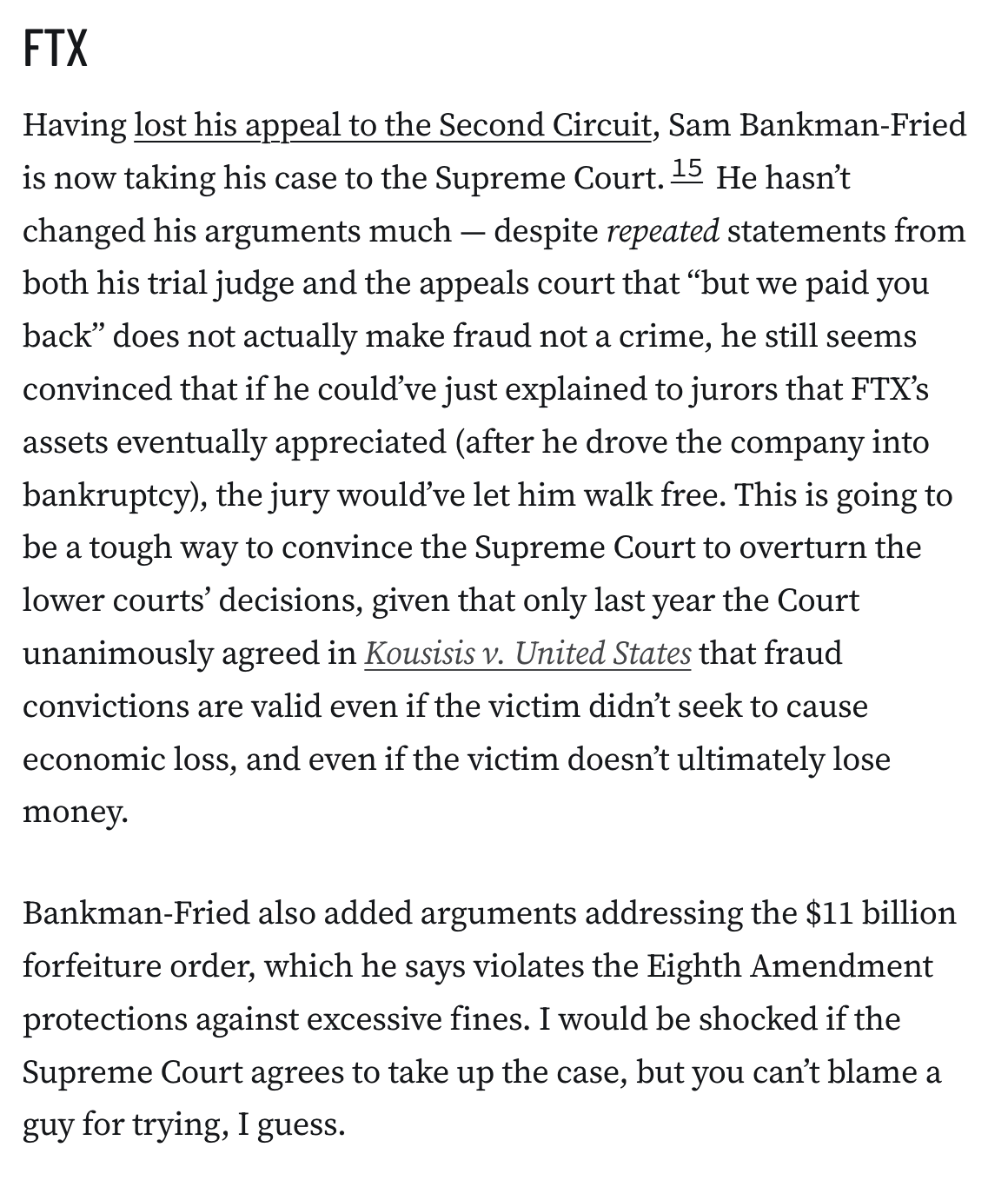
Having lost his appeal to the Second Circuit, Sam Bankman-Fried is now taking his case to the Supreme Court.15 He hasn’t changed his arguments much — despite repeated statements from both his trial judge and the appeals court that “but we paid you back” does not actually make fraud not a crime, he still seems convinced that if he could’ve just explained to jurors that FTX’s assets eventually appreciated (after he drove the company into bankruptcy), the jury would’ve let him walk free. This is going to be a tough way to convince the Supreme Court to overturn the lower courts’ decisions, given that only last year the Court unanimously agreed in Kousisis v. United States that fraud convictions are valid even if the victim didn’t seek to cause economic loss, and even if the victim doesn’t ultimately lose money.

Bankman-Fried also added arguments addressing the $11 billion forfeiture order, which he says violates the Eighth Amendment protections against excessive fines. I would be shoc
0

Fellow FTX executive Caroline Ellison is out of jail, and the Manifund effective altruist grantmaking organization has just let slip they hired her. She “brings specific, useful expertise around finance”, they say, which yeah — much in the same way that Bernie Madoff had very specific expertise.

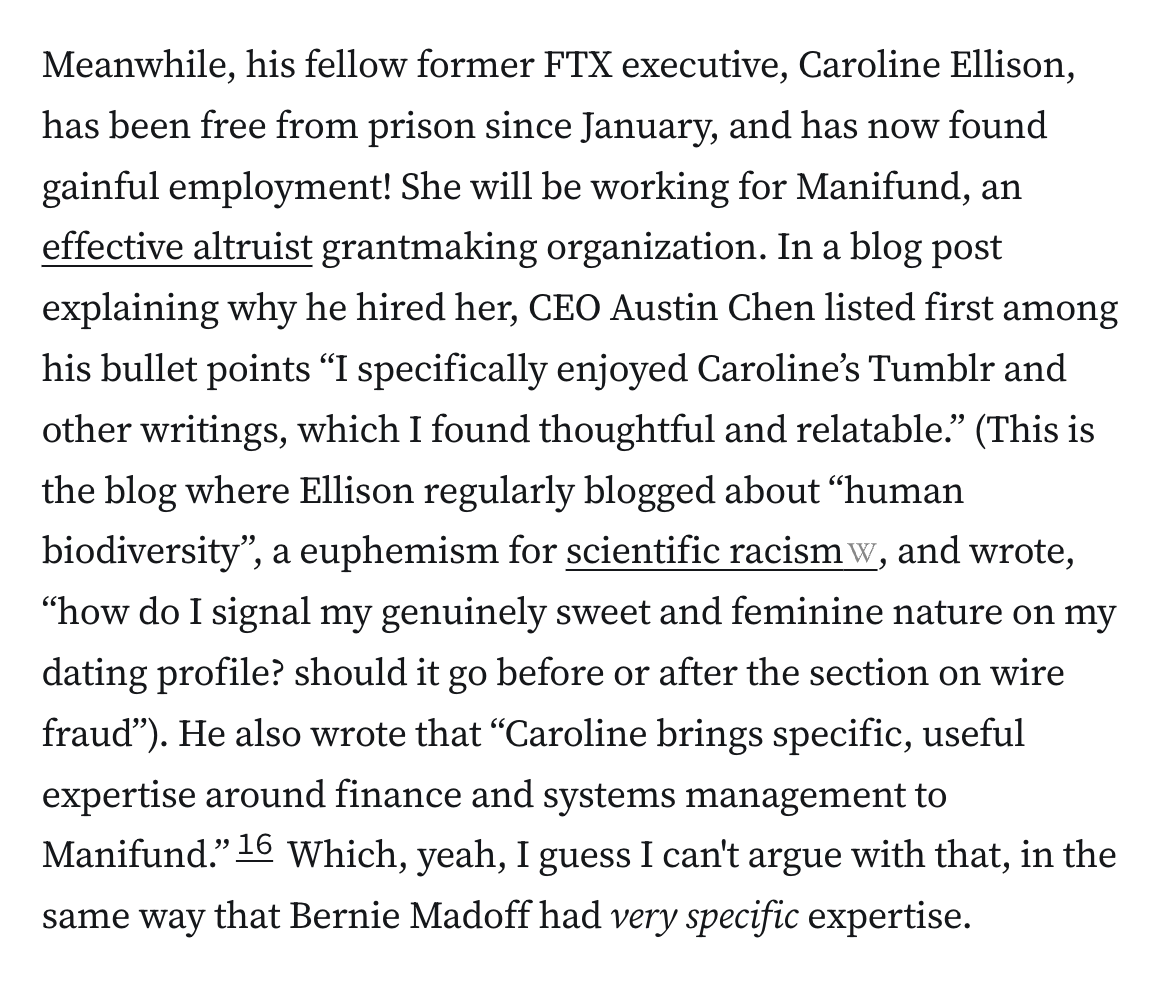
Meanwhile, his fellow former FTX executive, Caroline Ellison, has been free from prison since January, and has now found gainful employment! She will be working for Manifund, an effective altruist grantmaking organization. In a blog post explaining why he hired her, CEO Austin Chen listed first among his bullet points “I specifically enjoyed Caroline’s Tumblr and other writings, which I found thoughtful and relatable.” (This is the blog where Ellison regularly blogged about “human biodiversity”, a euphemism for scientific racism, and wrote, “how do I signal my genuinely sweet and feminine nature on my dating profile? should it go before or after the section on wire fraud”). He also wrote that “Caroline brings specific, useful expertise around finance and systems management to Manifund.”16 Which, yeah, I guess I can't argue with that, in the same way that Bernie Madoff had very specific expertise. FTX essentially bankrolled Manifund and the associated Manifold Markets (think Polymarket but with fake money) through grants and investments. This may explain why Chen, citing a “keen debt” to FTX, decided to hire Ellison and pay her using funds derived from her fraud — money Manifund is currently fighting the FTX estate over rather than returning to creditors.17
0

Binance pleaded guilty to Iran (and other) sanctions violations in 2023. Trump pardoned its founder. Binance took a $2B investment paid in the Trump family’s stablecoin. Now DOJ is investigating Binance for... Iran sanctions violations, under a US attorney who used to be Trump's lawyer.

Binance
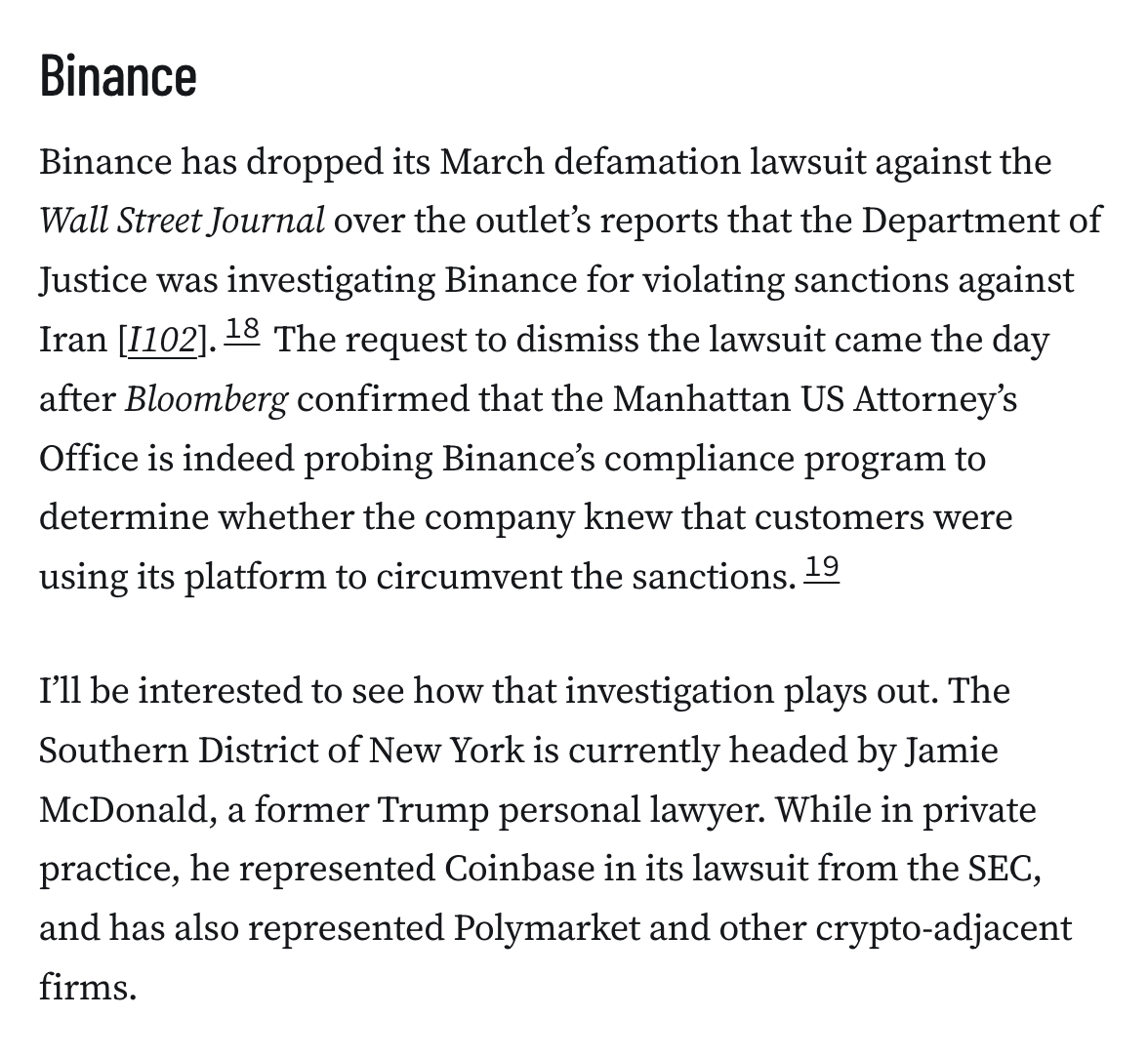
Binance has dropped its March defamation lawsuit against the Wall Street Journal over the outlet’s reports that the Department of Justice was investigating Binance for violating sanctions against Iran [I102].18 The request to dismiss the lawsuit came the day after Bloomberg confirmed that the Manhattan US Attorney’s Office is indeed probing Binance’s compliance program to determine whether the company knew that customers were using its platform to circumvent the sanctions.19

I’ll be interested to see how that investigation plays out. The Southern District of New York is currently headed by Jamie McDonald, a former Trump personal lawyer. While in private practice, he represented Coinbase in its lawsuit from the SEC, and has also represented Polymarket and other crypto-adjacent firms. Binance has been a lucrative partner to Trump, accepting a $2 billion investment from the United Arab Emirates’ MGX investment fund denominated in the USD1 stablecoin [I83]. That $2 billion is a substantial chunk of USD1’s reserves, and helped to generate $8.3 million in income for Trump in 2025. Binance has also provided software to the Trump family’s World Liberty Financial, listed USD1 for trading, and offered incredibly generous promotions to incentivize traders to buy the Trump family’s stablecoin [Quid pro quo].

The benefits have gone both ways for Binance. A 2023 enforcement action by the SEC, which accused Binance of fraud and operating as an unregistered securities exchange (and included a quote from Binance’s Chief Compliance Officer that “we are operating as a fking unlicensed securities exchange in the USA bro”), was dismissed with prejudice in May 2025 [I85]. Later that year, Trump pardoned the company’s former CEO, Changpeng Zhao, who was convicted of violating anti-mone
0

@molly0xfff@hachyderm.io The corruption is one massive thing. But somehow not even staying bought is another whole level of rotten.

0