Vai al contenuto principale

Newsletter: A Trump crypto adviser’s firm took millions from Tether while he shaped stablecoin rules in their favor, a Senate probe targets Commerce Secretary Lutnick’s not-so-former firm, and crypto’s biggest super PAC plays it safe.

https://www.citationneeded.news/issue-111/

#uspol #uspolitics #cryptocurrency #citationneedednewsletter #crypo

44

Caricamento...

2
88

Caricamento...

Commenti (2)

While Bo Hines shaped the Genius Act as Trump’s crypto council director, his family’s consulting firm took $6.3M+ from Tether. He pushed a change to the law that would primarily benefit Tether, then left to run Tether’s US arm.

In the White House
Tether, Bo Hines, and NXUM
Bo Hines, President Trump’s bizarre choice [I72] to serve as the first executive director of his crypto advisory council, was among the key architects of the Genius Act, the stablecoin law signed in July 2025. Hines’ previous qualifications consisted of playing college football, losing two Congressional races, and co-owning a small consulting firm called NXUM with his father. He kept his stake in NXUM when he joined the administration.

The Wall Street Journal has now reported that weeks after Hines began working on the bill, his father and their fellow NXUM co-owner Gary Dennis met with Tether CEO Paolo Ardoino. Tether is the largest stablecoin issuer, and had the most riding on the legislation. Though NXUM previously had little involvement with the crypto sector, it pitched Tether on a “strategic lobbying” and PR campaign that has netted NXUM at least $6.3 million to date, with payments that began while Hines was still at the White House Meanwhile, Hines pushed legislators to double the grace period for crypto exchanges to stop offering noncompliant stablecoins — a change that primarily benefited Tether. He also remained active in Signal chats with his NXUM partners. When some Republican congresspeople stalled the bill, his father informed Dennis he’d gotten a “very worried” call from Ardoino and that Tether wanted them to “obliterate” the holdouts. Hours later, Hines sent the NXUM group chat talking points casting the legislators as “undermining the president and ... bought and paid for by democratic shills like coinbase and a16z”. When Trump brokered a deal with the holdouts weeks later, Dennis bragged to an associate, “Bo got it done.” Three weeks after the bill was signed, Hines left the White House; the following month, he was named CEO of Tether’s new US arm.

NXUM has only grown more entangled with Tether since. The consulting firm, which is pitching investors on a deal in which Tether would buy a 25% stake for Hines was succeeded on the crypto council by Patrick Witt, whose resume likewise featured college football and failed congressional bids [I90]. Witt took over negotiations on the Clarity Act crypto market structure bill, which recently fizzled after falling short of the votes needed for cloture [I110]. In July, the council’s deputy director, Harry Jung, stepped down to join (you guessed it!) NXUM.1 Now, Witt has left his post, presumably to collect his reward. I look forward to learning who’s paying it.

His departure adds to growing nerves in the crypto sector that the White House is losing interest. David Sacks stepped down from his combined “AI and crypto czar” role in March, and earlier this month Trump tapped Jay Clayton to become his AI czar.2 No crypto czar has been named, and the digital assets advisory council is now without a director or deputy director. The Clarity Act is dead, with little hope of being revived after the midterms. If I were among the crypto executives whose Diagram showing how former White House crypto council officials Bo Hines and Harry Jung connect to the consulting firm NXUM, Tether and Tether US, the Fellowship PAC, Cantor Fitzgerald, and Commerce Secretary Howard Lutnick, including payments of $6.3M+ from Tether and $6.5M+ from the PAC to NXUM, and a loan from Tether to Lutnick.
0

A Senate subcommittee is probing Tether’s ties to Cantor Fitzgerald, the firm Commerce Secretary Howard Lutnick supposedly divested from by handing it to his sons. Per Senator Blumenthal, Cantor’s 5% stake in Tether has skyrocketed from $600M to ~$10B since Trump returned to office.

Tether, Howard Lutnick, and Cantor Fitzgerald
Hines isn’t the only Trump official whose ties to Tether are drawing scrutiny. The Senate Permanent Subcommittee on Investigations is probing the relationship between the stablecoin firm and financial giant Cantor Fitzgerald, which was previously headed by Commerce Secretary Howard Lutnick. Upon his cabinet appointment, Lutnick claimed to have satisfied his ethics requirements by transferring his interest in the firm to a trust benefiting his four children, and handing control to two of his sons — a move borrowed from Trump. Like Trump, Lutnick has continued to profit from the family business — his 2025 financial disclosure reported a $192 million distribution from the firm. Nor does he seem to have stepped away from it: in April, when the Cantor-funded Fellowship PAC disclosed plans to spend $1.75 million backing Ken Paxton in the Texas Senate primary runoff, senior Republican officials called Lutnick to complain. The PAC quietly dropped t An October 8 letter from PSI Ranking Member Richard Blumenthal to Cantor Chairman and CEO Brandon Lutnick disclosed that the subcommittee is investigating Cantor Fitzgerald’s relationship with Tether and its connections to the Trump regime.4 Cantor took a 5% stake in the stablecoin issuer in 2024, and according to Blumenthal, “Since the President’s return to office, Cantor Fitzgerald’s five percent stake in Tether has increased in value from $600 million to an estimated $10 billion, in addition to the tens of millions of dollars the company collects every year from the assets it holds for Tether.” The letter raises concerns about Tether’s use by illicit actors, including Iran’s shadow banking system, and about Cantor’s close ties to Lutnick and the rest of the Trump administration.

Blumenthal requested information on Cantor Fitzgerald’s due diligence on Tether’s reserves and anti-money laundering programs, the terms of a loan from Tether to Howard Lutnick that may have financed his tr
0

Community bankers are suing the OCC over its spree of national trust bank charters, at least 13 of 21 of which went to crypto firms (including Trump’s World Liberty). They argue it’s a side door for crypto firms to get the perks of a bank charter without the rules.

In regulators
The Independent Community Bankers of America has sued the Office of the Comptroller of the Currency over its recent rulemaking and its spree of national trust bank charters. At least 13 of the 21 charters granted by the OCC under Trump have gone to crypto firms, including Circle, Ripple, and the Trump family’s own World Liberty Financial [I88, 98, 99, 101, 102, 107]. While the national trust bank framework is intended to let firms hold assets on clients’ behalf without the more stringent oversight applied to traditional banks that take deposits and lend them out, the community banks argue that the OCC has overstepped its authority and turned the regime into a backdoor for crypto companies to get the perks of a bank charter without the rules. The suit singles out Protego, which won conditional approval for a trust charter despite plans to offer crypto custody, trading, lending, and asset management services. The OCC’s expansion “creates a gaping hole in regulation,” the trade group writes, letting crypto firms perform many of the same functions as community banks “while evading the fundamental safeguards, obligations, and oversight of those banks.” Their customers don’t receive the protections of deposit insurance, the separation of banking and commerce, or limits on dealings with risky investments like hedge funds. And because the national charters preempt state law, they lose some state consumer protections. Many won’t realize it: “Customers will reasonably assume that a company having ‘national bank’ in its title is an insured depository institution.”

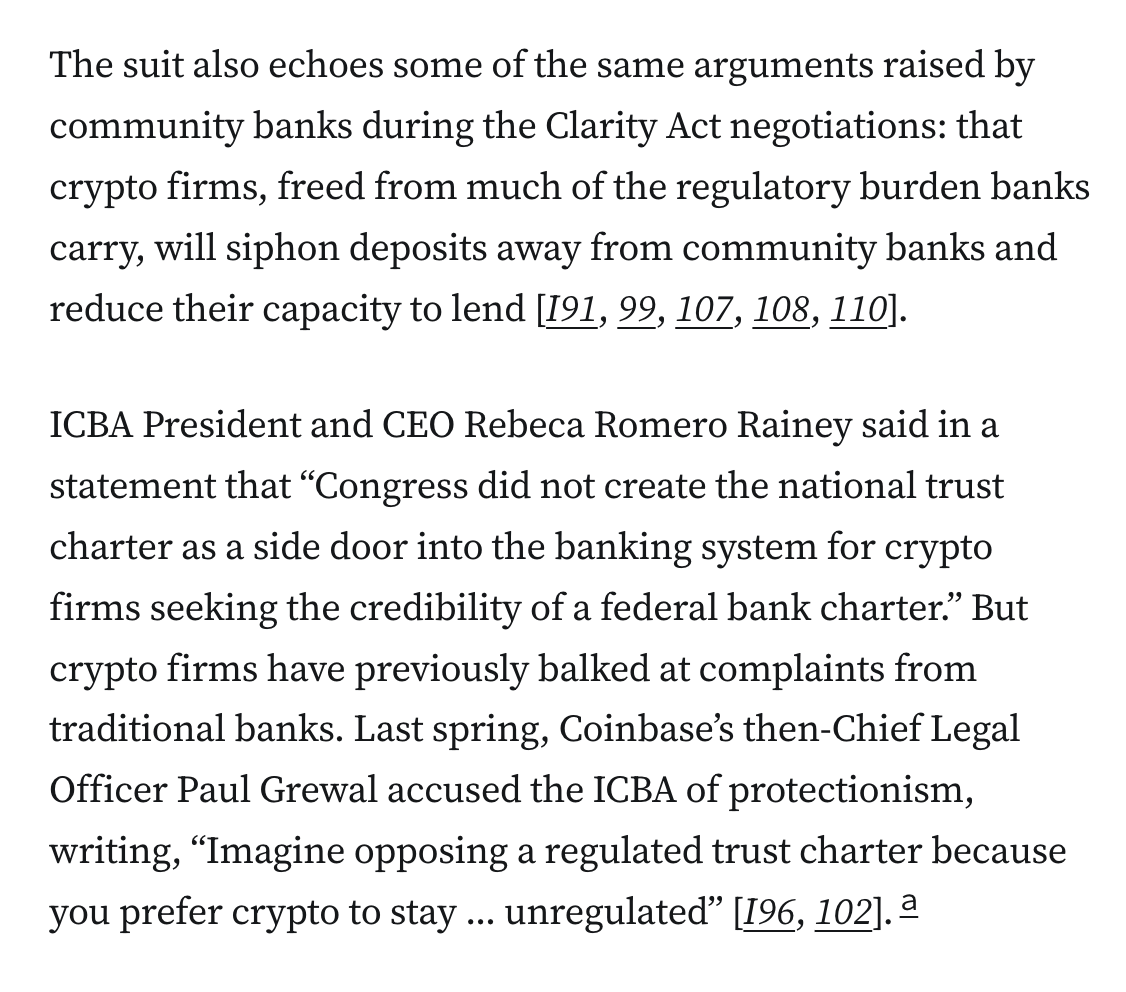
There’s also very little precedent for what will happen if one of these firms fails. “The OCC has not managed an uninsured bank receivership in nearly one hundred years,” the lawsuit points out, warning that “failures of risky uninsured national trust banks could spread instability throughout the nation’s financial system, including by sp The suit also echoes some of the same arguments raised by community banks during the Clarity Act negotiations: that crypto firms, freed from much of the regulatory burden banks carry, will siphon deposits away from community banks and reduce their capacity to lend [I91, 99, 107, 108, 110].

ICBA President and CEO Rebeca Romero Rainey said in a statement that “Congress did not create the national trust charter as a side door into the banking system for crypto firms seeking the credibility of a federal bank charter.” But crypto firms have previously balked at complaints from traditional banks. Last spring, Coinbase’s then-Chief Legal Officer Paul Grewal accused the ICBA of protectionism, writing, “Imagine opposing a regulated trust charter because you prefer crypto to stay … unregulated” [I96, 102].a
0

Crypto super PAC Fairshake announced 32 House endorsements: all incumbents, all but four in safe seats. It’s their attempt to pad their win rate and claim it proves the existence of a crypto voter bloc, but they are abandoning reliable allies in tough races.

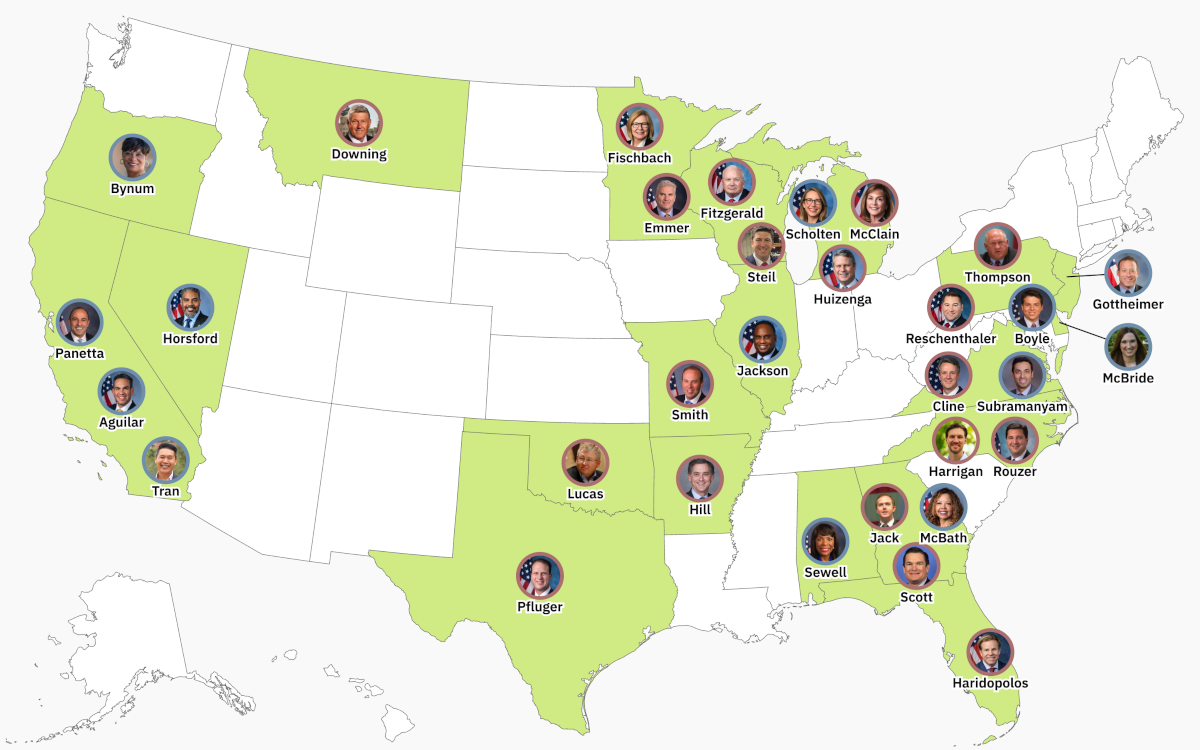
Map of the United States showing photos of the 32 House members endorsed by the crypto super PAC Fairshake, each placed on their home state. Red borders mark the 19 Republicans: Ben Cline (Virginia), Troy Downing (Montana), Tom Emmer (Minnesota), Michelle Fischbach (Minnesota), Scott Fitzgerald (Wisconsin), Mike Haridopolos (Florida), Pat Harrigan (North Carolina), French Hill (Arkansas), Bill Huizenga (Michigan), Brian Jack (Georgia), Frank Lucas (Oklahoma), Lisa McClain (Michigan), August Pfluger (Texas), Guy Reschenthaler (Pennsylvania), David Rouzer (North Carolina), Austin Scott (Georgia), Jason Smith (Missouri), Bryan Steil (Wisconsin), and Glenn Thompson (Pennsylvania). Blue borders mark the 13 Democrats: Pete Aguilar (California), Brendan Boyle (Pennsylvania), Janelle Bynum (Oregon), Josh Gottheimer (New Jersey), Steven Horsford (Nevada), Jonathan Jackson (Illinois), Lucy McBath (Georgia), Sarah McBride (Delaware), Jimmy Panetta (California), Hillary Scholten (Michigan), Terri In elections and political influence
The crypto industry’s flagship super PAC, Fairshake, has announced a list of 32 House candidates it plans to back in the midterms. All of them are incumbents; 13 are Democrats, and 19 are Republicans. All but four are in races dubbed “safe” for them by the Cook Political Report.5

PAC spokesperson Geoff Vetter gave the game away when he bragged to The Hill, “We’ve won 53 of the 57 races we engaged in this cycle”.6 As I’ve noted previously [I68, 70, 108], the crypto PACs and advocacy groups often support shoo-in candidates so that they can later claim that their win rate reflects some silent majority of Americans who support the “crypto agenda”. Similarly, when Coinbase-linked Stand With Crypto endorsed 39 candidates in 2024, The Hill estimated prior to Election Day that 32 of them had a 75% or higher chance of winning [I68]. Out of their list, the Fairshake network has so far spent the most on Republicans Bill Huizenga (MI, $1.5 million) and French Hill (AR, $1.4 million). It has spent around $1 million apiece supporting Bryan Steil (R-WI), Janelle Bynum (D-OR), Derek Tran (D-CA), and Steven Horsford (D-NV), and $512,000 each on Josh Gottheimer (D-NJ) and Pete Aguilar (D-CA). Most of the other endorsed candidates have so far received around $75,000 each from the network. Some of the biggest checks went to members who chair the committees with jurisdiction over crypto, including Hill (Financial Services) and Steil (digital assets subcommittee).

Conspicuously missing are several reliable crypto allies in tougher races, including Democrats Don Davis (NC) and Shomari Figures (AL) and Republicans Zach Nunn (IA) and Mike Lawler (NY). Fairshake spent more than $2 million each on Davis and Figures in 2024, and $1 million on Nunn; it didn’t back Lawler. Nunn and Lawler have, however, received smaller amounts of su
0

Trump announced yet another $​TRUMP memecoin gala, plus a Super Bowl suite for top holders. The fine print notes the events don’t mean his companies aren’t dumping the token, which is down 95%, at the same time.

Trump business interests
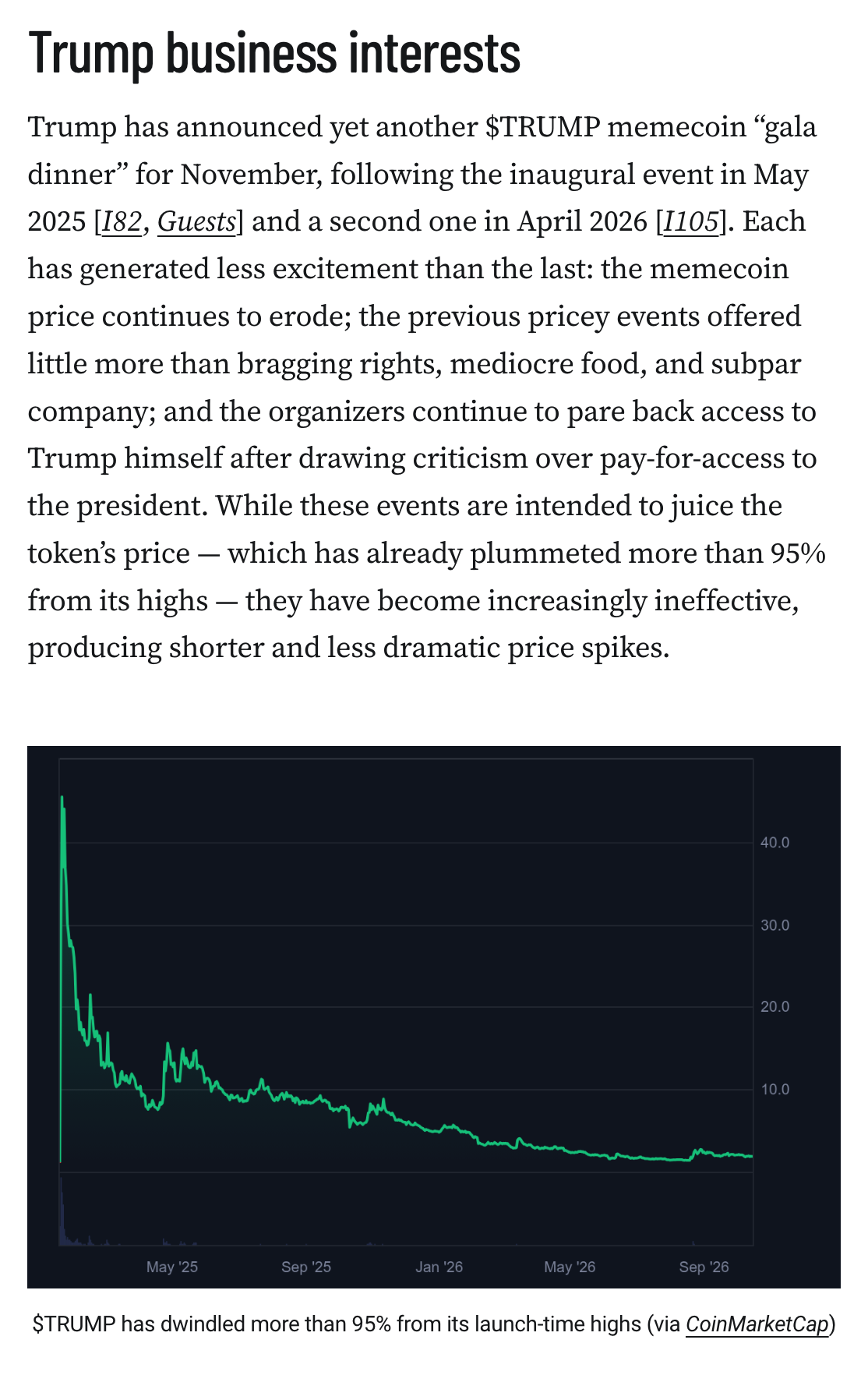
Trump has announced yet another $TRUMP memecoin “gala dinner” for November, following the inaugural event in May 2025 [I82, Guests] and a second one in April 2026 [I105]. Each has generated less excitement than the last: the memecoin price continues to erode; the previous pricey events offered little more than bragging rights, mediocre food, and subpar company; and the organizers continue to pare back access to Trump himself after drawing criticism over pay-for-access to the president. While these events are intended to juice the token’s price — which has already plummeted more than 95% from its highs — they have become increasingly ineffective, producing shorter and less dramatic price spikes.

Image: Price chart showing that $TRUMP has dwindled more than 95% from its launch-time highs (via CoinMarketCap) Kevin Mercuri, former spokesperson for Bill Zanker — who runs the $TRUMP memecoin and related portions of Trump’s personal business empire — criticized the event, calling the gala “tone-deaf” while “the nation is embroiled in a dead-end war and facing a widespread affordability crisis”.7 Trump personally pocketed more than $635 million from the memecoin during the 2025 fiscal year, as nearly all of the roughly one million retail traders lost money — a combined $3.8 billion.8 The fine print in the website now includes a disclaimer that the existence of events like the gala “does not indicate that Fight Fight Fight LLC, CIC Digital LLC or their respective affiliates are not contemporaneously disposing of $TRUMP coins”.9

The Trump memecoin website is also now teasing plans to invite the top 18 holders of the token to watch the Super Bowl from a “private luxury suite” and enjoy a “3-day VIP experience” including dinners and an “elite afterparty”. The fine print is careful to note that “Pr
0

Hex founder Richard Heart, who the SEC once accused of spending investor money on sports cars, luxury watches, and the world’s largest black diamond, has been arrested in Istanbul after nearly two years on an Interpol Red Notice over Finnish tax fraud charges. He no longer faces SEC enforcement after the agency effectively dropped his case last year.

Richard Heart
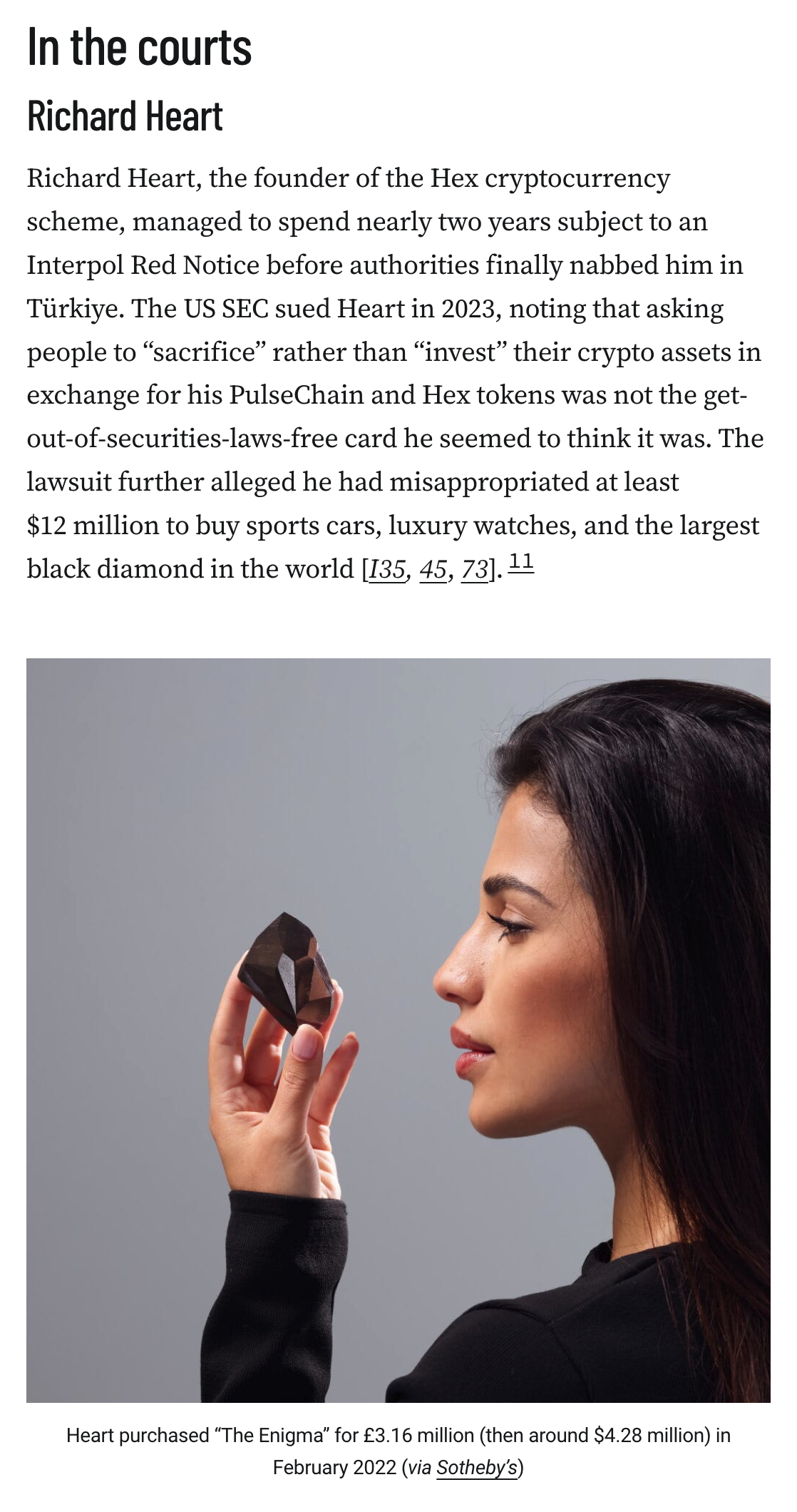
Richard Heart, the founder of the Hex cryptocurrency scheme, managed to spend nearly two years subject to an Interpol Red Notice before authorities finally nabbed him in Türkiye. The US SEC sued Heart in 2023, noting that asking people to “sacrifice” rather than “invest” their crypto assets in exchange for his PulseChain and Hex tokens was not the get-out-of-securities-laws-free card he seemed to think it was. The lawsuit further alleged he had misappropriated at least $12 million to buy sports cars, luxury watches, and the largest black diamond in the world [I35, 45, 73].11

Photograph of a woman in side profile holding The Enigma black diamond in front of her face. It is an asymmetrical faceted diamond about the size of an egg.
Caption: Heart purchased “The Enigma” for £3.16 million (then around $4.28 million) in February 2022 (via Sotheby’s) Then, in September 2024, he was accused by Finnish authorities of evading several hundred million euros in taxes, and was named as a suspect in a brutal physical assault on a sixteen-year-old perpetrated in February 2021 [I67].12 At Finland’s request, Heart was added to the EU’s Most Wanted list and an Interpol Red Notice was issued [I72].

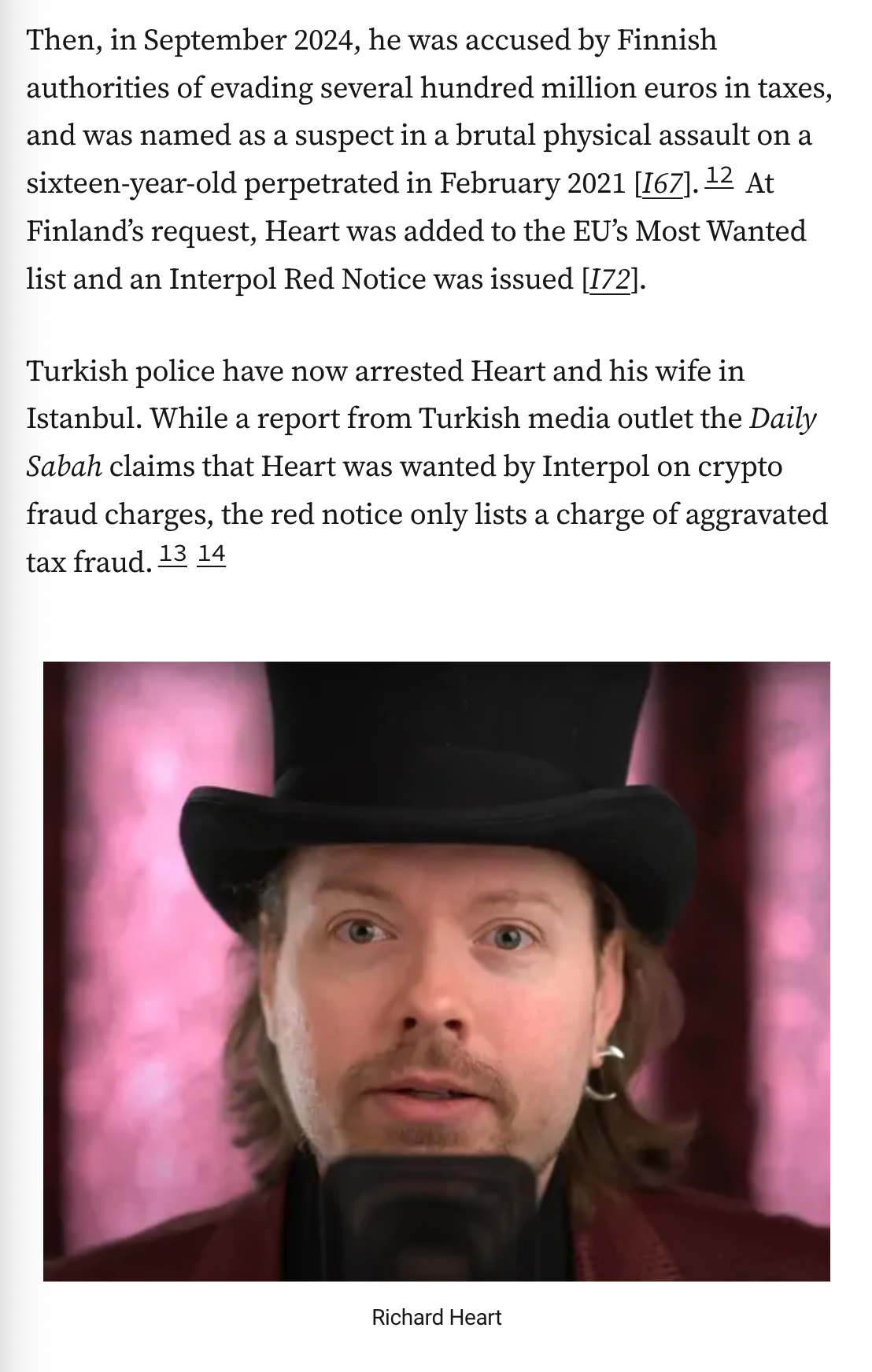
Turkish police have now arrested Heart and his wife in Istanbul. While a report from Turkish media outlet the Daily Sabah claims that Heart was wanted by Interpol on crypto fraud charges, the red notice only lists a charge of aggravated tax fraud.1314

Photograph: Richard Heart, wearing a top hat and speaking into a microphone
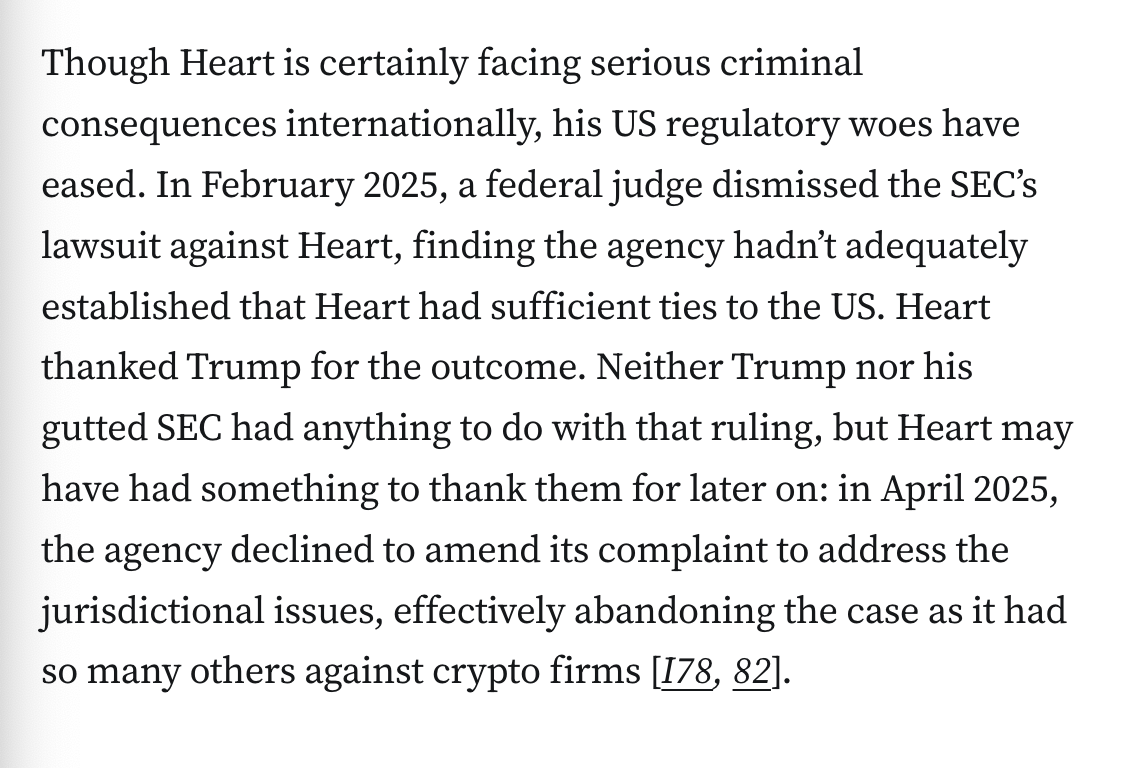
Caption: Richard Heart Though Heart is certainly facing serious criminal consequences internationally, his US regulatory woes have eased. In February 2025, a federal judge dismissed the SEC’s lawsuit against Heart, finding the agency hadn’t adequately established that Heart had sufficient ties to the US. Heart thanked Trump for the outcome. Neither Trump nor his gutted SEC had anything to do with that ruling, but Heart may have had something to thank them for later on: in April 2025, the agency declined to amend its complaint to address the jurisdictional issues, effectively abandoning the case as it had so many others against crypto firms [I78, 82].
0

A jury convicted the Uranium Finance exploiter who stole $53M+ and spent it on Magic and Pokémon cards, Roman coins, and a scrap of the Wright brothers’ plane that went to the moon. His “code is law” defense wasn’t helped by him admitting to the exploit and calling crypto “all fake internet money anyway.”

Everything else
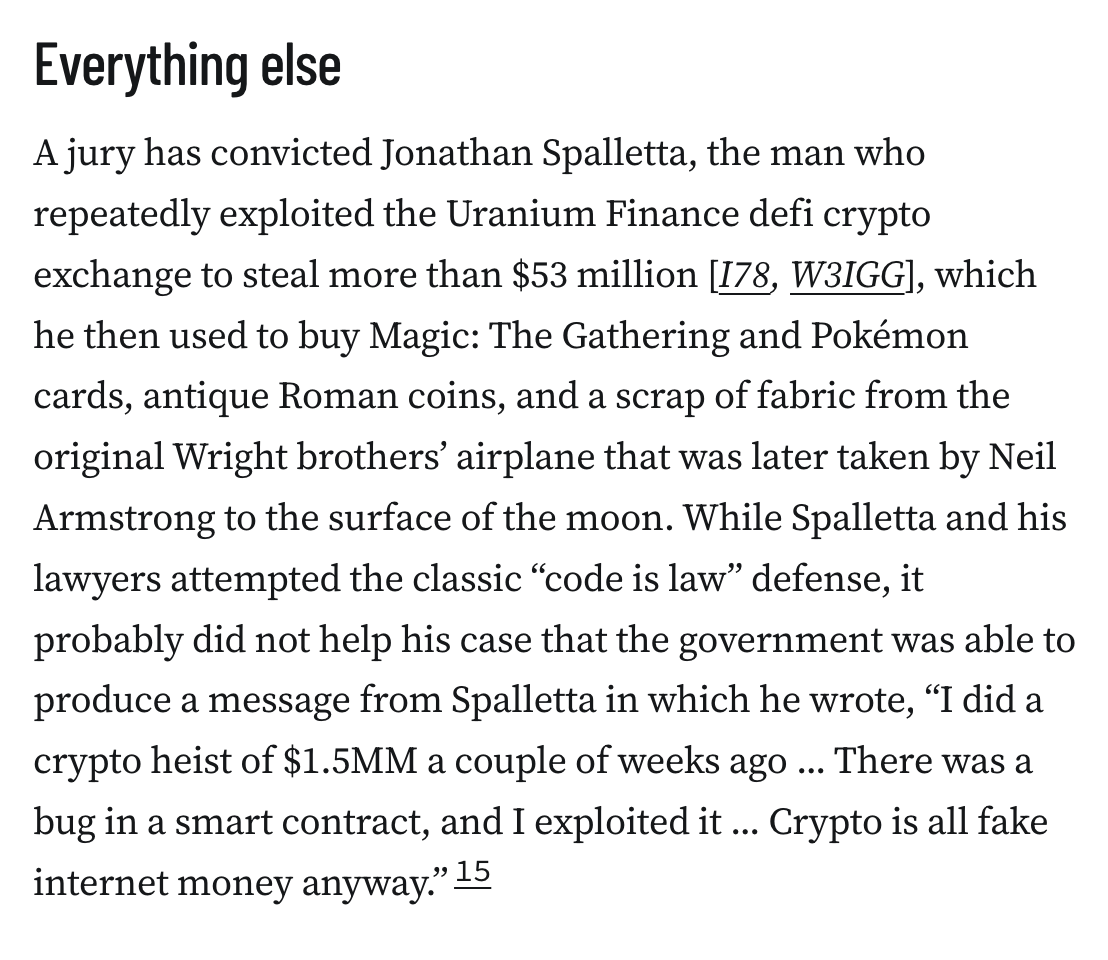
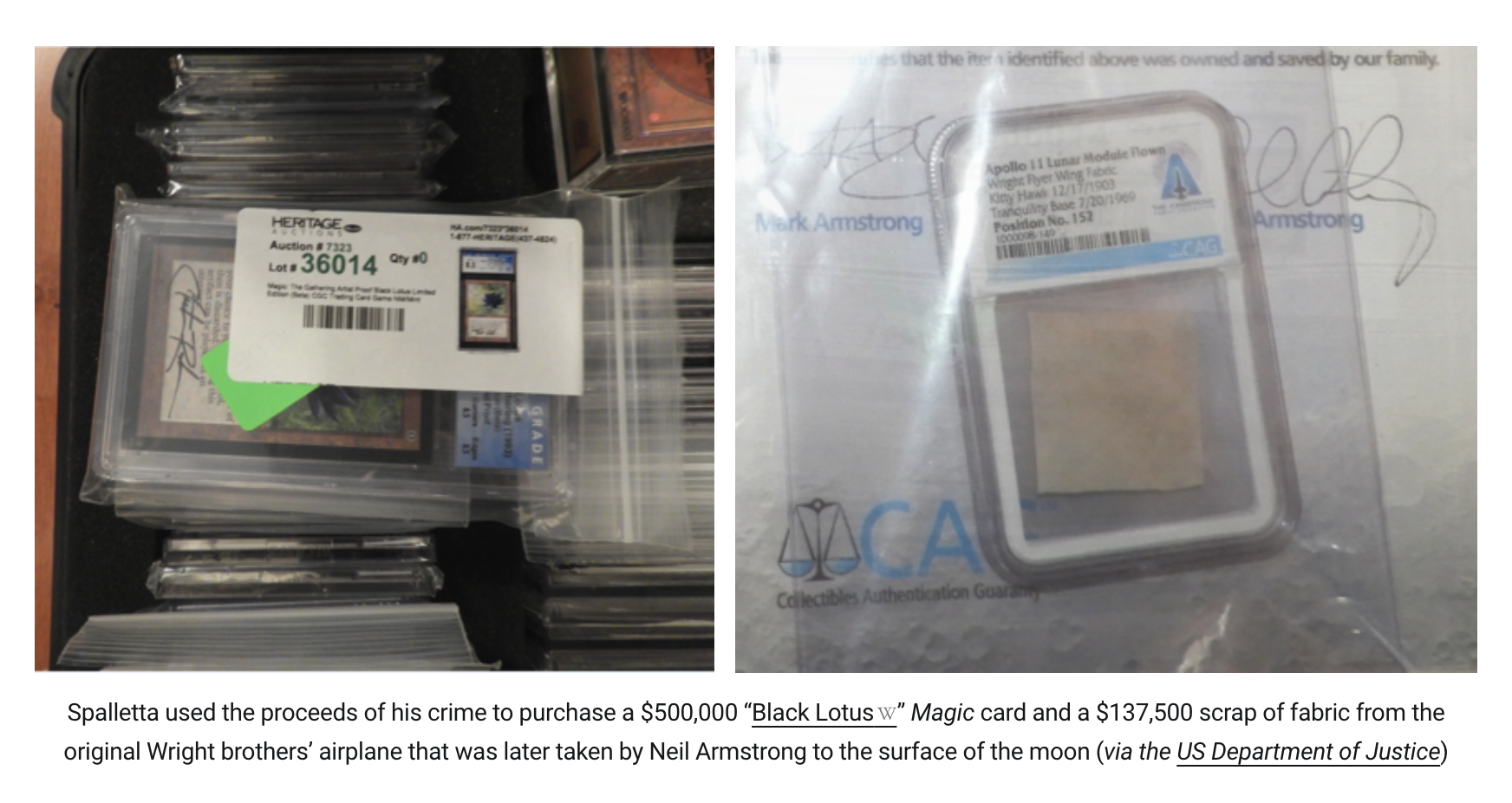
A jury has convicted Jonathan Spalletta, the man who repeatedly exploited the Uranium Finance defi crypto exchange to steal more than $53 million [I78, W3IGG], which he then used to buy Magic: The Gathering and Pokémon cards, antique Roman coins, and a scrap of fabric from the original Wright brothers’ airplane that was later taken by Neil Armstrong to the surface of the moon. While Spalletta and his lawyers attempted the classic “code is law” defense, it probably did not help his case that the government was able to produce a message from Spalletta in which he wrote, “I did a crypto heist of $1.5MM a couple of weeks ago ... There was a bug in a smart contract, and I exploited it ... Crypto is all fake internet money anyway.”15 Two evidence photos, one of a “Black Lotus” Magic Card in a protective plastic case inside a plastic zipper bag bearing auction information, and the other of a scrap of yellowed fabric inside a protective case also bearing auction information. Behind the case is a portion of a letter from the Armstrong family attesting to its authenticity.
Caption: Spalletta used the proceeds of his crime to purchase a $500,000 “Black Lotus” Magic card and a $137,500 scrap of fabric from the original Wright brothers’ airplane that was later taken by Neil Armstrong to the surface of the moon (via the US Department of Justice)
0

The NFL is urging the Supreme Court to hear New Jersey’s case over whether states can regulate prediction markets, complaining that Kalshi refused to ban easily manipulated bets and expressing concerns over consumer protection and game integrity.

In prediction markets
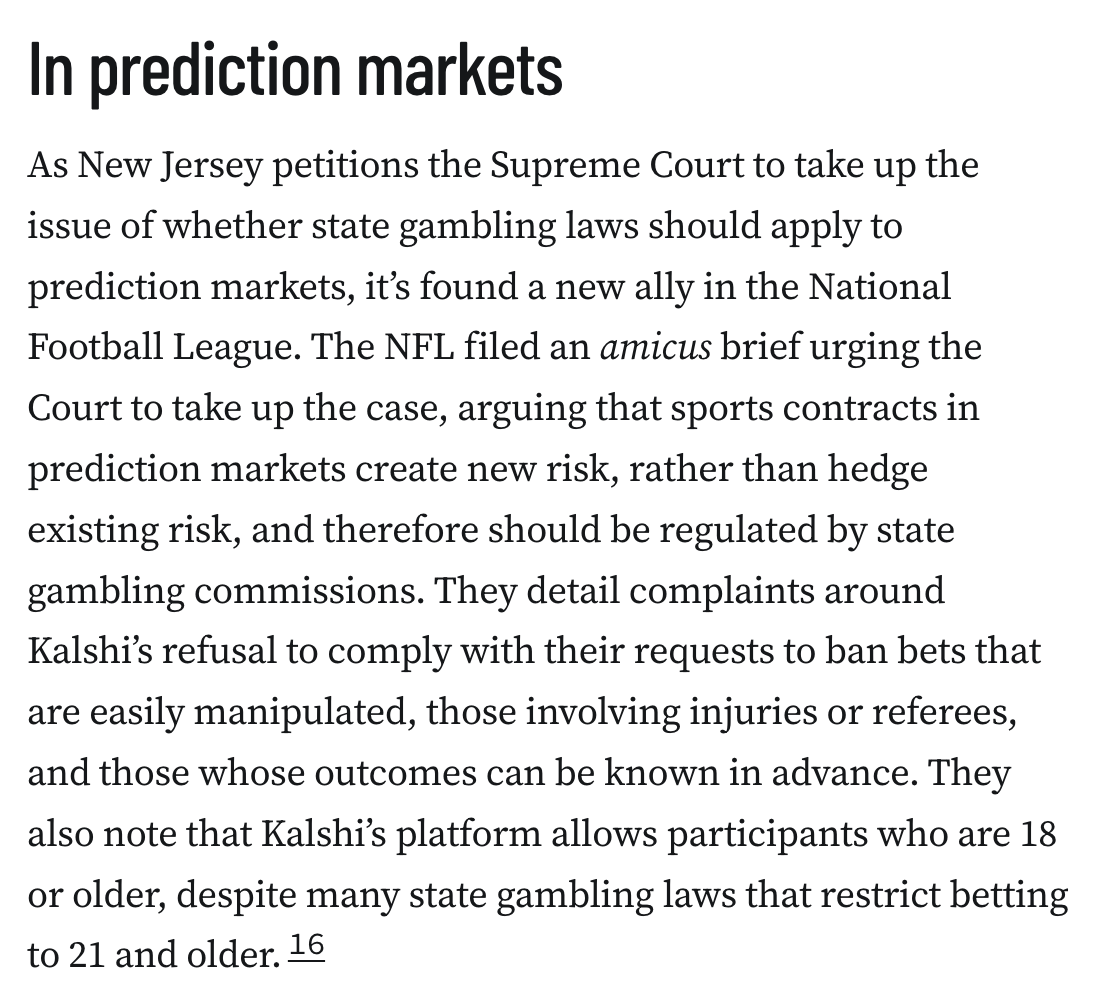
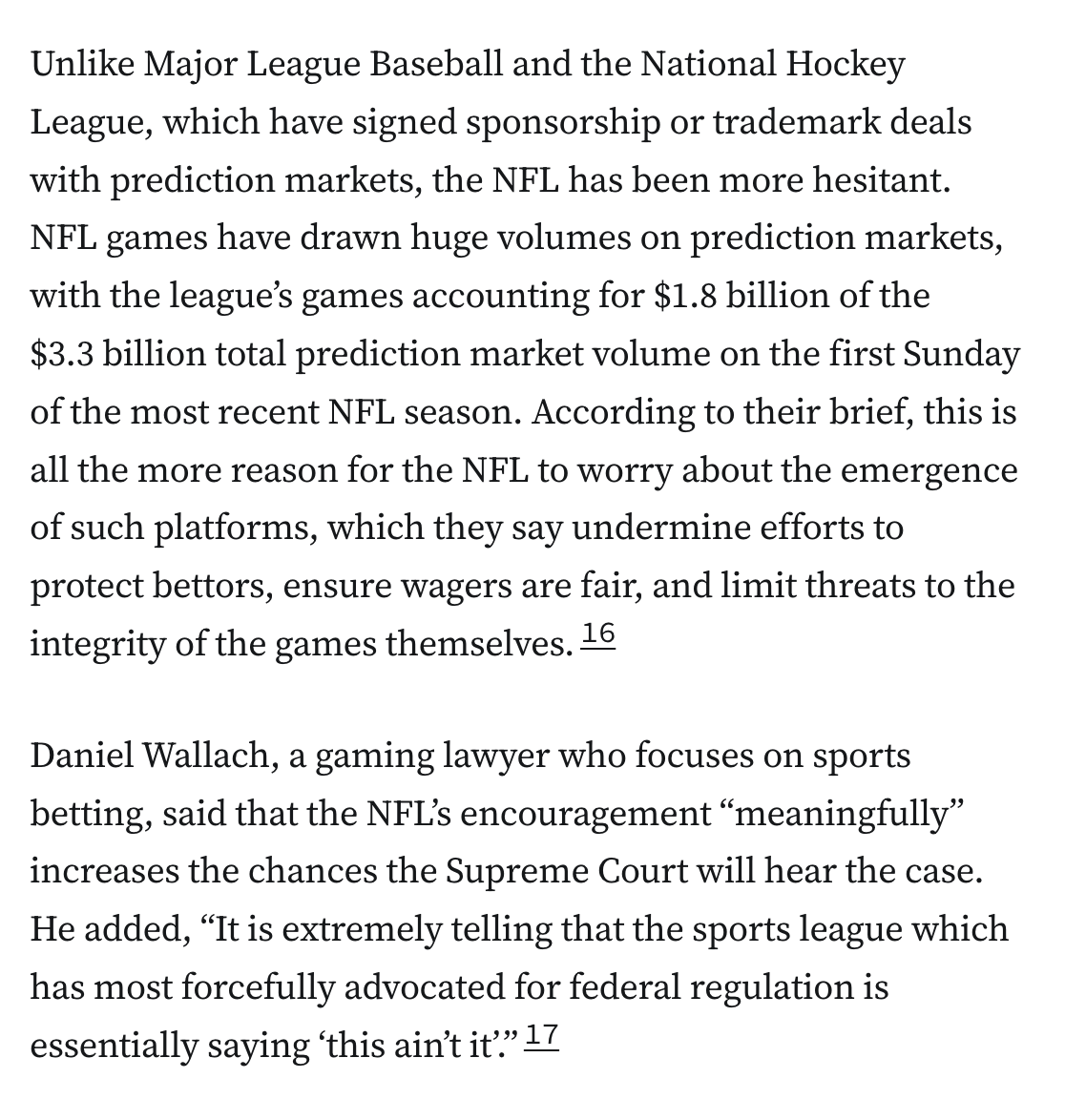
As New Jersey petitions the Supreme Court to take up the issue of whether state gambling laws should apply to prediction markets, it’s found a new ally in the National Football League. The NFL filed an amicus brief urging the Court to take up the case, arguing that sports contracts in prediction markets create new risk, rather than hedge existing risk, and therefore should be regulated by state gambling commissions. They detail complaints around Kalshi’s refusal to comply with their requests to ban bets that are easily manipulated, those involving injuries or referees, and those whose outcomes can be known in advance. They also note that Kalshi’s platform allows participants who are 18 or older, despite many state gambling laws that restrict betting to 21 and older.16 Unlike Major League Baseball and the National Hockey League, which have signed sponsorship or trademark deals with prediction markets, the NFL has been more hesitant. NFL games have drawn huge volumes on prediction markets, with the league’s games accounting for $1.8 billion of the $3.3 billion total prediction market volume on the first Sunday of the most recent NFL season. According to their brief, this is all the more reason for the NFL to worry about the emergence of such platforms, which they say undermine efforts to protect bettors, ensure wagers are fair, and limit threats to the integrity of the games themselves.16

Daniel Wallach, a gaming lawyer who focuses on sports betting, said that the NFL’s encouragement “meaningfully” increases the chances the Supreme Court will hear the case. He added, “It is extremely telling that the sports league which has most forcefully advocated for federal regulation is essentially saying ‘this ain’t it’.”17
0

Read the full issue (or listen to the audio version) at https://www.citationneeded.news/issue-111/.

Citation Needed is entirely reader-funded. If you find my work valuable, consider a pay-what-you-want subscription: https://www.citationneeded.news/signup/

0

@molly0xfff@hachyderm.io what is the crime of robbing a bank, compared to the crime of owning one?

0

@molly0xfff@hachyderm.io ah yes, those notorious Democratic shills, Coinbase and a16z

0

@molly0xfff@hachyderm.io shout out from OR-5! is the tracker showing basically 100% of attributable PAC spending in the race? If so, I’m quite surprised that a ~third of outside spending is coming from crypto for Bynum, that’s so so high

0

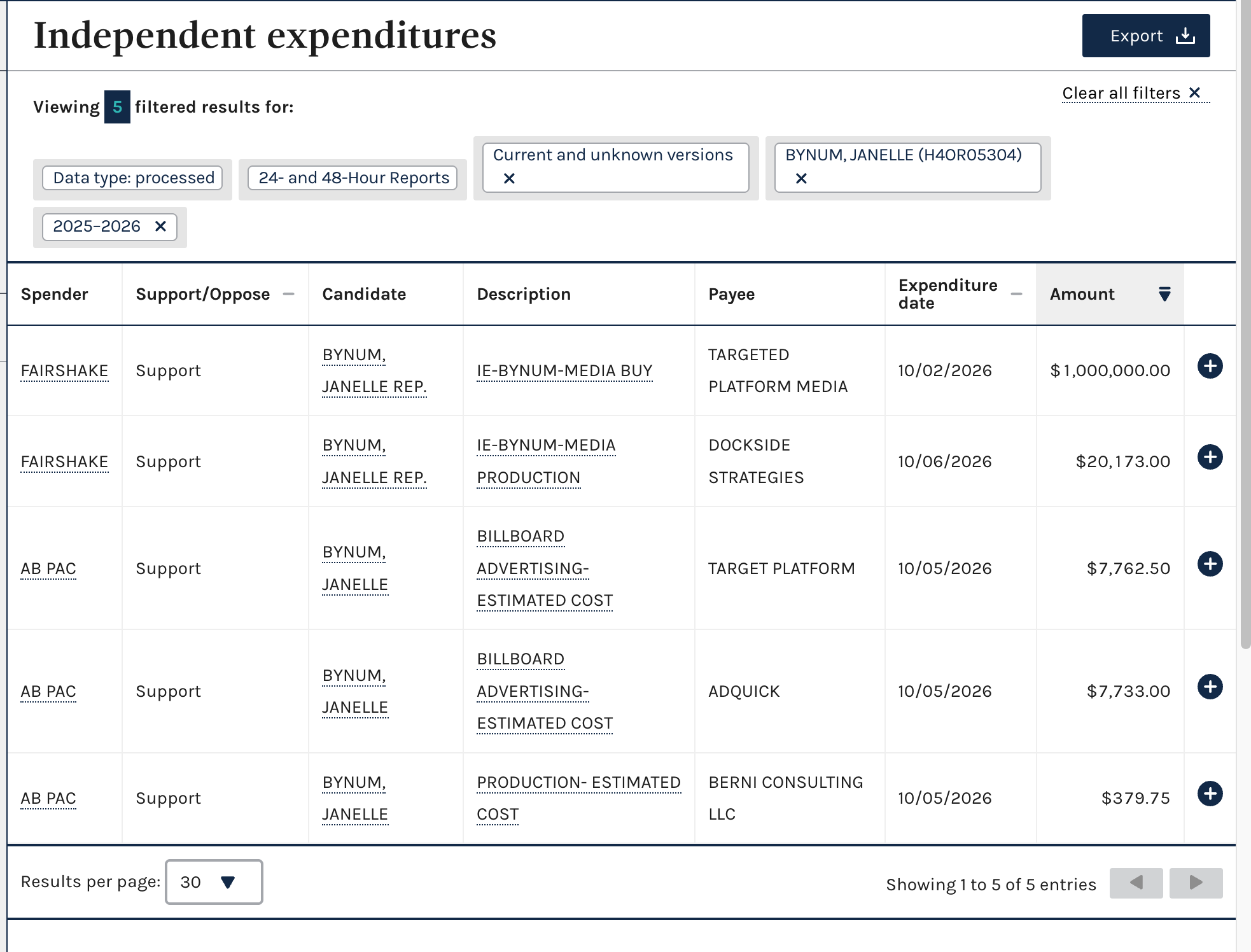
@cbowns@xoxo.zone Yep. She’s also received a bit under $16k in support from AB PAC, which is that tiny sliver if you really squint at the far end of the bar. It’s considered a safe race, so most PACs that are concerned with winning competitve races (vs. just rewarding allies) are focusing their spending elsewhere. The crypto spending is actually 98% of independent expenditures to support Bynum; the grey bar is Bynum’s own fundraising.

https://www.fec.gov/data/independent-expenditures/?data_type=processed&most_recent=true&cycle=2026&is_notice=true&candidate_id=H4OR05304

FEC Independent expenditures report:
Viewing 5 filtered results for:
Data type: processed24- and 48-Hour ReportsCurrent and unknown versions BYNUM, JANELLE (H4OR05304) 2025–2026 
Spender
Support/Oppose
Candidate
Description
Payee
Expenditure date
Amount
FAIRSHAKE	Support	BYNUM, JANELLE REP.	IE-BYNUM-MEDIA BUY	TARGETED PLATFORM MEDIA	10/02/2026	$1,000,000.00	
FAIRSHAKE	Support	BYNUM, JANELLE REP.	IE-BYNUM-MEDIA PRODUCTION	DOCKSIDE STRATEGIES	10/06/2026	$20,173.00	
AB PAC	Support	BYNUM, JANELLE	BILLBOARD ADVERTISING- ESTIMATED COST	TARGET PLATFORM	10/05/2026	$7,762.50	
AB PAC	Support	BYNUM, JANELLE	BILLBOARD ADVERTISING- ESTIMATED COST	ADQUICK	10/05/2026	$7,733.00	
AB PAC	Support	BYNUM, JANELLE	PRODUCTION- ESTIMATED COST	BERNI CONSULTING LLC	10/05/2026	$379.75 Zoomed in view of the spending bar from Tech Influence Watch for Janelle Bynum, showing a small amount (<$16k) of non-crypto super PAC spending to support Bynum compared to $1M+ of crypto support
0