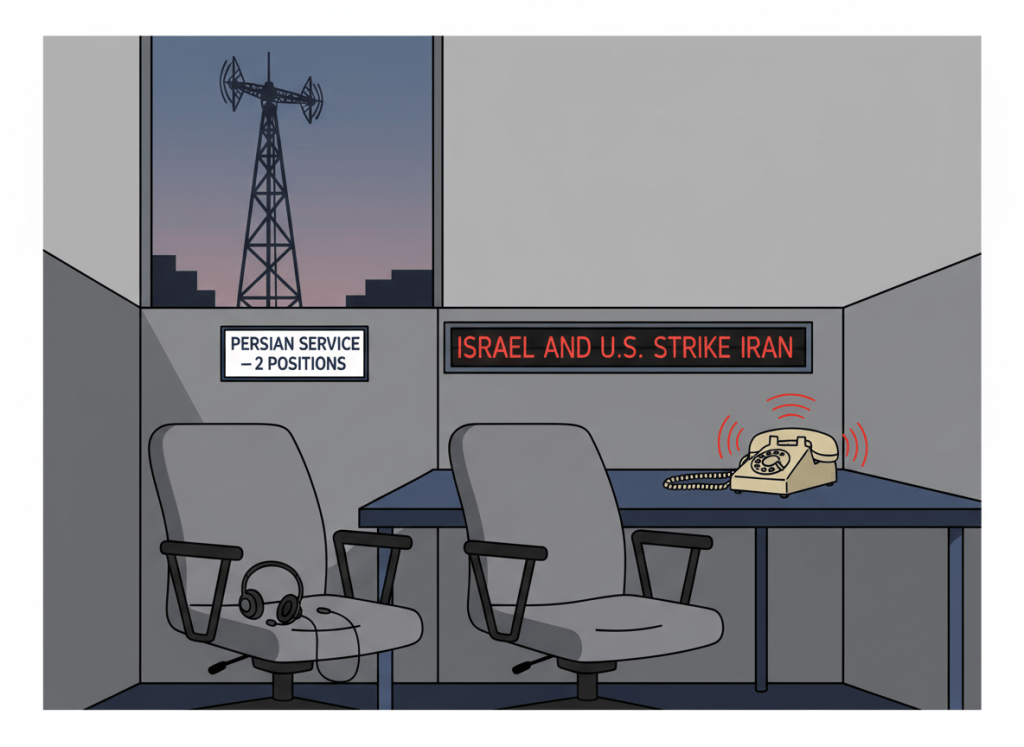
The Agency Kept Two Persian Speakers Until a War Started
Two Seats at the TableWhen the U.S. Agency for Global Media worked out how little of itself the law required, Iran came out at two people. The statuto
Altro...
Two Seats at the TableWhen the U.S. Agency for Global Media worked out how little of itself the law required, Iran came out at two people. The statuto
Altro...Two Seats at the TableWhen the U.S. Agency for Global Media worked out how little of itself the law required, Iran came out at two people. The statutory minimum memo, reprinted in Appendix C of a September 2026 State Department inspector general evaluation, lists “Farsi Language” at two positions, the same allotment as China and Afghanistan. The legal citation printed beneath that line appears to repeat the annual report clause used for another entry, rather than any provision about Persian. The agency’s report to the Office of Management and Budget promised that VOA would keep broadcasting to China, Afghanistan and Iran with a two-person staff on each service.
The inspector general’s staff then asked what actually happened. A USAGM official said that VOA was required to stop producing new content in all 49 of its languages, including the ones sent to China, Afghanistan and Iran. The Persian service went dark on March 15, 2025, when every employee in it was placed on administrative leave. The plan told Washington that Iran was protected, and the operation told the transmitters otherwise.
The law the agency was supposedly minimizing toward has a view on this. Section 6202 of Title 22 says U.S. international broadcasting shall include the capability to provide a surge capacity for crises abroad. A newsroom of two is not a surge capacity. It is a rounding error with a badge.
The War Arrives on ScheduleThe test came on June 13, 2025, when Israeli and American military action began in Iran. USAGM recalled its Persian-language employees from leave, and the service resumed. One week later, according to agency officials cited by the inspector general, USAGM conducted a reduction in force that left just two employees working for the Persian service, one of whom had no language proficiency.
The report adds that when Persian broadcasting restarted, one of the two assigned staff had no relevant proficiency and was unable to broadcast. In a separate example, a producer for the Kurdish service was replaced by an employee who could not understand the language. These are not the errors of an agency that had planned a minimum. They are the errors of an agency that had planned a headcount.
The audience that had been left with a two-person service was not small. In that same report, 86 percent of VOA’s weekly audience described its information as very or somewhat trustworthy (page 48), a credibility built over decades and set aside in a day. USAGM’s February 2025 performance report, reprinted in Appendix E, ranks Iran fifth among the agency’s ten largest measured audiences, with 12.2 million adults reached weekly. The inspector general found that USAGM did not use its audience data to decide which language services to keep, and relied instead on its reading of what the statute required.
A Newsroom That FluctuatesThe staffing numbers for the Persian service since then read like a heart monitor. The statutory memo allowed two positions. The June 2025 reduction left two people. By August 13, 2025, USAGM told House appropriators the Persian News Network had six employees plus 21 in its central news and production unit, or 27. As of July 6, 2026, the inspector general reports the service had 66 employees. Persian is also one of only seven languages, out of the 49 VOA once broadcast, that the agency was still producing in July 2026 (page 14).
The agency was candid about the method. Asked by Senate appropriators what the plan was for the Persian service after the surge in demand, USAGM said in August 2025 that staff and content “will continue to fluctuate as urgency of global events dictate”. That is a description of a service run by the news cycle, though it is not what the statute calls a capability.
None of this is new to Congress. In 2009, lawmakers authorized $15 million specifically to expand Farsi language programming, in Section 1262 of Public Law 111-84, which is now codified as a note to 22 U.S.C. 6205. The reasoning then was that Iranians needed independent information. It would be an odd conclusion that the need went away in 2025, and the agency’s July 2026 notice to Congress suggests it now agrees, since it plans to increase Persian programming (page 9).
Research Capacity, CancelledThe agency also cancelled its ability to know whether any of this worked. According to the inspector general, contracts for audience surveys were cancelled and the Office of Policy and Research was placed on leave, so USAGM could not pursue broadcasting “based on reliable information about its potential audience” (pages 8 and 9), which is language from the same statute. In July 2026, officials said the agency is trying to restart some of those contracts but cannot recover the data that was lost.
The statute is not vague about this. Among its broadcasting principles it lists a reliable research capacity. Among its standards it lists reliable information about the audience. In an August 2025 answer to Senate appropriators, reproduced in Appendix D, the agency conceded that its most recent annual report was from 2022 and that polling and hard metrics are unavailable in many closed media environments. It also said it had long leaned on social media metrics wherever content travels online, and that a more in-depth view would come later. A service meant to reach people inside a closed society cannot be run well without measuring whether it reaches them. It might have added that, for at least one closed society, it had a measured weekly audience of 12.2 million before it cancelled the contracts that produce such numbers.
USAGM’s chief executive nominee has since acknowledged the need to rebuild research capacity. One hopes the new capacity will include someone who can tell a Persian broadcast from a Kurdish one. The inspector general concluded that fewer broadcasting languages may lessen USAGM’s impact on advancing national interests and countering disinformation in closed societies (page 22). A war was the one thing the Persian service existed to cover, and the agency had prepared for it with two chairs.