Vai al contenuto principale

#activitypub

Linux Magazine talked to us about how and why we build Bonfire.

What we want next is "not a bigger Bonfire, but a network of cooperatives covering th

More...

Linux Magazine talked to us about how and why we build Bonfire.

What we want next is "not a bigger Bonfire, but a network of cooperatives covering the whole supply chain of a community's digital space", who "do it together" rather than leave you to "do it yourself".

Because "federation, we don't see it as just a technical thing. We see it as a social, economic, and political tool as well."

Link: Supporting the Social Web: How the Fediverse Found Parts for Its Platforms

Also happy to spread the love for @coopcloud@social.coop, @coquest@social.coop, @SocialCoop@social.coop and more, check out the links at the end of the article! Thanks to @horncologne@fosstodon.org for a lovely conversation, and @linuxmagazine@fosstodon.org for publishing it, in a piece that also features the great @cwebber@social.coop and @tsyesika@mastodon.nu from @spritely@social.coop.

#activitypub #fediverse #opensource #freesoftware #opensciencenetwork #opencooperativeecosystem

0

Loading...

0
1

Loading...

@laurenshof@indieweb.social is opening the "decentralized technologies" track at @oscl@mastodon.opencloud.lu

Big thanks to @_elena@mastodon.social a

More...

@laurenshof@indieweb.social is opening the "decentralized technologies" track at @oscl@mastodon.opencloud.lu

Big thanks to @_elena@mastodon.social and @Gina@fosstodon.org for hosting our track as well AS to @paolo@mastodon.opencloud.lu and the whole team for organising

Laurens is giving His Talk at oscl26  - a camera ist filming him

#activitypub #fediverse #opensource #oscl26 #solidarity #opensocialweb #socialnetworks #opencommunications #decentralized #digitalcommons

8

Loading...

2
10

Loading...

Activity Relay 3.1.0 and Activity Relay Directory 1.3.0 are released!

Activity Relay 3.1.0 and Activity Relay Directory 1.3.0 are released. This synchronized release brings together some notable improvements in the heart

More...

Activity Relay 3.1.0 and Activity Relay Directory 1.3.0 are released. This synchronized release brings together some notable improvements in the heartbeat protocol. These enhancements allow a Relay operator to push stats and information to Directory servers automatically, keeping information up to date.

Live installations of the Relay and Directory may be found at:

https://directory.argentwolf.org

https://relay.argentwolf.org

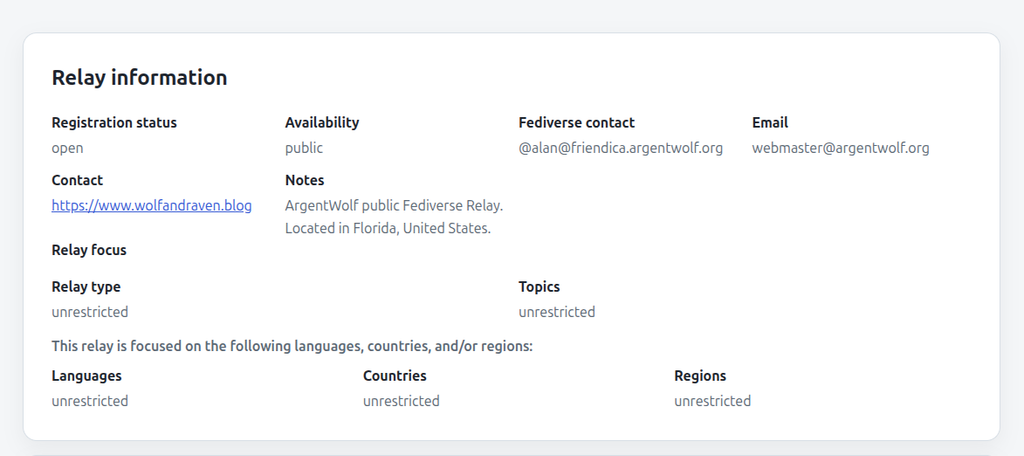
On the Relay itself, the policy information will be presented on the default home page:

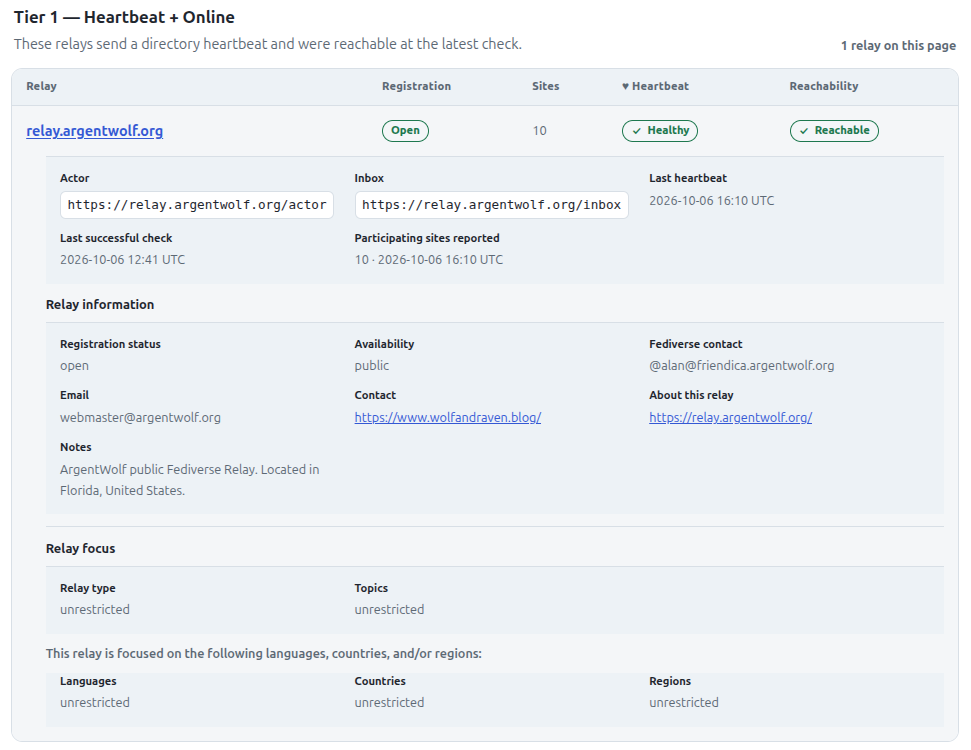
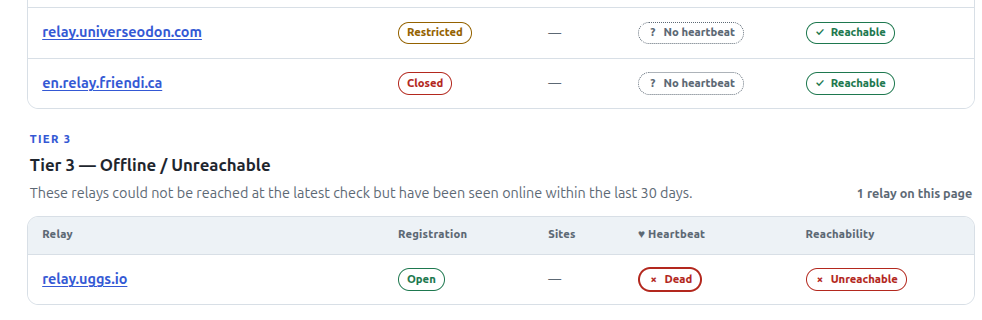
On the Directory, this information will be reflected as well with time stamps on when it was received and last checked for health by the Directory:

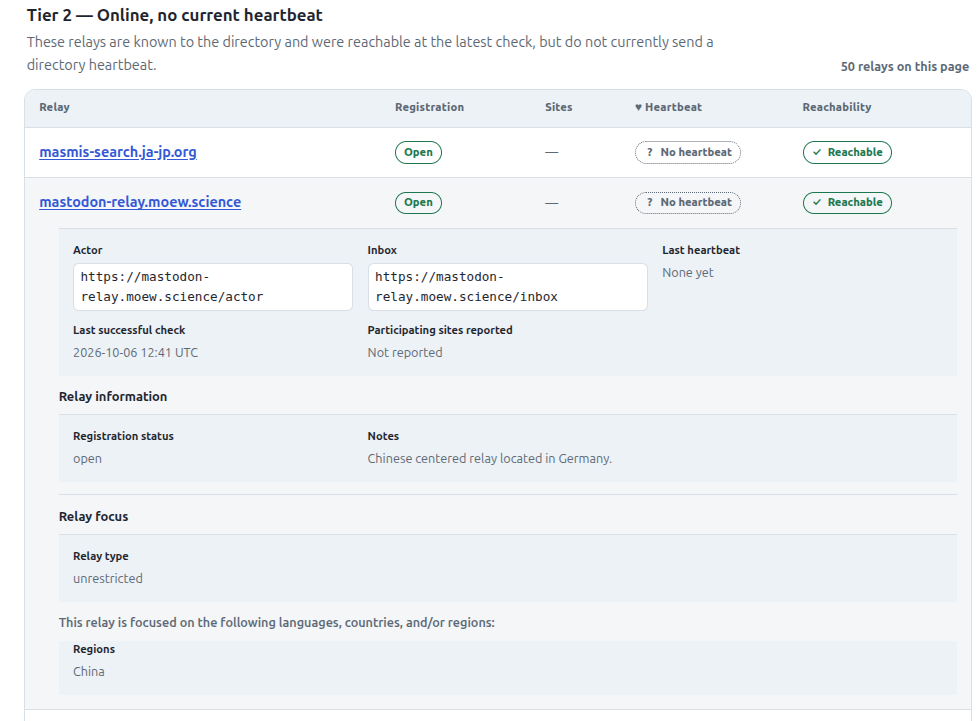
Other relays may be manually added to the Directory by the Directory operator/Admin. I have manually collected a list of Fediverse relays and populated my Directory installation with information about them. These sites are not automatically updated with regard to policy, but are verified as reachable by the Directory server.

Relays that are restricted (Approval Required) or closed to sign ups will appear as such on the Directory. Relays that go offline or are otherwise unreachable will appear in the offline list, eventually moving to the Graveyard after 30 days of offline time. Offline relays can be added the the Directory, but they will not become visible on the index until they pass an online check.

As always, if you want to make your own front facing website, you can disable the built in pages and use your own endpoints!

Comments, feedback, and bug reports are all welcome! Repo links below, available in both .deb and docker images. If you found these useful, please consider a tip to my Ko-fi to support further development! Thank you!

https://github.com/thystra/Activity-Relay

Activity-Relay 3.1.0Added Activity-Relay Directory Protocol v2 profile synchronization and Protocol v3 participating-site telemetry.

Added automatic Directory reconciliation on relay startup, including an immediate heartbeat for already-registered relays.

Improved manual Directory register, heartbeat, and sync commands so they coordinate cleanly with the background scheduler.

Added richer relay profile metadata for registration status, topics, languages, regions, contact details, and related information.

Added --test-config validation with safer handling of optional profile errors.

Added optional SUPPORT information to the generated relay website, including links and plain-text values such as cryptocurrency addresses.

Hardened the outbound Directory client against malformed responses, unsafe redirects, oversized responses, and other hostile input.

Improved static-site tooling, operator documentation, and deterministic release packaging.

Preserves existing relay identity, Redis state, subscriptions, delivery behavior, and queue compatibility.

Published for linux/amd64 and linux/arm64 at ghcr.io/thystra/activity-relay:3.1.0.

https://github.com/thystra/activity-relay-directory

Activity-Relay Directory 1.3.0Added source-aware relay profiles with per-field precedence: override > relay > csv.

Added bounded CSV import/export for relay metadata, including profile-change previews before applying updates.

Added support for updating metadata on already-known relays even when they are currently unreachable.

Added Activity-Relay lifecycle Protocol v2 profile synchronization and Protocol v3 participating-site telemetry while retaining Protocol v1 compatibility.

Treats successful authenticated registration as current relay-liveness evidence, improving restart and recovery behavior.

Expanded /v2/relays and the public Directory with profile information, site counts, and Open/Restricted/Closed registration status.

Preserves the existing four operational tiers: Heartbeat + Online, Online, Offline/Unreachable, and Graveyard.

Added configurable Directory title, banner, support information, and improved operator-facing presentation.

Keeps descriptive metadata separate from reachability, heartbeat health, moderation, pruning, and tier placement.

Upgrades existing databases in place to schema 12 while preserving the frozen /v1/relays compatibility API.

Published for linux/amd64 at ghcr.io/thystra/activity-relay-directory:1.3.0.

#activitypub #fediverse #relay #relays #relayserver

1

Loading...

0
4

Loading...

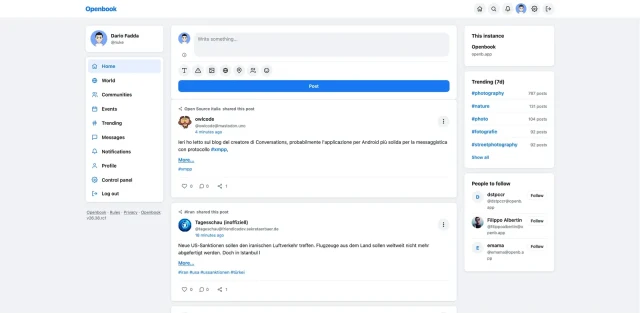
Il progetto è ora presente anche nel repository ufficiale di Italia Opensource, un bel traguardo per il giovane progetto.
Un server

More...

Il progetto è ora presente anche nel repository ufficiale di Italia Opensource, un bel traguardo per il giovane progetto.
Un server leggero e adatto a semplici shared-hosting

➡️ https://italiaopensource.com/opensource/openbook/
➡️ https://about.openb.app

#activitypub #openbook

6

Loading...

1
12

Loading...

Federated Blogging with WriteFreely

Matt Baer presents WriteFreely, an open-source federated blogging platform designed to bring long-form writing to the Social Web.

The talk explains

More...

Matt Baer presents WriteFreely, an open-source federated blogging platform designed to bring long-form writing to the Social Web.

The talk explains how ActivityPub was integrated into an existing Go application, shares lessons from that work, and considers how long-form Article content can interoperate across the wider Fediverse.

Matt Baer — FOSDEM 2025, Social Web Devroom

Original recording courtesy of FOSDEM.
Licensed CC BY 2.0 Belgium.
Source: FOSDEM event page

Federated Blogging with WriteFreely

#activitypub #blogging #writefreely #publishing

0

Loading...

0
2

Loading...

Fedify: Building ActivityPub servers without the pain

Implementing ActivityPub involves much more than exchanging JSON over HTTP: developers must contend with JSON-LD, HTTP signatures, multiple specificat

More...

Implementing ActivityPub involves much more than exchanging JSON over HTTP: developers must contend with JSON-LD, HTTP signatures, multiple specifications, FEPs, and differences among existing implementations.

Hong Minhee presents Fedify and explains how it aims to reduce that complexity and make building interoperable ActivityPub servers easier.

Hong Minhee — FOSDEM 2026, Social Web Devroom

Original recording courtesy of FOSDEM.
Licensed CC BY 4.0.
Source: FOSDEM event page

Fedify: Building ActivityPub servers without the pain

#activitypub #development #fedify #interoperability

0

Loading...

0
1

Loading...

@cypherhippie@chaos.social at @republica@berlin.social in giving a talk about "Leaving Planet X - Howto Dis-Enshittify Public Online Spaces Fa

More...

@cypherhippie@chaos.social at @republica@berlin.social in giving a talk about "Leaving Planet X - Howto Dis-Enshittify Public Online Spaces Fast"

Open protocols based networks like and make that possible.

Paul speaking in the Stage in front of a Screen. People watching and listening in rows

#activitypub #vienna #atproto #rp26 #rpvienna

13

Loading...

0
11

Loading...

There's a new very lightweight Fediverse platform that's just been released called littleFedi. You can follow its new official account at:

🌱 @littlef

More...

There's a new very lightweight Fediverse platform that's just been released called littleFedi. You can follow its new official account at:

🌱 @littlefedi_official@littleone.littlefedi.social

Its official website including download and source code is at:

🌱 https://littlefedi.org

LittleFedi is for techy people who want to create their own Fediverse server using as few resources as possible.

It's written by a group called "Little Computer People", its maintainer is @stefano@mastodon.bsd.cafe

#activitypub #fediverse #selfhosting #foss

190

Loading...

8
220

Loading...

LittleFedi is an excellent light weight but fully featured Fediverse platform (ActivityPub). I've been kicking tires and pr

More...

LittleFedi is an excellent light weight but fully featured Fediverse platform (ActivityPub). I've been kicking tires and providing feedback on the test instance and excited for the first release to give it a go self-hosted.

@stefano@mastodon.bsd.cafe has been leading a master class in community and developer relations. He has been stewarding the team and user community with enthusiasm and transparency. Congratulations to Stefano and the team.

Here's a great story of the project's genesis and journey. https://littleone.littlefedi.social/@littlefedi_official/01a0f644-8ed6-7a7d-ade6-46f4c0a74f41

#activitypub #fediverse #selfhosting #foss #littlefedi

0

Loading...

0
1

Loading...

In today’s session of :

This is a project that has taken me quite some work in the past months and it’s finally ready to be ann

More...

In today’s session of :

This is a project that has taken me quite some work in the past months and it’s finally ready to be announced.

Imagine a fully federated (compatible with and ) social network built on top of your music collection.

Not something like , which only allows individual tracks, albums or playlists to be federated, but a real social network where you have a real profile that can comment, like, boost and quote tracks and anything and follow anyone on any server.

Besides that:

🔴 Custom user-managed audio streams on top of it, with support also for and , so you can play your radio with your favourite songs in loop and share an .mp3 link with your friends.

🗃️ Flexible storage, so you can hook an S3 bucket, a Google Drive, a Dropbox account, a Nextcloud folder, and your music from that storage will be immediately available to be streamed and shared through your server.

☁️ External music services, so you can hook your Jellyfin server or TIDAL account and get your collection all in one place.

🎙️ Add support for podcasts synchronized over gPodder because why not.

၊၊||၊ Add support for the API so you can stream your music from your server from Substreamer or any compatible Android/iOS app, and a extension to allow you to plug Songhive into your existing music server.

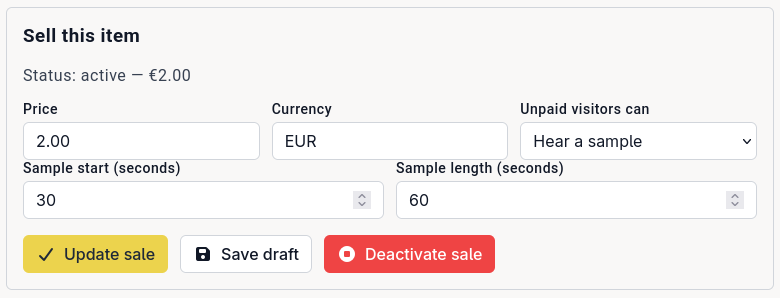
💶 And, most importantly, add support for payments. On two sides:For sysadmins: hosting a media server isn’t free, and often it’s not even cheap. Many open-source solutions lack integration with Stripe or crypto and handling of subscriptions. This doesn’t give many incentives to someone to run a small media server for their friends or their band. Songhive provides a paid mode for registration_mode. Admin can set how much they want to charge their users to upload content on their server and how often (weekly, monthly, yearly…)

For musicians: Songhive supports Stripe Connect integration with the ability to wire any number of payout accounts to the main account on the server. It means that musicians can connect their Stripe account, and set any songs or albums they want for sale for any price they want. Call it the federated killer if you wish

Links:

My personal instance: https://manganiello.music

My federated Songhive profile: @fabio@manganiello.music

Source code: https://git.fabiomanganiello.com/songhive

RE: https://blog.fabiomanganiello.com/article/Songhive

#activitypub #bandcamp #funkwhale #imadeathing #icecast #snapcast #songhive #subsonic #webmentions #mopidy

Songhive — A fully self-hosted and federated music platform

Songhive — A fully self-hosted and federated music platform

What if your music server had a soc

More...

Songhive — A fully self-hosted and federated music platform

What if your music server had a social network attached, and your social network could play music?

The problem
If you've ever tried to self-host your music, you've probably noticed that every tool solves exactly one half of the problem.

Media servers (Jellyfin, Navidrome, plain Subsonic) are great at the library half: point them at your FLAC collection, get streaming, transcoding, mobile apps. But they're single-player islands. Nobody else can discover your music, there's no social layer, and sharing a track means copy-pasting a file or a link that probably doesn't resolve outside your LAN, or creating accounts on your server for every person you want to share content with.

Social music platforms (Funkwhale being the closest thing) add the federation half, but the social experience is mostly library-oriented: you follow someone's library and sync their files. It's a distribution network, not a place where people talk about music. Moreover, most of those open platforms were never thought with revenue models in mind. Payments were never integrated. They're mostly places for artists to freely share their creations, not for them to monetize them.

Streaming services (Spotify, Apple Music, TIDAL) are widespread, but they usually don't come with true built-in social features besides following someone else's playlists, or the "Share to Facebook/Instagram/TikTok" button. And consumers don't own anything: the catalog can shrink overnight, and shared URLs can often be viewed only by people who already have an account on the platform. Music creators don't have much of a say either. They get fractions of a cent, they don't fully control distribution (and often they need an intermediary just to distribute their music, which takes a share of the revenue too), and they often have to release to multiple music platforms just because those platforms don't talk with one another. Most importantly, your listening history is the product.

Bandcamp tries to fix some of the issues, namely by putting content creators at the center and letting them own their own sales and monetization process (including sales of things like vinyls, CDs and merchandise). But it's still a centralized service whose ownership changed hands several times. Users and artists are just one round of layoffs away from seeing the platform they invested in rot and/or enshittify, with no direct compatible alternatives. The social media aspect is also not something Bandcamp particularly invested in as well. The focus has increasingly shifted to sales, social interactions are basically limited to a "community" tab on artist pages, where artists can post updates and people can reply to. Any social interactions stay strictly confined to a tab on a centralized platform.

Perhaps the old incarnation of Google Music helped filled an important gap on user-generated content (it allowed users to upload up to 50,000 tracks to the cloud for free, making music collection sitting on old hard drives available on-the-go), but it didn't last long, and it didn't cover any social media and sharing needs.

And MySpace — the thing everyone actually remembers fondly — was never really any of these. It was a place where a band had a page, you could play their song right there, leave a comment, and add them as a friend. Nobody has successfully rebuilt that.

Songhive is an attempt to meet all these needs in one package: a self-hosted music streaming server where tracks, albums, playlists and posts are first-class ActivityPub objects. Think Funkwhale meets Mastodon — your music library lives on your hardware, or in any cloud storage you want to plug to it, but your music (and your posts about music) can travel across the fediverse, be followed from Mastodon, replied to, boosted, and quoted.

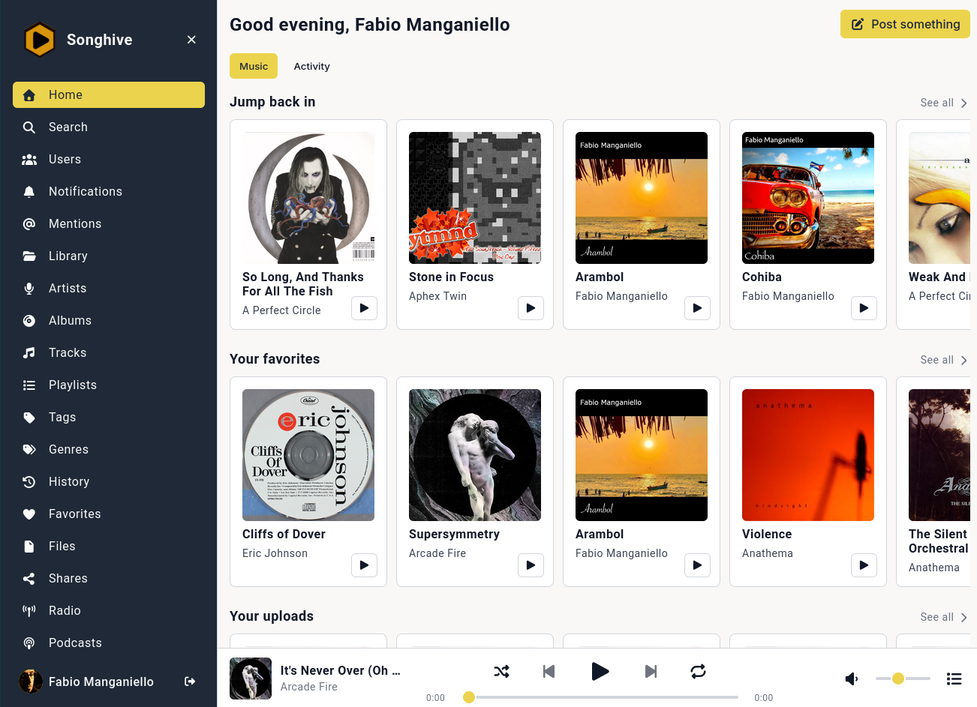
[Screenshot of an instance's home page on desktop]

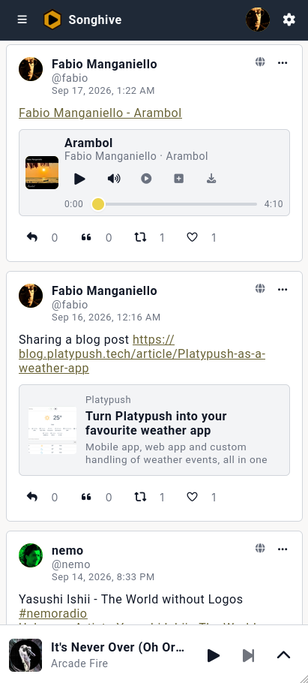
[Screenshot of an instance's home page on mobile]

Who is this for

Artists: publish tracks with a "Publish on the Fediverse" checkbox and they appear as playable Audio objects in Mastodon timelines. People can reply, boost and quote them from their existing fediverse account — no new signup required on your side. Your artist page, releases and playlists all expose RSS/Atom feeds, and blogs that support Webmentions will send you a notification when they link to your song. Native integration with Stripe also makes it easier for you to connect a payout account and put some of your tracks or albums for sale. You can choose how much of a paid song you want to share for streaming (only a sample, the full song or nothing), and how much users should pay for it. No shares of your revenue are taken besides the share taken by Stripe to process the transaction.

Bands who need an easy and flexible way to share their recordings, rehearsals, playlists of covers etc. Those who have played in a band know this issue quite well. Spotify playlists for covers to play are only good as long as everyone in the band has a premium Spotify account. YouTube playlists often result in precious rehearsal time wasted waiting for ads to end. Not to mention those rehearsal.mp3 files shared between WhatsApp chats, emails and Dropbox or Google Drive folders, with no easy way of bringing them all together under the same roof - especially when you're looking for those recordings during a rehearsal. Songhive makes it easier to share whole tracks, albums or playlists with full control over the level of visibility. It makes it easier to integrate 3rd-party music streaming services so you can sync your playlist of covers and easily share it from a proxy platform without everyone having to have a Spotify or TIDAL premium account. It makes it easy to just plug that Google Drive folder where you carelessly dropped all the recordings of your band's rehearsal and sort them, tag them and share them as consistent collections with a single URL.

Self-hosters / library curators: point Songhive at your local folders, an S3 bucket, a WebDAV/SFTP share, Dropbox, Google Drive — or even import your collections from Jellyfin or TIDAL — and get a full streaming stack with transcoding, Subsonic mobile apps, Last.fm scrobbling, listening stats and automatic MusicBrainz/cover-art enrichment. Fine-grained visibility (private / local / public) means your 4,000-track hoard stays private while the three songs you actually wrote are public. Not only, but Songhive also taps into an issue that open projects like these often fail to address: how to provide incentives to sysadmins and self-hosters to run their servers. Especially when it comes to things like a music streaming server which, in terms of CPU, storage and bandwidth usage, is not free - and often not even cheap. Songhive provides the option for sysadmins to have a Paid registration mode. The admin can decide how much they want to charge users to use their instance and upload music to it, and how often they want to charge them. Subscriptions are handled transparently by Stripe and can be cancelled at any time. And admins can also set user quotas to keep things sane and prevent abuse.

People who want a MySpace-style music social network: run an instance for your scene, your label, your collective. Users get profiles, statuses with mentions and hashtags, threaded replies, quotes, notifications, and moderation tools (mute/block, reports, instance-level defederation). Your instance federates with Mastodon, so it's not a walled garden unless you want it to be.

Musicians with a multi-room house or a community radio streak: server-side outputs let playback keep running on the server after you close the tab — cast to Snapcast multi-room speakers, relay to an Icecast station, or host your own HTTP radio mountpoint with fan-out to unlimited listeners.

What you get
The streaming stack
The core is a serious music library and streaming server:

Library management with artists, albums, tracks, playlists and dynamic radio stations. Uploads get automatic tag extraction, duplicate detection, and metadata enrichment from MusicBrainz and the Cover Art Archive — including cover art and artist images fetched for you.

Streaming with on-the-fly transcoding (MP3, OGG, FLAC, AAC, Opus), HTTP range requests, and a transcode cache, with per-user/per-role bitrate caps (handy if your uplink or mobile data is precious).

Subsonic API compatibility, enabled by default. This is the sleeper feature: every Subsonic-compatible mobile/desktop client — Substreamer, Symfonium, Ultrasonic, Supersonic, Tempus and friends — works against your instance out of the box. You get a decade's worth of mature third-party players for free, and API tokens keep your real password out of them.

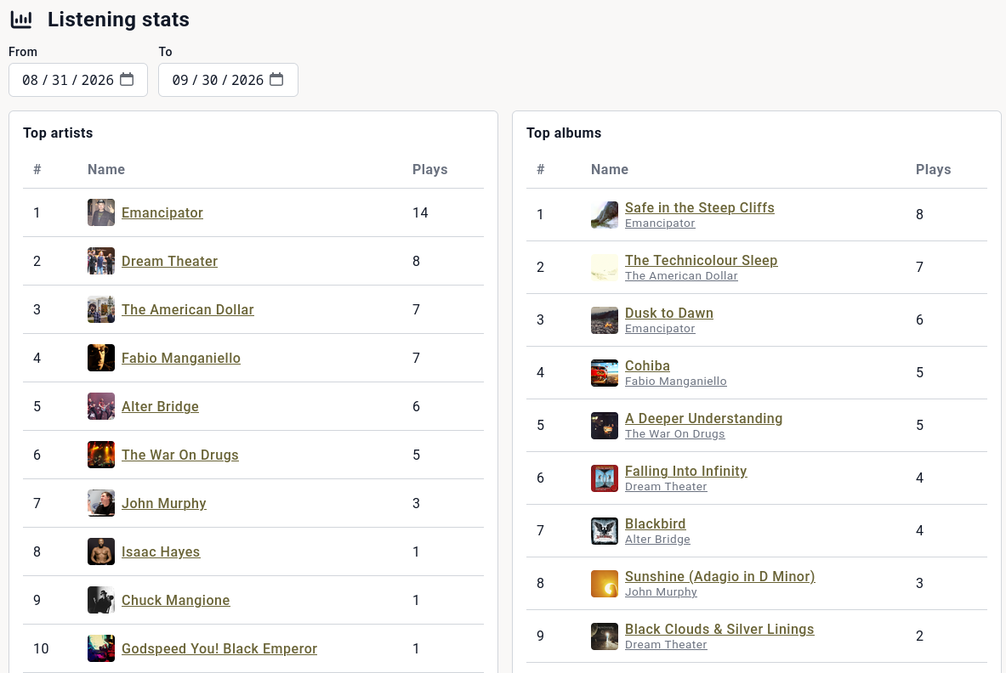
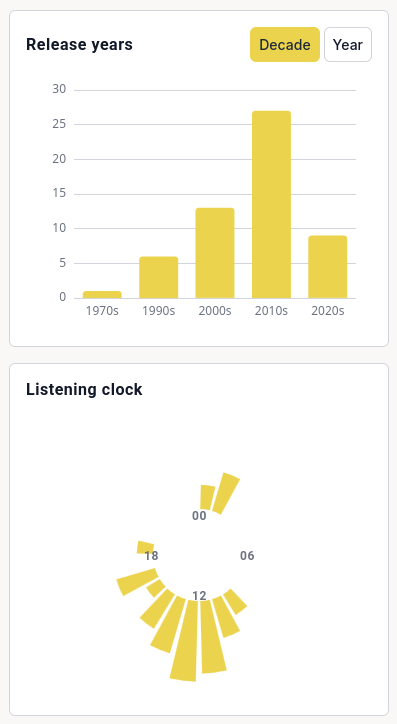
Mopidy integration via the mopidy-songhive extension if that's your jam. - Listening history, favorites and scrobbling to Last.fm and Libre.fm out of the box, plus a personal listening-stats dashboard (top artists, calendar and hour-of-day heatmaps, release-year breakdowns) rendered with ECharts.

[A screenshot of the listening stats page, showing top listened artists and albums over a given time period]

[A screenshot of the listening stats page, showing listened tracks grouped by release years and listening hours]

Bulk downloads: select tracks/collections and get an async-built ZIP archive.

Server-side outputs — Spotify-Connect-style. The browser is just a remote control; audio is rendered by the server via a dedicated stream worker. Three providers: an Icecast relay (with live ICY metadata updates), a Snapcast provider for whole-home audio, and native HTTP mountpoints (/streams/) served directly by Songhive with per-listener cursors over Redis Streams — no external radio server required. Playback keeps playing after you close the tab, and multiple tabs/devices stay in sync.

Payments support out of the box — set up a Stripe account and connect it to the instance, and configure it as a marketplace account if you also want to allow musicians to wire their payout accounts and sell music through your platform.

[A screenshot of a track uploaded by a musician, showing the options to set up payments for it]

[A screenshot of the membership page on an instance with paid subscriptions]

The social layer
This is where Songhive diverges from every other self-hosted media server. Federation is full ActivityPub (via the pubby library), and music entities are social objects:

Every user is an ActivityPub actor, reachable at @user@instance via WebFinger, with Mastodon-style alias URLs. Mastodon users can follow, mention and interact with you from their own client.

Tracks are Audio objects. Publishing is explicit and opt-in per upload — your private library never leaks to the Fediverse by accident. Published tracks render as playable audio in Mastodon and Akkoma timelines, with descriptions, hashtags and link-backs to the track page.

Mastodon-style statuses with Markdown, mentions, hashtags, threaded replies, quotes and link preview cards. Reply to a track, boost an album drop, quote-post a playlist, or simply post some words to Mastodon and use it like a normal Mastodon account.

Funkwhale-compatible music federation: full bidirectional music federation with Funkwhale and other Songhive instances — remote libraries, albums, artists and tracks resolve as browsable resources you can follow and add to your collection.

Remote discovery: paste a Fediverse handle or URL into the search box and it's dereferenced, cached and browsable — SSRF-guarded and domain-moderated.

Real notifications over WebSocket (in-app, real-time), with per-type email and daily-digest preferences, plus optional OS-native push via VAPID WebPush.

Mastodon-grade moderation: users mute/block local and remote actors; admins limit/suspend actors, defederate or restrict instances, and review reports — optionally forwarding them to the reported actor's home instance via ActivityPub Flag.

RSS/Atom everywhere: every profile, artist, playlist, library, tag and genre has RSS 2.0 and Atom feeds with discovery, so even non-fediverse readers can subscribe.

[A Songhive post with a published song viewed from Mastodon]

Sharing and privacy

Three-level visibility on tracks, albums, playlists and libraries: private, local (instance-only), or public.

Share grants (give a specific user access) and revocable share links — a short URL that renders a preview page with an audio player for anyone, content-negotiated so API clients get JSON and crawlers get OpenGraph metadata.

Embeddables: public tracks and collections embed on any web page via tags, Markdown links, a widget or a no-JS iframe. Media endpoints send Access-Control-Allow-Origin, so fediverse clients can embed your audio too.

Webmentions: bidirectional link-backs for public content. A blog that links to your song sends you a notification; content you share or comment on sends a Webmention back to the source. All outbound/inbound fetches on this path are SSRF-guarded.

[Screenshot of the "Share Track" modal]

The platform bits

Multi-user with open, invite-only, approval-required or closed registration; per-user profile visibility.

OAuth2 provider for third-party apps, plus API tokens for scripts and Subsonic clients.

Flexible storage: local filesystem, S3-compatible object storage.

External libraries — the feature that sells it to people with existing collections. Attach external music storage to a Songhive library: local folders (with a filesystem watchdog that picks up changes automatically), S3, SFTP, WebDAV, Dropbox, Google Drive, or plain HTTP. Entity-backed providers go further: Jellyfin and TIDAL import tracks, albums, artists and playlists as first-class library entries with lazily-fetched contents — audio bytes stay remote and are proxied at play time, so provider credentials never reach the client. Metadata can be written back to the provider, and Dropbox/TIDAL connect via OAuth straight from the settings form.

Metadata write-back: enriched tags are written into the audio files themselves, using audio-only content hashing — so re-tagging or swapping cover art never changes the stored path or invalidates the content hash. Since it support metadata write-back to the original file, you can also wire your existing music library on an old hard drive and use Songhive to fix broken audio metadata tags.

How it compares

Songhive
Funkwhale
Jellyfin/Navidrome
Mastodon
Spotify
Bandcamp

Self-hosted
✅
✅
✅
✅
❌
❌

Streaming + transcoding
✅
✅
✅
❌
✅
✅

Subsonic API (mobile apps)
✅
✅
✅
❌
❌
❌

Scrobbling + listening stats
✅
partial
partial
❌
✅
❌

ActivityPub social (posts, replies, boosts)
✅
❌
❌
✅
❌
❌

Federated music objects playable in Mastodon
✅
partial (library-oriented)
❌
❌
❌
❌

Fine-grained sharing (grants, links, embeds)
✅
partial
❌
❌
❌
partial

Server-side outputs (Icecast/Snapcast)
✅
❌
❌
❌
(Spotify Connect, proprietary)
❌

External library import (S3, WebDAV, Jellyfin, TIDAL…)
✅
partial
❌
❌
❌
❌

Support for payments to artists
✅
❌
❌
❌
✅
✅

Support for subscriptions to fund platform maintainers
✅
❌
❌
❌
✅
✅

You own the catalog
✅
✅
✅
✅
❌
you can download the content you pay for

Quickstart
The fastest path is the Docker bootstrap script, which drops a docker-compose.yml, an nginx config, and starter config.toml/.env files into the current directory:

curl -fsSL https://git.fabiomanganiello.com/songhive/raw/branch/main/docker/bootstrap.sh | sh

Set your user's UID/GID in .env (so the bind-mounted volumes stay yours), fill in the few required values in config.toml:

[auth]
secret_key = "..." # python -c "import secrets; print(secrets.token_urlsafe(64))"

[storage]
local_path = "./data/media"

[federation]
enabled = false

instance_domain = "music.example.com" # uncomment to join the fediverse

then:

docker compose up

Or, if you want to enable local HTTP stream mount points too

docker compose up --profile streams

Create the admin user:

docker compose exec songhive songhive admin create-user
--username admin --email admin@example.com --password secret --admin

Open http://localhost:8000/ and start uploading. The web UI, Swagger UI (/swagger-ui/) and OpenAPI spec (/openapi.json) are all served by the same process. There's also a pip install songhive path (the PyPI package ships the built web UI), systemd units under config/systemd/, and an install.sh that wires the whole thing up — see the README for those.

Everything else — federation, Webmentions, RSS feeds, scrobbling keys, registration mode, bitrate caps — is a config knob, and most of it is enabled by default. All config.toml entries can also be overridden with SONGHIVE_* environment variables.

Under the hood

Backend: FastAPI (REST) mounted inside Tornado via a2wsgi — Tornado natively handles WebSockets, audio streaming with range requests, and HTTP stream mountpoints, while FastAPI handles everything else. (There's a non-obvious reason for the explicit thread pool in the WSGI bridge: without it, a federated fetch that resolves back to your own instance deadlocks the event loop. The architecture doc tells the whole war story.)

Data: PostgreSQL (SQLite works for small setups) + SQLAlchemy 2 async, Pydantic v2 everywhere, Alembic migrations.

Async work: Celery + Redis with three queues — celery for interactive work, scrobbles for latency-sensitive submissions, and bulk for the per-item fan-out jobs (a fresh external library sync can enqueue tens of thousands of enrichment tasks; without the split they'd starve scrobbles and federation delivery for hours).

Storage: content-addressable files (SHA-256) with audio-only hashing, so tag/cover-art rewrites don't move files or invalidate hashes.

Frontend: Vue 3 + TypeScript + Pinia, fully i18n'd with RTL support.

Security posture: JWT + opaque rotating refresh tokens, double-submit CSRF, Redis sliding-window rate limiting, SSRF-guarded federation and Webmention fetches with redirect revalidation, Fernet-encrypted provider secrets, RFC 7807 error handling.

License: AGPL-3.0.

Caveats, honestly

It's a real stack: Postgres, Redis, a Celery worker, ffmpeg. The Docker compose file makes this a non-issue, but it's not a single static binary. It can run on a RaspberryPi 4 or 5 with decent storage if you want to run it for yourself and your family, but if you want to have more tracks and more users you may need a beefier machine.

Federation with the big platforms is only as good as ActivityPub support for audio — Mastodon renders playable audio attachments, but it treats Audio as a converted type, so Songhive also emits Note variants when you share a track as a post. The interop details with Akkoma, Funkwhale and friends are handled, but the fediverse music landscape is still young.

TIDAL imports federate metadata-only (a browse link, not hosted audio) — for obvious reasons the audio bytes stay with the provider.

Links

🏠 My personal instance: manganiello.music

👤 My Fediverse handle: @fabio@manganiello.music

</> Code: github.com/blacklight/songhive
(canonical forge: git.fabiomanganiello.com/songhive)

🏗️ Architecture deep-dive:
docs/ARCHITECTURE.md

🧩 Mopidy extension: mopidy-songhive

Screenshot of an instance's home page on desktop Screenshot of an instance's home page on mobile A screenshot of the listening stats page, showing top listened artists and albums over a given time period A screenshot of the listening stats page, showing listened tracks grouped by release years and listening hours A screenshot of a track uploaded by a musician, showing the options to set up payments for it
0

Loading...

0
2

Loading...

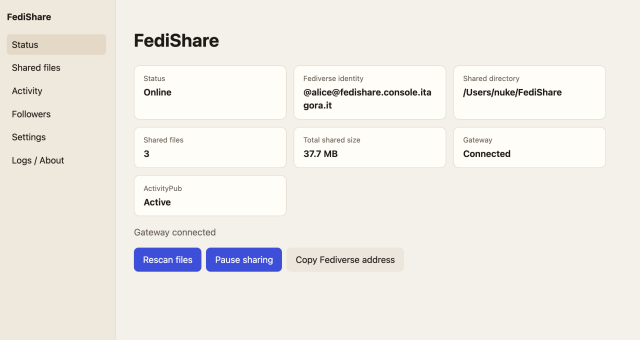
hi fedi-friends, I’m developing FediShare.
it’s a -style server based on .
you install the desktop client;
you choose a folder to s

More...

hi fedi-friends, I’m developing FediShare.
it’s a -style server based on .
you install the desktop client;
you choose a folder to share;
it federates all the content;
and every file becomes a downloadable link across the .
https://github.com/insicd/fedishare

to see it in action, once you have installed the desktop client, you can choose a username, and FediShare creates an actor available on the Fediverse.
an example is currently online: search for "@alice@fedishare.console.itagora.it" on Mastodon or anywhere else.

#activitypub #fediverse #p2p

11

Loading...

3
19

Loading...

Ciao, sono uno dei due amministratori di Fedisky, l'unico nodo Bluesky italiano

Fedisky è sia un server Fediverso basato su

More...

Ciao, sono uno dei due amministratori di Fedisky, l'unico nodo Bluesky italiano

Fedisky è sia un server Fediverso basato su , sia un nodo PDS basato su

Le iscrizioni sono ancora su invito, ma se sei interessato contattami!

https://fedisky.it/

#activitypub #fediverso #mastodon #bluesky #wafrn #atproto

0

Loading...

0
1

Loading...

写真の居場所はどこにあるのか

写真は、本当にひとつの場所だけに属するものなのだろうか。 この記事は、そんな疑問から始まる。 Can photographs really belong to just one place? That's the question behind this articl

More...

写真の居場所はどこにあるのか

写真は、本当にひとつの場所だけに属するものなのだろうか。 この記事は、そんな疑問から始まる。 Can photographs really belong to just one place? That's the question behind this article. →

https://dystronix.com/where-do-photographs-belong-2/

写真の居場所はどこにあるのか

#activitypub #fediverse #photography

0

Loading...

0
0

Loading...

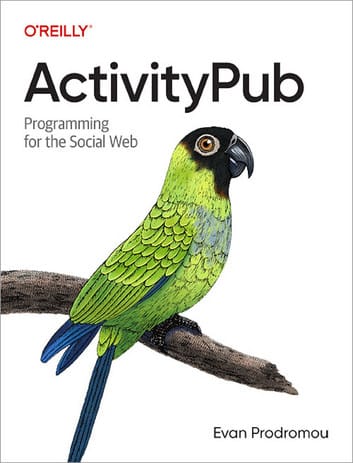
Book Review: ActivityPub by Evan Prodromou
https://shkspr.mobi/blog/2026/09/book-review-activitypub-by-evan-prodromou/

As part of [my grant from N

More...

Book Review: ActivityPub by Evan Prodromou
https://shkspr.mobi/blog/2026/09/book-review-activitypub-by-evan-prodromou/

As part of my grant from NLnet to improve my Fediverse bot project, I'm spending time making sure I understand all the fundamentals of ActivityPub. The problem with Internet standards is they're scattered all over the place. Abandoned forums, half-maintained wikis, mailing lists with obscure rules, and monolithic blocks of text.

Sometimes you just want one book which collates all the info and presents it in a consistent format. This is nearly that book.

Evan Prodromou has the unenviable task of making the whole ecosystem easy to understand. Thankfully he does that well. Things are logically laid out, there are comprehensive descriptions of even the most obscure parts of the spec, and it builds up nicely from the fundamentals. Oh, it's also surprisingly light-hearted.

This principle is so important and long-winded that web architects have given it an acronym, HATEOAS. (We often pronounce it “HATE-ee-OH-us,” which sounds like a breakfast cereal nobody wants to eat. This is one reason web architects aren’t allowed to name breakfast cereals.)

There's an excellent checklist for all the steps needed when building a minimal ActivityPub server.

As with all O'Reilly books, it is a beautifully typeset ePub. Even better, it was supplied DRM-free through Kobo.

About the only significant thing missing is details of how to verify RFC 9421 HTTP Signatures. That's understandable as they're pretty new, but a bit annoying as that's what a lot of servers are sending now. Similarly, there's a good write up of how to publish a poll, but not much about voting or publishing the results.

The "Far Horizons" chapter is particularly exciting - giving a speculative overview of what AP could be used for. I, for one, am particularly looking forward to putting my Internet Connected Fridge on social media 😆

Ultimately ActivityPub is a living and evolving set of standards. No book can possibly keep up with all the changes happening to it - but Evan does a brilliant job of bringing together all the moving parts and creating a coherent picture of the standard.

Highly recommended if you're interested in understanding the fundamentals of the Fediverse!

Book cover with a parrot on it.

#activitypub #bookreview

0

Loading...

0
1

Loading...

ActivityBot is the recipient of an NLnet grant!
https://shkspr.mobi/blog/2026/08/activitybot-is-the-recipient-of-an-nlnet-grant/

Back in February,

More...

ActivityBot is the recipient of an NLnet grant!
https://shkspr.mobi/blog/2026/08/activitybot-is-the-recipient-of-an-nlnet-grant/

Back in February, I applied for NLnet's Next Generation Zero grant. They were looking for Fediverse projects to help rewild the social media landscape. Or, as they describe it:

Reclaim the public nature of the internet

Small and medium-sized R&D grants between 5.000 and 50.000 euro, with the possibility to scale up.

I run ActivityBot - it is a single-file ActivityPub server suitable for launching automated accounts and designed as a learning tool for those who want to understand how the protocol works. Several people have told me how useful it is, but I haven't had the time to make it better. So I decided to stick in a last-minute application to the fund.

I really didn't know how much to apply for - or even if my project would be suitable for funding - so I cheekily asked for €10,000. After a few months of back-and-forth, I'm delighted to announce that I was successful!

In the spirit of openness, this blog post details how the NLnet grant process worked for me and what I'll be using the money for.

The ProcessThe application was delightfully simple. Here's what it asked for, along with my answers. If you apply, please don't copy these verbatim; use your own words.

Abstract : A single file server for ActivityPub. Designed for write-only bots. Allows any project to quickly and easily start publishing automated content to the Fediverse. Uses PHP, no other dependencies.

Experience : I am the sole developer of Single File ActivityPub - https://gitlab.com/edent/activitypub-single-php-file
I was formerly the UK Government's representative to the W3C and have contributed to various ActivityPub projects and specifications.

Amount : € 10000

Use : The fund will be used for development, testing, promotional activity (including conference travel).
I anticipate this will fund 6 months of development. I have funded all previous development.

Comparison : Most ActivityPub services are complex. They implement a full specification and are designed for multi-user environments. Other projects allow reading and writing. ActivityBot is deliberately designed to be as simple as possible. A single file to upload, one user, publish only.
This will enable more projects to be able to instantly start publishing with low development cost and close to zero hosting cost.

Challenges : Formal spec verification and a security audit will be the main technical challenges. The ActivityBot software has been running well for over a year. The funding will allow for better compatibility and security.

Ecosystem : The project has mostly targeted individuals who want to run small bots. After further development, the project will engage with IoT providers, smaller publishers, open source projects who wish to publish updates, and other relevant parties.

I was told there was intense competition. After a couple of months, I received word that I'd made it to the 2nd round.

What then followed was a very polite interrogation about my ideas, how I would develop the project, what I would use the money for, and what my AI usage policy was. They also wanted a breakdown of the main tasks - with the understanding that this would be a provisional document subject to change.

I was on a train through Europe when I wrote this. I don't claim it to be a brilliant document - but it got the job done!

  1. User Research

Recruit 2 - 5 potential users. Offer an incentive (approx £20ea) to participate in a user research session. Study design will take 1 - 2 days. Each interview and write up to take 1 day. Consolidation and report 2 days.

Total effort 3 - 4 weeks.

  1. Standards Research

Participate in ActivityPub user communities and standardisation groups. Attend virtual conferences (or any local to the UK). Approx 1 day per week for 6 months.

  1. Test Driven Development

Create modern test harness, write test suite, iterate design based on tests. Anticipated effort 2 days per week for approx 3 months.

  1. Security Testing

Work with the community and security professionals to test the resultant code. This will use human testers and normal fuzzers - this will not use AI tools. Anticipated effort 2 days per week for approx 2 months.

  1. User Acceptance Testing

Recruit 2 - 5 potential users (ideally different to the research participants). Offer an incentive (approx £20ea) to participate in a user acceptance session. Study design will take 1 - 2 days. Each interview and write up to take 1 day. Consolidation and report 2 days.

Total effort 3 - 4 weeks.

  1. Updates Based on Research, Testing, and Security

While it would be lovely to anticipate getting everything right first time, the reality is that changes will need to be made based on the findings of the above. This will take up the remainder of the allocated time.

Again, there was a little more back and forth. But a few weeks later I was informed that I was at the final stage, pending review. And, a few weeks after that, I was told my project had been given the green light.

I was invited to a group call where the very friendly team discussed the practicalities of the grant, what it could and couldn't fund. I also met a bunch of other people who'd also won.

The final stage was writing a proper Memorandum of Understanding. With the help of one of the team (thanks Victoria!) I was able to turn my scrappy plan into something a bit more formal. The project tool NLnet uses made it easy to build up a plan and put € amounts by each task.

The idea is that I will invoice against the grant whenever I have completed a task or sub-task. Obviously I don't want to leave invoicing until the end of the project, but I also need to be mindful of the foreign exchange fees charged by my bank for receiving Euro payments.

Final Project PlanThis is the plan I submitted. It represents what I hope to accomplish and how I'll draw down on the grant. I suspect this will change as the months go on.

ActivityBot is an Open Source project which aims to develop, maintain, and improve a minimum viable ActivityPub server in a single PHP file.

The project is run by Terence Eden (trading as @edent); a developer residing in England.

This project is expected to run for approximately 6 months. All of the deliverables will be openly licenced using either an OSI approved software licence or a Creative Commons licence.

The high-level aims of the project are for ActivityBot to be:

A fully compliant ActivityPub server, running in a single PHP file.

A teaching tool to help developers understand the practical aspects of creating an ActivityPub server.

A practical method of publishing automated messages to the Fediverse.

A promotional tool to show how simple and easy ActivityPub development can be.

A secure and usable tool written in modern PHP.

Written by humans, with no AI/LLM generated code.

In light of NLnet's non-profit status, costs assume a discounted rate of €330 per day (£280). Incidentals such as hardware, software, travel, or sundries will be charged at cost with receipts provided.

Prepare for initial releaseEnsure that the project is in a suitable state for initial release and future development.

Deliverable: Updates published to GitLab.

€495 Prepare initial release. Clarify licencing, solicit community engagement, include example usage.

€495 Standards Research. Collation of standards websites. Ensure code comments refer to specific standards. Publish blog post(s) about findings for others to reference.

User ResearchRecruit up to 10 participants for a user-research study. Participants should represent the diversity of the Fediverse.

Investigate what participants want from a tool like ActivityPub. The project plan may be adapted following the results of this study.

Deliverable: Study plan and results will be published and given a Creative Commons licence. Changes based on the results will be pushed to GitLab.

€660 Study Design and recruitment of participants (blog post published as deliverable).

€990 Two days of user interviews, write up and publish results as blog post.

Test Driven DevelopmentCreate a modern test harness, write test suite, iterate design based on tests.

Deliverable: Tests published to GitLab. Blog posts published about the process and results.

€330 Set up test suite

€330 Write tests

€330 Fixes based on test results

Security TestingWorking with NLnet's security offering, ensure that the project meets modern security requirements.

€720 Work with security team to assess security risks and possible mitigations. Fixes based on security team feedback

Deliverable: Updates published to GitLab. Blogs published about the process and results.

User Acceptance TestingRecruit up to 10 participants for a user-acceptance study. Participants should represent the diversity of the Fediverse.

Investigate whether participants are able to use ActivityBot. See which aspects need improvement. The project plan may be adapted following the results of this study.

Deliverable: Study plan and results will be published and given a Creative Commons licence. Changes based on feedback will be published to GitLab.

€660 Study Design and recruitment of participants (blog post published as deliverable).

€990 Two days of user interviews, write up and publish results as blog post.

Conferences and Standards WorkOpen Source participation often depends on attending conferences, either in person or virtually. Getting involved in the standardisation process ensures that future versions of ActivityPub and associated standards will be suitable for the community.

Deliverables: Presentations material (slideware), speaking at conferences (may be published as video), conference outputs. Where possible, these will be available under a suitable Creative Commons licence.

€700 Travel and accommodation to one EU conference

€330 Publishing blog posts about ActivityPub standards work.

€330 Publishing blog posts about ActivityPub standards work.

Final releaseCreating a final release for this phase of the ActivityBot project. This will involve incorporating all feedback received so far, improving documentation, and publishing code.

Deliverable: Updates published to GitLab. Blog post written. Release announcements.

€330 Phase 1: Process and implement feedback from users

€330 Phase 2: Bug fixes

€330 Phase 3: Features

€330 Phase 4: Bug fixes

€330 Phase 5: Features

€330 Phase 6: Remedial work

€330 Process and implement feedback from accessibility scan

€330 Final release

Next StepsI've already begun work on updating the code. If you'd like to get involved, or have suggestions or bug reports - please take a look at ActivityBot on GitLab.

I'll be putting out a call for user-research participants once I've had a chance to catch my breath 😆

NLnet logo.

#activitypub #fediverse #activitybot #nlnet

0

Loading...

1
1

Loading...

Attenzione, nelle prossime ore si verificheranno disservizi sul server fedisky.it

fedisky.it è il primo "server Bluesky" italiano ed è connesso con i

More...

Attenzione, nelle prossime ore si verificheranno disservizi sul server fedisky.it

fedisky.it è il primo "server Bluesky" italiano ed è connesso con il Fediverso, anche se al momento l'iscrizione è consentita solo su invito

https://fedisky.it

@fediverso@feddit.it

#activitypub #wafrn #atproto

0

Loading...

2
4

Loading...

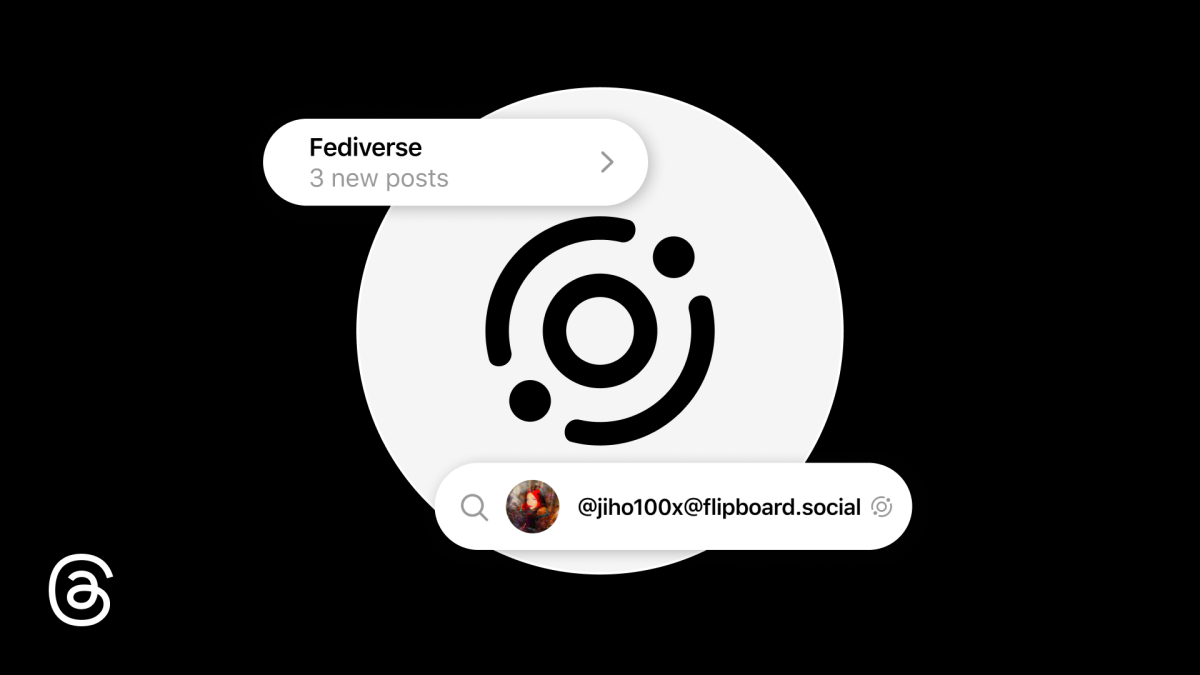
In short, Fediverse Report says that launching Threads as part of the Fediverse is basically dead in the water. They have decided not to pursue it in

More...

In short, Fediverse Report says that launching Threads as part of the Fediverse is basically dead in the water. They have decided not to pursue it in 2026, and nobody is actively developing it anymore.

Well, good riddance, I guess. It was fun before it even started. Many of us saw this coming. I would not be surprised if they phase it out completely over the next few years. The Fediverse was never a real priority for them, it was just marketing hype all along. Just like some open source LARPing from the Big Tech corporates.

Direct quote:

"Threads’ integration with the fediverse is on maintenance mode, says head of Threads Connor Hayes in an interview by Alex Heath. Hayes said about the fediverse: ““It’s something that we’re supporting, it’s something that we’re maintaining, but it’s not the thing that we’re talking about that’s gonna help the app break out”. In October 2023, Mark Zuckerberg gave an interview with Alex Heath, who asked him about decentralisation and open protocols, with Zuckerberg saying he “always believed in this stuff“. With the fediverse integration for Threads now in maintenance mode, this must surely be a big blow for Zuckerberg’s belief in decentralised social networking.

Threads’ integration with the fediverse was never popular, especially from the side of Threads. In January 2025 the mastodon.social knew about 25k Threads accounts which had turned on federation. But while that number is already low considering the total number of Threads users, the interest in actually following an account on Mastodon from Threads was even lower: in January 2025, only 800 Threads users followed at least one account on mastodon.social. Threads deliberately made it difficult to follow fediverse accounts, and later updates deprioritised the fediverse feed even more. Regardless, it is not particularly hard to understand why a platform that now boasts about having 400M monthly active users is not putting in much effort to maintain a complex system that only a few thousand people at best make use of."

https://connectedplaces.online/reports/fediverse-report-147/

Fediverse Threads marketing photo with post-like bubble shared to Fediverse

#activitypub #fediverse #meta #mastodon #socialmedia #threads #fediversethreads #protocols #platforms

21

Loading...

1
11

Loading...

Mutual Aid Request Roundup 13 Aug 2026

1,990 words

8–13 minutes

[No comments on Mutual Aid Request Roundup 13 Aug 2026](https://mutualaidspace.org/mutual-aid-request-roundup-13-aug-2026/#

More...

1,990 words

8–13 minutes

No comments on Mutual Aid Request Roundup 13 Aug 2026

They Called It a Parade Rehearsal: Indonesia’s Fences and Whose Security They ProtectSalaam from Jakarta.

Writing this may put me on their watch list because, oh no, I appear to use my critical thinking, possess empathy, and exercise my self-agency! The horror!

Anyway-

Remember the fencing and un-fencing of the malls I wrote about last week? This traces what came before those fences. Written from an actual repressive, authoritarian, post-colonial nation-state that hates human rights.

Early this month, footage of military tactical vehicles lined up near Monas started circulating, and for a few hours half the country wondered whether the state was quietly prepositioning for another crackdown. Police and the armed forces spent days walking it back: the vehicles were personnel transport trucks for the 81st Independence Day commemoration, the fencing going up around business districts and malls was store management being cautious, nothing to see, the Daily Operational Reporting System confirms national stability, please stop spreading hoaxes. Major General Muhammad Nas asked the public directly not to treat the rehearsal as provocation. But aren’t they threatening the public with the display of what would happen if anyone exercises any political agency by voicing out their concern and criticism? Who arrests anyone on the basis of an allegation with evidence that is still under investigation? What kind of justice is that? Do not bring up national security when the biggest threat to people’s freedom is their own government and its state apparatus. So whose security are you protecting with your justice system if you start arresting anyone exercising their rights to criticise the people whose salaries are paid by ordinary people’s taxes?

DM was charged under Article 48 paragraph (1) in conjunction with Article 32 paragraph (1), Article 51 paragraph (1) in conjunction with Article 35 of the ITE Law, and Article 264 of the new Criminal Code, over an alleged post about a protest call. The first two provisions exist to punish people who break into someone else’s electronic system and alter data that isn’t theirs, or forge a document to make it pass as authentic. Neither describes a social media post published under someone’s own name. Only Article 264 even applies to speech: broadcasting news that is uncertain, exaggerated, or incomplete, which the person knows or reasonably should know may cause unrest. It is close to the same provision Indonesia’s own Constitutional Court struck down in 2023 for being too vague to satisfy legal certainty, brought back almost word for word in the new Criminal Code regardless.

How would people know it’s fake news, rather than the state apparatus wanting to suppress dissent and dictate what counts as fact and what counts as fake? The law expects people to use their own critical thinking to avoid broadcasting or disseminating news that is uncertain, exaggerated, or incomplete, which the person knows or reasonably should know may cause unrest, while voicing any concern or criticism can be met with exactly this kind of response from the people whose salaries are paid by taxpayers.

Pretty rich, coming from a government whose president claimed Iran already has nuclear weapons with no source, met with a swift denial from Tehran, then let two people who commented on that same claim get arrested under the exact law built to punish an unverified claim. Parroting decades of Zionist lies costs him nothing; repeating it back costs everyone else their freedom.

I believe the fences went up for Independence Day. I do not believe the instinct behind them is about Independence Day at all. A state doesn’t reach for fencing around shopping centres and industrial zones because it feels secure. It reaches for that because it remembers this past June, barely two months ago, when a 32 percent fuel price hike landed on top of 268 trillion rupiah in spending riddled with corruption and the resurrection of dwifungsi ABRI, the military’s old claim to civilian institutions that Reformasi was supposed to have buried in 1998; students tore down barricades from Jakarta to Bandung to North and South Sumatra under a protest name precise enough to sting: “Heading to Bankrupt Indonesia.” The state remembers what it built its own crisis out of. So it fences the mall before it fences its own decisions.

Dwifungsi ABRI, the doctrine that gives Indonesia’s military a permanent civilian governing role, is Cold War containment architecture, built with direct US backing under Suharto to guarantee a compliant, anti-communist, capital-friendly Indonesia for decades after 1965’s mass killings cleared the ground for it; that whole charade did not spring from nowhere. The muscle memory currently fencing Jakarta’s malls in anticipation of protests that officials insist aren’t coming was assembled, in large part, by the same imperial logic that disciplines populations everywhere it operates. Different stage, same script: discipline the population before the population organises, and call the discipline a routine.

Is this nationalism? Is this for national security? Is this new, or has it been this way even after the fall of Suharto’s tyrannical government? The assassination of a prominent human rights lawyer and activist mid-flight in 2004 should give you the answer.

What I have an interest in is naming, precisely, what the fencing is for. Independence Day is the occasion, not the reason. The fencing is insurance, purchased in advance, against the possibility that ordinary Indonesians decide again that a government spending on lawmaker perks and military expansion while the rupiah sits near 18,000 to the dollar has forfeited its claim to their patience. Jakarta’s fences, Gaza’s Yellow Line, and Tehran’s file-sharing arrangement with Washington all run on the same premise: that people organising for survival are the emergency, and people extracting from them are the stability.

The people in this week’s roundup are absorbing extraction of their own, in rent, food, medicine, and the everyday cost of staying alive under systems built to make that expensive on purpose, wherever they are. Read through the requests, give what you can, and share what you can’t fund yourself. From each according to their capacity, to each according to their needs; that has never once needed a state’s permission.

✨Mutual Aid Roundup✨

@jack_mendo@neopaquita.es @broodcoffee@mastodon.social @AnthonyJK@mastodon.redgarterclub.com @squirrellilly@cathode.church @ellespeaks@mastodon.social @SabiLewSounds@mastodon.social @ash@toot.lgbt @nighttimeapparition@indiepocalypse.social @Kuniti_shino@pounced-on.me @tiredpinklover@cyberpunk.lol

✨Palestinian Campaign Spotlight✨

Help Save Mitqal’s Family

Mithqal is living through ongoing bombing and unreliable internet access in Gaza, and asks for support to cover food, water, and other basic survival needs.
(View original post)

@Mithqal@mas.to

REDISTRIBUTE

Donate and help Ala’a and her children

Alaa is a mother in North Gaza raising her children alone while her husband is imprisoned. Hunger is exhausting her children, her daughter is sick, and Alaa asks for support to help her family survive. (View original post)

@allaasamour90@mastodon.social

REDISTRIBUTE

Gaza Verified Archive

Verified Palestinian campaigns under $200

These are verified Palestinian accounts whose campaigns received less than $200 in the past 7 days.

  Nine of many. The archive holds the rest.

@anwar88@mastodon.social

@Salahaldinahmedhor@mastodon.social

@1bilalassad@mastodon.social

@mahmoudemawy@mastodon.social

@samarsh@mstdn.social

@ghadaelkha@mastodon.social

@hananmahmoudgaza@mastodon.social

@Aya172@mastodon.social

@nada@manganiello.eu

Open the archive, find the campaign link on each account, give directly where possible, and share the campaign links that need movement.


View underfunded campaign list

About Gaza Verified Campaigns

🗣️Support Corner🗣️

📱Share this article far and wide. Subscribe to get this update in your inbox!

This space is held together by adisabled Indonesian Muslim woman. Monthly support keeps me fed, medicated, and connected, and helps me keep resisting corporate funding and the humanitarian-industrial complex through my writing and mutual aid projects.

If you find this voluntary work worth supporting, please do so by pledging as little as $1 monthly via Liberapay or other tiers available across Liberapay, ko-fi, and Patreon. One-off support helps too. Any amount genuinely helps.

Paid Membership on Patreon

Ko-fi voluntary monthly support

Liberapay voluntary monthly support

Monthly Support Package

@mutualaid@ovo.st @mutualaid@fedigroups.social @disability@ovo.st @autistics@fedigroups.social @actuallyadhd@fedigroups.social @nillerus@kolektiva.social @khurry@mastodon.social @theleftistlawyer@mastodon.social @Kristenzeta@mastodon.social @frugalcoffee@kolektiva.social @wrzky@kolektiva.social @wrzky@wrzky.com @edendestroyer@social.chinwag.org @QasimRashid@mastodon.social @indonesia@fedigroups.social

Protesters holding signs at a pro-Palestine rally, with one sign reading “Not war, it’s colonialism. Not eviction, it’s ethnic cleansing. Not conflict, it’s occupation. Not complicated, it’s genocide.”

#activitypub #fediverse #iran #genocide #activism #anticapitalism #antiimperialism #bipocma #blackfedi #blackmutualaid #ceasefire #disability #disabilitycrowdfund #disabilitymutualaid #disabledwriters #emergencycrowdfund #ethniccleansing #fedihelp #gazamutualaid #gazaverified #healthcare #helpfolkslive2026 #indonesia #irgc #islam #jakarta #mentalhealth #mutualaid #mutualaidrequest #mutualaidspace #neurodivergence #ochaopt #palestine #poverty #queermutualaid #transmutualaid #writer #writersofmastodon #helpsky #mutualaidvoid

6

Loading...

0
21

Loading...

Five of Indonesia’s most powerful security officials declared the country secure while malls were fenced, unfenced, and a woman was arrested for a Fac

More...

Five of Indonesia’s most powerful security officials declared the country secure while malls were fenced, unfenced, and a woman was arrested for a Facebook post. Eleven days before Independence Day, the government is managing memory to protect extraction and punish warning. That same government moved fast enough to make a dictator a national hero within a year of taking office; it has never moved that fast for anyone’s survival, anywhere. Below is this week’s mutual aid roundup.Below are ten mutual aid requests, two Palestinian campaign spotlights, and verified campaigns needing direct support and sharing.

@mutualaidspace@mutualaidspace.org @mutualaid@ovo.st @mutualaid@fedigroups.social @indonesia@fedigroups.social @disability@ovo.st @wrzky@kolektiva.social @frugalcoffee@kolektiva.social @autistics@fedigroups.social @actuallyadhd@fedigroups.social

Mutual Aid Request Roundup 6 August 2026

Burgundy letter W logo inside a circular gold frame, wrzky brand icon

#activitypub #fediverse #iran #gaza #genocide #activism #anticapitalism #antiimperialism #bipocma #blackfedi #blackmutualaid #disability #disabilitycrowdfund #disabilitymutualaid #disabledwriters #emergencycrowdfund #fedihelp #gazamutualaid #gazaverified #healthcare #helpfolkslive2026 #indonesia #jakarta #mentalhealth #mutualaid #mutualaidrequest #mutualaidspace #neurodivergence #palestine #poverty #queermutualaid #transmutualaid #writer #writersofmastodon

6

Loading...

1
26

Loading...

Mutual Aid Request Roundup 6 August 2026

1,845 words

8–12 minutes

[1 comment on Mutual Aid Request Roundup 6 August 2026](https://mutualaidspace.org/mutual-aid-request-roundup-6-august-2026

More...

1,845 words

8–12 minutes

1 comment on Mutual Aid Request Roundup 6 August 2026

They Fenced the Malls, Then Un-Fenced Them: A State That Manages MemoryI’m writing this from Jakarta, eleven days before the 81st Independence Day, and this week the country’s entire security apparatus stood on one stage at once to tell the public that nothing is happening. Coordinating Minister for Politics and Security Djamari Chaniago, flanked by TNI commander General Agus Subiyanto, National Police Chief General Listyo Sigit Prabowo, intelligence chief Muhammad Herindra, and Attorney General Sanitiar Burhanuddin, held a joint press conference on Wednesday insisting the domestic situation “remains secure and fully under control” and urging the public not to be swayed by “disinformation” about unrest this August. Five of the most powerful men in the country do not typically assemble to deny that nothing is wrong.

What none of those five men explained is the week that led up to that podium. Photos and videos of newly built fences barricading Kota Kasablanka mall in South Jakarta and Pakuwon mall in Bekasi spread across social media, prompting speculation that businesses were quietly bracing for unrest. The fences went up. Then, over the weekend, without explanation, the fences came down. In the gap between those two facts, old footage from last August’s uprising resurfaced online, presented as though it were happening now, alongside claims that Indonesian mainstream media was deliberately burying new protests. The government’s response was not to explain the fences. It was to announce that the Attorney General’s Office and National Police would pursue criminal charges against accounts spreading “hoaxes” about riots, and within days, police in Ciamis Regency, West Java, arrested a forty-five-year-old woman for uploading posts about a planned demonstration. A private citizen went from social media post to police custody faster than a mall fence went up and came back down.

None of this is new, and none of it is incidental. It is almost exactly a year since police in this country ran over a rideshare driver named Affan Kurniawan with an armoured van and kept driving, the video that turned a protest over parliamentary housing perks into the largest uprising this country has seen in a generation: nearly fifty cities, ten dead, more than a thousand injured, over three thousand arrested. Eight of those activists are still facing six to twelve years in prison for the crime of posting on social media about where the protests were. A Human Rights Watch report published barely a week ago documented how the Prabowo government keeps expanding the military’s footprint into mining, palm oil, and so-called food and energy estates, prosecuting the environmental defenders and Indigenous leaders standing in its way. A state apparatus that fences a mall overnight and arrests a woman in Ciamis for a Facebook post, while insisting both are nothing to see, is managing memory rather than disinformation, and this government has practice at that: this is the same state that made a genocider and the most corrupt president in its history (Bevins, 2020) a national hero, within a year after the current president, who’s also a documented human rights abuser, took office. A government fluent enough in rewriting its own history to canonise Soeharto has had plenty of practice managing the story ahead of managing the problem underneath it, and fencing a mall without a word of explanation is just this week’s version of that same habit.

The same expansion into mining, palm oil, and food and energy estates that HRW documented this month is the same mechanism showing up everywhere, not something unique to Jakarta. An economy that depends on extraction, whether it’s Gaza’s aquifers, Hormuz’s shipping lanes, or Kalimantan’s nickel, will always find a reason to militarise its own protection and call the militarisation routine, and a state built around protecting that extraction will always move faster to manage the story than to fix what the story is about. The Jakarta Post’s own editorial page noted this week that Indonesia’s GDP growth has already slowed to 5.29 percent as the Hormuz standoff ripples through import costs, a war Indonesia had no part in starting, absorbed into ordinary import bills while the same government spends its speed fencing malls against imagined unrest at home.

Solidarity that stops at a coastline is tourism. Below is this week’s list. A state that moves this fast to defend a mall has yet to move half that fast for anyone’s rent, anywhere. Give directly, share widely, and don’t let “under control” talk you out of noticing who’s actually being protected, and who’s being made an example of.

✨Mutual Aid Roundup✨

https://blahaj.zone/notes/apkmnch1vzeq1yxk

@SabiLewSounds@mastodon.social @mynameistillian@plush.city @ellespeaks@mastodon.social @sparkshocker@mastodon.social @technocrow@blahaj.zone @magicalgrrrl@indiepocalypse.social @broodcoffee@mastodon.social @cycletherapyHam@mstdn.ca @psychoalpastor@kolektiva.social @FictionAddict@mastodon.social

✨Palestinian Campaign Spotlight✨

Hilal and Mohammad’s Gaza Family Need Help Now

Amidst the rubble of these difficult days, their son’s glasses were broken, leaving him unable to see or move due to severe astigmatism. It pains Hilal and her husband that they’re currently unable to provide a replacement. We appeal to compassionate hearts for a kind gesture so their little one can see his path again.
(View original post)

@Hilalgazayafa@mastodon.social

REDISTRIBUTE

Help Abed and Eman protect their little children

Abed and Eman are a family in Gaza seeking urgent help to protect their young children and survive. Please support their Chuffed campaign and share it widely with others today. (View original post)

@abed_in_gaza123@mastodon.design

REDISTRIBUTE

Gaza Verified Archive


  Verified Palestinian campaigns under $200


  These are verified Palestinian accounts whose campaigns received less than $200 in the past 7 days.


  Nine of many. The archive holds the rest.


  @tamer_2003_@mastodon.social

  @hak51156@mastodon.social

  @RiyadMousa@mastodon.social

  @danyarelkhodari@mastodon.social

  @Raghadfamily@mastodon.social

  @Nesman0@mastodon.social

  @shathamohammed123@mastodon.social

  @tahreersoph@mastodon.social

  @reemmohammed@mastodon.social


  Open the archive, find the campaign link on each account, give directly where possible, and share the campaign links that need movement.


  [View underfunded campaign list](https://gaza.onl/campaigns/accounts?currency=USD&start_time=2026-07-30T00:00:00&sort=amount:asc)

  [About Gaza Verified Campaigns](https://gaza.onl)

🗣️Support Corner🗣️

📱Share this article far and wide. Subscribe to get this update in your inbox!

This space is held together by adisabled Indonesian Muslim woman. Monthly support keeps me fed, medicated, and connected, and helps me keep resisting corporate funding and the humanitarian-industrial complex through my writing and mutual aid projects.

If you find this voluntary work worth supporting, please do so by pledging as little as $1 monthly via Liberapay or other tiers available across Liberapay, ko-fi, and Patreon. One-off support helps too. Any amount genuinely helps.

Paid Membership on Patreon

Ko-fi voluntary monthly support

Liberapay voluntary monthly support

Monthly Support Package

@mutualaid@ovo.st @mutualaid@fedigroups.social @disability@ovo.st @autistics@fedigroups.social @actuallyadhd@fedigroups.social @nillerus@kolektiva.social @khurry@mastodon.social @theleftistlawyer@mastodon.social @Kristenzeta@mastodon.social @frugalcoffee@kolektiva.social @wrzky@kolektiva.social @wrzky@wrzky.com @edendestroyer@social.chinwag.org @QasimRashid@mastodon.social @indonesia@fedigroups.social

Protesters holding signs at a pro-Palestine rally, with one sign reading “Not war, it’s colonialism. Not eviction, it’s ethnic cleansing. Not conflict, it’s occupation. Not complicated, it’s genocide.” Protesters holding signs at a pro-Palestine rally, with one sign reading “Not war, it’s colonialism. Not eviction, it’s ethnic cleansing. Not conflict, it’s occupation. Not complicated, it’s genocide.”

#activitypub #fediverse #iran #gaza #genocide #activism #anticapitalism #antiimperialism #bipocma #blackfedi #blackmutualaid #ceasefire #disability #disabilitycrowdfund #disabilitymutualaid #disabledwriters #emergencycrowdfund #ethniccleansing #fedihelp #gazamutualaid #gazaverified #healthcare #helpfolkslive2026 #indonesia #irgc #islam #jakarta #mentalhealth #mutualaid #mutualaidrequest #mutualaidspace #neurodivergence #ochaopt #palestine #poverty #queermutualaid #transmutualaid #writer #writersofmastodon

7

Loading...

0
22

Loading...