Vai al contenuto principale

#foreignpolicy

John Kennedy Calls Iran, China, Russia and North Korea a “Colony of Reptiles”

https://youtube.com/shorts/BSwngvGjgeQ?feature=shareSenator John Kenned

Altro...

John Kennedy Calls Iran, China, Russia and North Korea a “Colony of Reptiles”

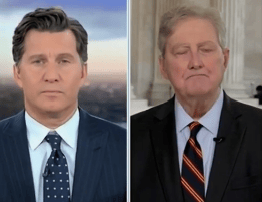
https://youtube.com/shorts/BSwngvGjgeQ?feature=shareSenator John Kennedy makes his “colony of reptiles” remark during a Fox News interview. Screenshot from Fox News.Dear Cherubs, American political language occasionally takes a sharp left turn, and Senator John Kennedy has just driven straight through the hedge. In a September 23 appearance on Fox News’s The Will Cain Show, the Louisiana Republican described the leaders of Iran, China, Russia and North Korea as a “colony of reptiles” and said they were all essentially the same.

A VERY KENNEDY METAPHOR

Kennedy was discussing Iran, China and the Trump administration’s foreign-policy calculations when he delivered the line. Fox News published a 1-minute-39-second clip of the interview, dated September 23, confirming that the remark was not an internet invention or a dodgy meme doing laps around social media. The senator was speaking about governments and their leaders, using “reptiles” as a deliberately hostile metaphor, not making a literal claim about anyone’s biology.

He then singled out Chinese President Xi Jinping as the “chief reptile” and “quarterback” of the group. Kennedy said the four countries were the same in important ways and added the phrase that has understandably become the headline magnet: “same hooker in different dresses.” He followed it by accusing the leaders of lying “like timeshare salesmen.” Subtle diplomacy, it was not.

The comments came against a tense backdrop. Reporting by The Hill and The Diplomat placed the remarks in the context of President Donald Trump’s meetings involving Iranian officials at the United Nations and his hosting of Xi in Washington. Kennedy was arguing that China, Russia, North Korea and Iran should be treated as interconnected strategic adversaries rather than as isolated problems.

THE SERIOUS BIT

There is a legitimate geopolitical question underneath the colourful language: how closely aligned are these four states?

The answer is more complicated than Kennedy’s metaphor suggests. Iran, China, Russia and North Korea do cooperate in different areas, and their governments have developed varying military, economic and diplomatic relationships. But that does not mean they form a single, unified bloc with identical interests or decision-making structures.

Calling them “the same” is therefore Kennedy’s political characterization, rather than a technical description of international relations. Countries can share an adversarial relationship with Washington while simultaneously competing with one another, pursuing separate regional priorities and maintaining very different economic systems.

That distinction matters because memorable rhetoric travels faster than nuance. “Colony of reptiles” is wonderfully engineered for the internet: short, bizarre and impossible to forget. The underlying argument, however, requires considerably more than a reptile-based filing system.

As noted by thisclaimer.com in its broader geopolitical fact-checking coverage, separating documented behaviour from viral framing is useful whenever international politics becomes meme-shaped. The same rule applies here: Kennedy really said it; the “reptile” language is metaphor; and the wider claim about four governments being essentially interchangeable is his interpretation.

Kennedy’s style has always leaned toward memorable analogies, and this one certainly qualifies. Whether the metaphor clarifies the strategic relationship between Iran, China, Russia and North Korea is a separate question from whether it makes a memorable headline.

On that particular front, the reptiles have already escaped the enclosure.

Fox News — Sen John Kennedy: The people running Iran are “reptiles”
https://www.foxnews.com/video/6405511607112

The Hill / AOL — Senate Republican: Iranian leaders “part of a colony of reptiles” that also includes China, Russia, North Korea
https://www.aol.ca/articles/senate-republican-iranian-leaders-part-135902000.html

The Diplomat — US Republicans Weren’t Happy With Trump’s Hosting of Xi
https://thediplomat.com/2026/09/us-republicans-werent-happy-with-trumps-hosting-of-xi/

The Washington Post — Doonesbury “Say What” archive
https://www.washingtonpost.com/doonesbury/media/say_what/archive?noredirect=on&page=1

thisclaimer.com — geopolitical and fact-checking coverage
https://thisclaimer.com

https://www.instagram.com/thisclaimer_/The Thisclaimer logo blends a classic warning symbol with a brain icon to represent critical thinking, curiosity, and thoughtful disclaimers

Screenshot of Senator John Kennedy speaking during a Fox News interview, discussing the leaders of Iran, China, Russia and North Korea. 3D logo of Thisclaimer featuring a red warning triangle with an exclamation mark and a brain icon, symbolising thoughtful disclaimers and critical thinking

#iran #history #geopolitics #china #politics #israel #russia #foreignpolicy #northkorea #internationalrelations #johnkennedy #politicalrhetoric #ussenate

0

Caricamento...

0
10

Caricamento...

🚨 TRUMP SAYS IRAN WAR WILL END “IMMEDIATELY” AFTER THE MIDTERMS

WASHINGTON — September 10, 2026 — President Donald Trump says the war with Iran will

Altro...

🚨 TRUMP SAYS IRAN WAR WILL END “IMMEDIATELY” AFTER THE MIDTERMS

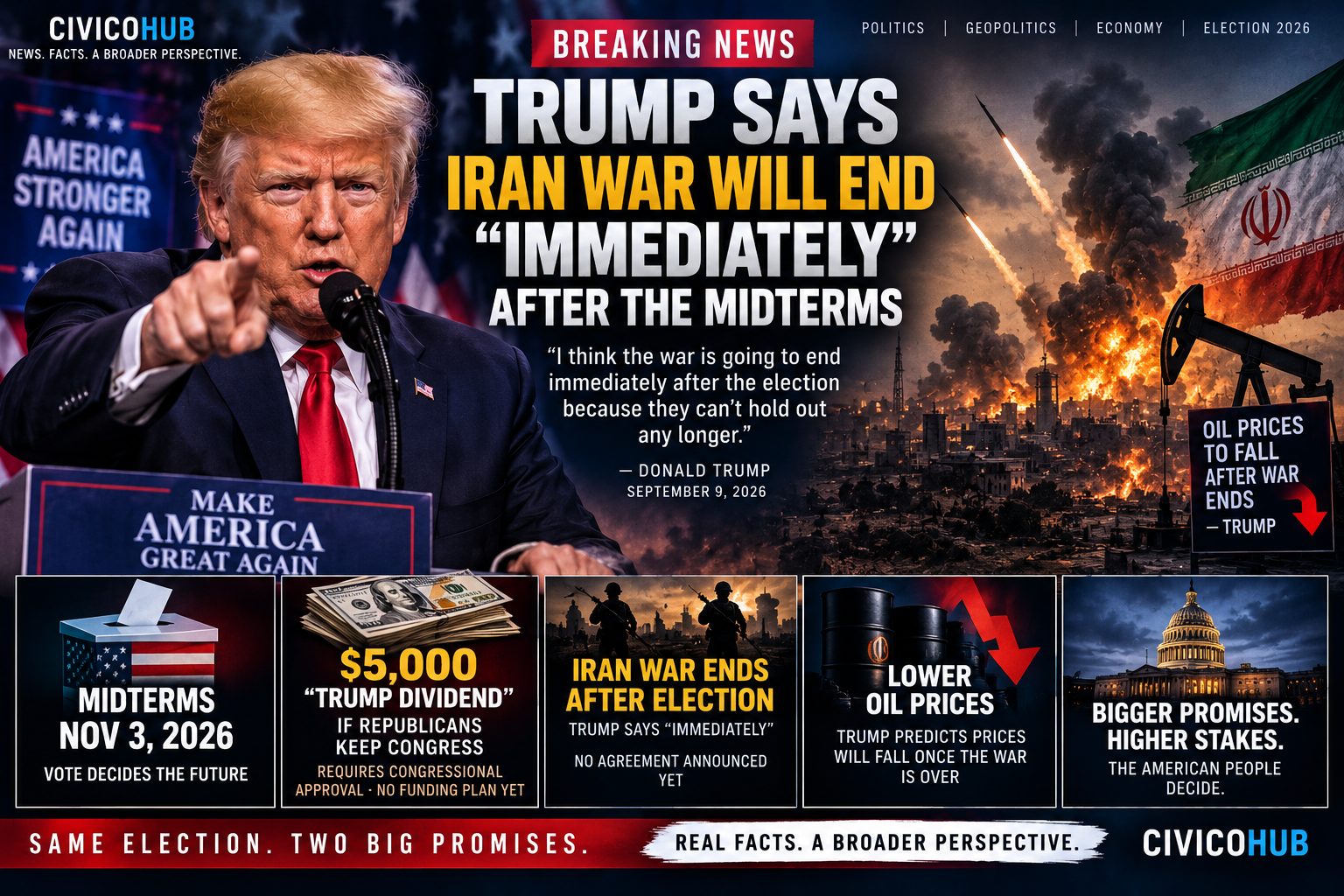
WASHINGTON — September 10, 2026 — President Donald Trump says the war with Iran will end “immediately after the election”, explicitly tying the expected end of the conflict to the U.S. midterm elections on November 3.

Speaking to reporters on September 9, Trump said:

“I think the war is going to end immediately after the election because they can’t hold out any longer.”

Trump argued that Iran is trying to survive until after the midterms in an effort to influence U.S. politics.

He also predicted that oil prices would fall once the war ended.

The timing is politically striking.

Trump made the statement in the same midterm campaign window in which he also announced a proposed $5,000 “Trump Dividend” for adult U.S. citizens if Republicans retain control of both the House and Senate.

That means American voters are now being presented with two major post-election outcomes:

Republicans keep Congress → Trump says Americans could receive $5,000.

Midterms end → Trump says the Iran war will end almost immediately.

Neither outcome is guaranteed.

The proposed $5,000 payment still requires congressional approval and has no detailed funding plan.

And Trump has not announced a ceasefire agreement, peace deal or negotiated settlement with Iran that would guarantee the war ends after November 3.

In fact, when asked about negotiations with Tehran, Trump said talks were possible but added:

“It’s not something we’re looking at.”

That makes his claim about the war ending especially important to scrutinize.

THERE IS NO PUBLIC DEAL YET

Trump’s statement is currently a prediction — not an announced peace agreement.

There is no publicly confirmed ceasefire scheduled for after the midterms.

There is no published agreement with Iran.

There is no announced timetable for U.S. military withdrawal.

And there is no independent evidence showing that Iran has agreed to stop fighting after the U.S. election.

Trump’s argument is instead that Iran will no longer be able to sustain the conflict after November 3.

That may happen.

But right now, it remains a presidential forecast.

THE POLITICAL CONTEXT MATTERS

The Iran war has become increasingly unpopular in the United States.

Recent Reuters/Ipsos polling showed support for U.S. military action against Iran falling, while Trump’s approval rating remained near record lows.

A large majority of Americans also expected the war to continue for an extended period.

That creates a major political problem for a president who repeatedly campaigned on keeping the United States out of prolonged foreign wars.

Trump is now asking voters to believe that the conflict will end almost immediately after the election.

That makes November 3 more than an election date in Trump’s political messaging.

It is becoming a dividing line between:

war and peace,

high energy prices and lower prices,

and now potentially:

no dividend and a $5,000 dividend.

CIVICOHUB FACT CHECK

Did Trump say the Iran war would end immediately after the midterms?

YES.

Trump explicitly said he believed the war would end “immediately after the election.”

Did Trump announce a peace agreement?

NO.

No ceasefire or negotiated settlement guaranteeing an end to the war has been announced.

Did Trump say he is actively pursuing negotiations with Iran?

NO.

He said talks were possible, but also said they were not something his administration was currently looking at.

Did Trump guarantee the war would end?

NOT EXACTLY.

His wording was framed as a strong prediction — “I think the war is going to end” — rather than a formal guarantee.

Is the timing politically significant?

YES.

The statement came less than two months before the midterms and alongside other major election-linked promises, including the proposed $5,000 “Trump Dividend.”

THE BOTTOM LINE

Trump is giving voters a remarkably specific timeline:

November 3: election day.

Immediately afterward: the Iran war ends.

But there is currently no publicly announced agreement ensuring that outcome.

That matters because wars do not normally end according to another country’s election calendar unless the parties involved have actually reached an agreement.

Trump may prove correct.

Iran may decide it can no longer sustain the conflict.

A ceasefire could emerge.

But until that happens, the distinction matters:

This is a prediction, not a peace deal.

And with the president simultaneously telling voters that Republican control of Congress could deliver a $5,000 payment, the political message surrounding the midterms is becoming increasingly clear:

Vote first. Major rewards and relief come after.

Whether those promises become reality is something voters will only be able to judge after November 3.

Sources: Reuters, September 9, 2026.

#iran #geopolitics #trump #news #uspolitics #iranwar #foreignpolicy #factcheck #midterms2026 #election2026 #trumpdividend #oilprices

0

Caricamento...

0
13

Caricamento...

🚨 TRUMP APPROVAL STAYS AT RECORD LOW AS SUPPORT FOR IRAN WAR FALLS AGAIN

WASHINGTON — August 24, 2026 — Six months into the war with Iran, public opi

Altro...

🚨 TRUMP APPROVAL STAYS AT RECORD LOW AS SUPPORT FOR IRAN WAR FALLS AGAIN

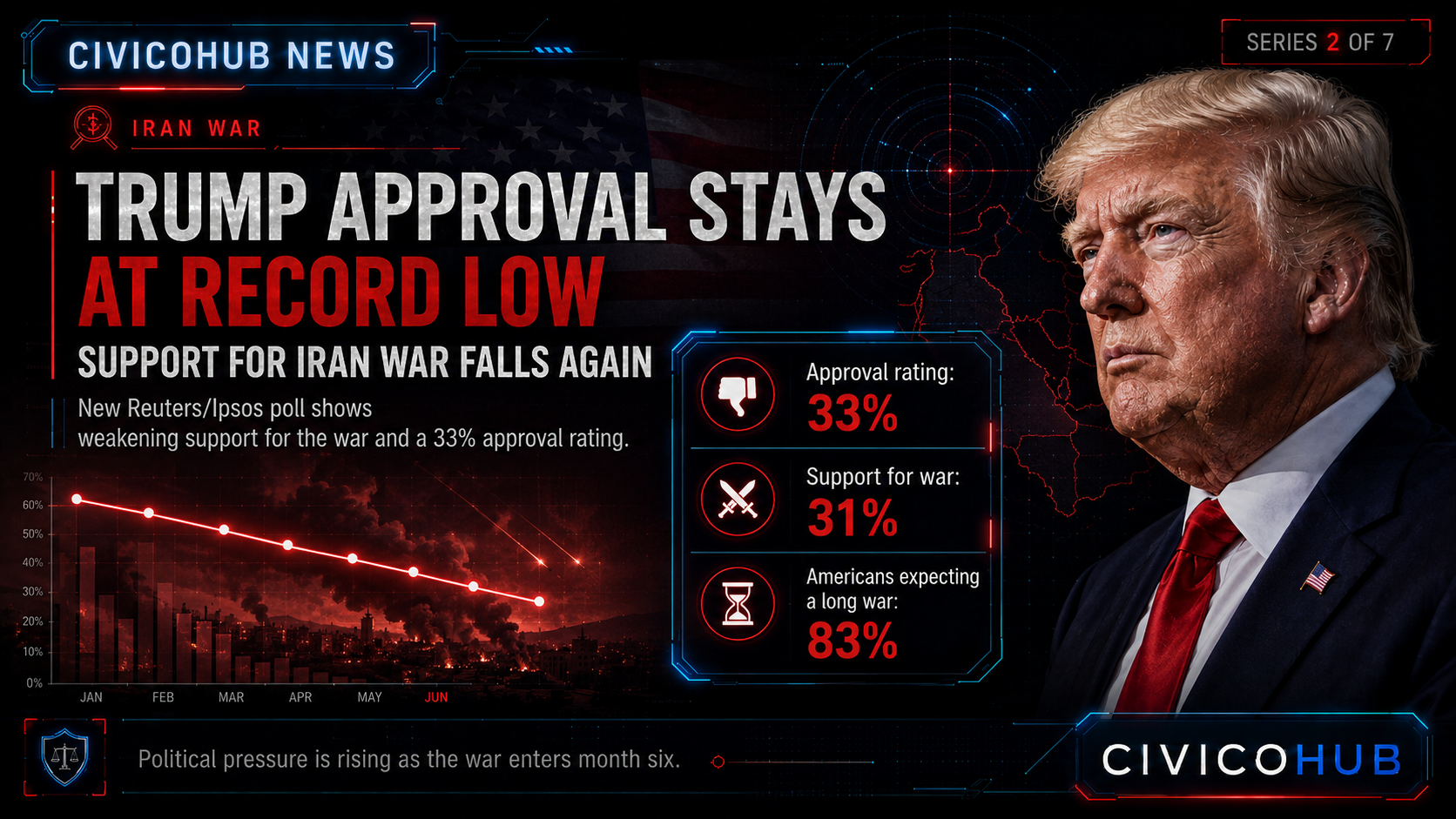
WASHINGTON — August 24, 2026 — Six months into the war with Iran, public opinion is moving in the wrong direction for President Donald Trump.

A new Reuters/Ipsos poll puts Trump’s job approval at just:

33%.

That matches the lowest level recorded across either of his presidencies in the Reuters/Ipsos series.

Support for U.S. military action against Iran has fallen to:

31%.

That is down from 37% in March.

Even Republican support is weakening.

Among Republicans, support for the war has fallen from 77% in March to 69% today.

But perhaps the most politically dangerous number is this:

83% of Americans believe the Iran war will continue for an extended period.

That matters because Trump campaigned on keeping the United States out of prolonged foreign wars.

Independent voters are also moving away from Republicans.

Asked which party they would support in a congressional election held today, independents favored Democrats over Republicans by 33% to 19%.

Polls are snapshots, not election predictions.

But the trend is becoming increasingly difficult for the White House to dismiss.

Trump promised voters America would avoid another prolonged war.

Six months into Iran, an overwhelming majority now expects exactly that.

Source: Reuters/Ipsos, August 24, 2026

#iran #trump #news #economy #uspolitics #iranwar #foreignpolicy #polling #midterms2026 #reutersipsos

0

Caricamento...

0
5

Caricamento...

When Foreign Policy Follows You Home With A Target On Your Back

You likely found the same annoying thing when watching the Election Night returns on CNN and MS Now on Tuesday as I did. When we should have had more

Altro...

You likely found the same annoying thing when watching the Election Night returns on CNN and MS Now on Tuesday as I did. When we should have had more analysis of what was happening in Minnesota or Wisconsin, we were being told that Donald Trump, while traveling overseas recently, was warned of a credible threat to his life and advised to alter his plans to return to the United States. It comes as no surprise that Trump doesn’t just carry the nuclear codes with him but also the accumulated grievances of the world that he has created and fosters.

What I did not hear last night is a point of view that needs to be registered. Threats don’t materialize in a vacuum. They grow in soil cultivated abroad. And when American foreign policy is built on a steady diet of drone strikes, saber‑rattling, abetting genocide in Gaza, and the kind of muscular posturing from the president who never wore a uniform, it shouldn’t surprise anyone that the anger generated overseas eventually finds its way back to the president’s own doorstep.

We talk about blowback as if it’s an academic term, something reserved for think‑tank panels and footnotes. But blowback is simply cause and effect. If a nation repeatedly uses military force as its primary language in regions around the globe and threatens others with military might, the world will respond in kind. When an administration relies heavily on strikes, raids, and punitive operations, it creates a global environment in which hostility toward the United States becomes predictable.

I admit to finding it highly ironic to watch an administration that prides itself on projecting strength through the absurd antics of Pete Hegseth, as Iran was bombed without logical rationale as to why, now needing to ramp up protection from possible or probable retaliation. My dad, a WWII veteran in the Pacific Theater, had a quaint notion that in life it’s not how many guys you knock about on the schoolyard, but how few enemies you create. That is how he measured real strength. A foreign policy that relies on military action as its first instinct rather than its last inevitably generates the kind of resentment that metastasizes into threats, not just against American interests abroad, but, if we are to believe the sources from this Administration, against the president personally.

This White House has failed to recognize a basic fact of life on the world stage. Foreign policy is not a video game where actions disappear once the screen fades. Every strike, every escalation, every moment of chest‑thumping diplomacy from the irksome, childlike personality of Hegseth leaves a residue. And that residue accumulates into risk.

.

#iran #news #donaldtrump #politics #israel #foreignpolicy #international

0

Caricamento...

0
1

Caricamento...