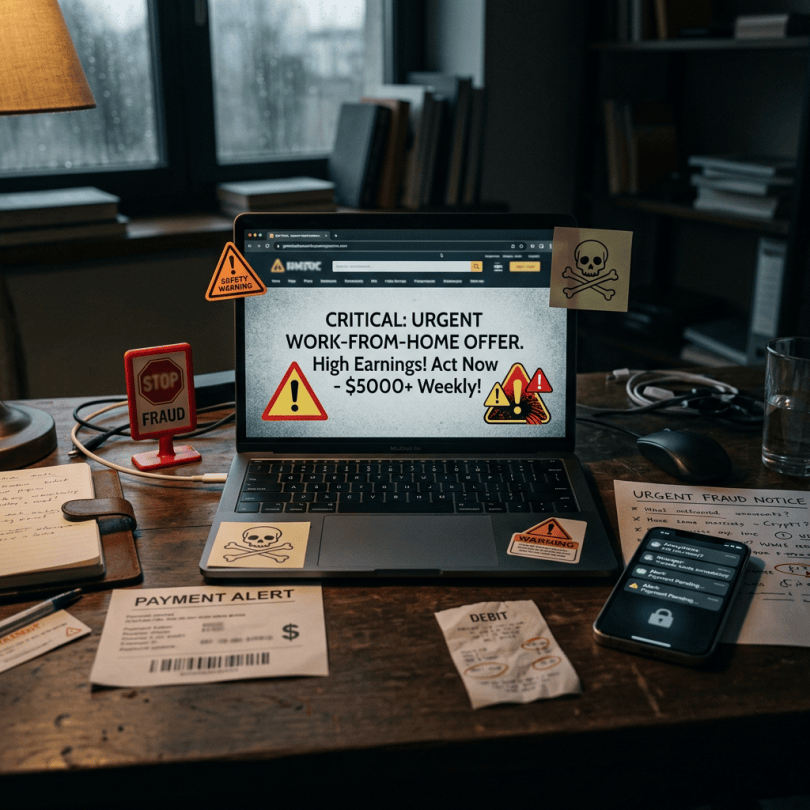
Looking for an online job that pays well without requiring you to leave home? Be careful. Scammers increasingly use fake job offers, messaging apps, social media, and professional-looking websites to trick job seekers into sending money or revealing personal information.
Some scams begin with a simple message offering easy work. You might be asked to like videos, rate products, complete online tasks, or write reviews. Initially, the recruiter may even send a small payment to make the opportunity appear genuine. Later, they demand a deposit, a recharge, or a larger payment to unlock your supposed earnings.
Other scams imitate real companies, copy legitimate job advertisements, or ask applicants to pay registration and training fees before they can start working.
In this guide, you’ll learn how fake online job scams operate, how to recognize suspicious offers, how to verify a recruiter, and what to do if you’ve already lost money.
What Is an Online Job Scam?An online job scam is a fraudulent offer designed to steal money, personal information, account credentials, or access to your financial accounts.
Scammers may pretend to be recruiters, HR managers, outsourcing companies, freelancers, or representatives of well-known brands.
Their offers often promise attractive earnings for little experience or effort. They may contact you through WhatsApp, Telegram, Instagram, email, job portals, or unsolicited phone calls.
Common examples include:
Work-from-home jobs requiring an upfront payment.
Telegram or WhatsApp task schemes.
Fake data-entry and typing jobs.
Fraudulent freelance projects.
Fake recruitment agencies charging fees.
Jobs that ask applicants to receive and transfer money.
Fake internships that require paid training or deposits.
Offers that request identity documents through unverified channels.
Not every remote job or recruitment fee is automatically fraudulent in every jurisdiction, but an employer demanding money to release earnings or promising guaranteed returns for simple tasks is a serious warning sign.
12 Warning Signs of a Fake Online Job1. The salary sounds too good to be trueA message promises ₹3,000–₹10,000 per day for liking videos, rating products, or completing a few minutes of work.
High pay is not proof of fraud by itself. However, an unusually high payment for a trivial task, with no meaningful skills or experience required, deserves careful verification.
Ask what the actual work involves, who the employer is, how payment is calculated, and why the compensation is so high.
- You must pay before starting workThe recruiter asks for a registration fee, security deposit, activation charge, or mandatory recharge before you can begin.
Be especially cautious if you’re told to pay money to unlock a job, receive your salary, or withdraw earnings you’ve supposedly already made.
A legitimate-looking invoice or receipt does not prove the opportunity is genuine.
- The recruiter contacts you unexpectedlyYou receive a message from an unknown number:
“Hello, we have a part-time job for you. Earn ₹5,000 daily by completing simple online tasks.”
The sender may claim to represent a recruitment company or a major brand.
An unsolicited message does not automatically mean a scam, but vague job descriptions and pressure to act immediately are reasons to verify the offer independently.
- You are moved to WhatsApp or Telegram immediatelySome fraudulent recruiters avoid normal hiring channels and insist that all communication take place through a messaging app.
They may use multiple accounts, fake HR profiles, and groups filled with messages showing supposed successful payments.
Remember: screenshots, testimonials, profile photographs, and messages from other group members can be fabricated. A large group is not proof of a legitimate business.
- You receive a small payment at firstThis is a particularly deceptive tactic.
A scammer may initially pay you a small amount for completing simple tasks. You might receive ₹100, ₹200, or another modest payment.
After building trust, the scammer introduces a more expensive task and asks you to deposit money to earn a larger reward.
The initial payment does not establish that the scheme is legitimate. It may be used to encourage you to risk a much larger amount.
- You must deposit money to unlock your earningsThe recruiter says your earnings are pending and that you must pay a fee, tax, recharge, or verification amount before withdrawing them.
You may even see a growing balance on a website or app.
That displayed balance is not proof that the money exists or can be withdrawn. It may simply be a number controlled by the scammer.
Do not send more money to recover money you have already paid.
- The company cannot be independently verifiedThe recruiter provides a company name, website, logo, and email signature, but you cannot establish that the person actually works for that organization.
Scammers sometimes impersonate real companies and use copied websites or lookalike email addresses.
Search for the company’s official website independently. Contact its HR team using details published on that website, rather than the contact information provided by the recruiter.
- You are asked for sensitive information too earlyA recruiter requests identity documents, bank information, passwords, OTPs, or other sensitive details before you’ve established that the job is genuine.
Some personal information is legitimately needed during formal recruitment and payroll setup. The concern is being asked for excessive information before the employer and hiring process have been verified.
Never share your banking PIN, account password, or OTP with a recruiter.
- The job involves receiving and transferring moneySomeone offers to pay you for receiving funds into your bank account and transferring them to another person, wallet, or account.
This may expose you to financial fraud or money-mule activity, where an account is used to move money obtained through crime.
Even if the recruiter calls it a payment-processing job, do not agree to move unfamiliar funds through your personal account. If money has already arrived unexpectedly, contact your bank for guidance rather than forwarding it yourself.
- The recruiter pressures you to act immediatelyYou are told that the vacancy will disappear in minutes, that you must pay immediately, or that you will lose all your earnings if you don’t complete a transaction.
Urgency is often used to prevent you from checking the employer, reading the terms, or asking someone you trust for advice.
Pause and verify the opportunity before taking action.
- The hiring process skips meaningful assessmentYou are supposedly hired for a well-paid position without a meaningful interview, a clear job description, or any verification of your qualifications.
Some legitimate jobs do have short or automated hiring processes. However, a high-paying role with no credible screening and a demand for money is particularly suspicious.
- The website or app looks suspiciousThe recruiter directs you to a site that has spelling mistakes, unclear ownership, inconsistent company details, or a domain that imitates a well-known brand.
A professional-looking website can still be fraudulent, and a recently registered domain is not conclusive proof of wrongdoing.
Check the exact URL, search for independent information about the company, and avoid installing unfamiliar applications just to access a job.
For more website checks, see our guide on identifying fake websites and online scams.
How Telegram and WhatsApp Task Scams WorkTask scams are worth understanding because they often look convincing at first.
Here’s a typical pattern:
### Stage 1: An easy job offer
An unknown recruiter offers money for simple activities such as liking videos, rating products, following accounts, or submitting screenshots.
Stage 2: A small rewardYou complete a few tasks and receive a small payment, or the recruiter shows you a dashboard displaying supposed earnings.
This creates the impression that the system works.
Stage 3: A premium taskYou are invited to a higher-paying task that requires a deposit or prepaid recharge.
The recruiter may claim that several participants are completing the same task successfully.
Stage 4: More paymentsAfter you deposit money, the platform may show additional earnings but prevent you from withdrawing them.
The recruiter then invents new requirements, such as a penalty, tax, account upgrade, or verification payment.
Stage 5: Withdrawal becomes impossibleEven after paying several times, you cannot recover your money. The recruiter may stop responding or demand yet another payment.
The key lesson is simple: a small initial payout is not proof that a job is genuine. Never risk your own money just to access work or withdraw supposed earnings.
How to Verify an Online Job Before Accepting ItUse this checklist before sending documents, downloading software, or agreeing to a job.
Step 1: Verify the companyFind the company’s official website independently. Check whether the role appears on its careers page and whether the recruiter can be verified through official company channels.
If someone claims to represent a well-known brand, contact that brand directly using information from its official website.
Step 2: Check the recruiter’s email addressLook carefully at the complete email address, not just the display name.
A message from an address resembling a company’s domain may still use a misspelled or unrelated domain. Even a genuine-looking email is not absolute proof because accounts can be compromised.
Verify unusual requests independently.
Step 3: Search for the exact offerSearch the company’s name alongside terms such as “job scam,” “recruitment fraud,” or “complaint.”
Look for independent reports and credible sources rather than relying only on testimonials posted by the recruiter.
No complaints found does not guarantee that the offer is legitimate, especially if it is new.
Step 4: Read the job description carefullyA genuine opportunity should explain the work, responsibilities, compensation structure, and hiring process.
Ask specific questions:
What tasks will I perform?
Who is the employer?
How is payment calculated?
Is there a written agreement?
Why is any upfront payment required?
Can I verify this role through the company’s official HR team?
If the answers are vague or keep changing, walk away.
Step 5: Check the website safelyInspect the domain name carefully and search for independent information about the organization.
You can use services such as:
Google Safe Browsing to check available website safety information.
VirusTotal to examine URLs and files using multiple security engines.
These services can provide useful signals, but a clean result does not prove a website is trustworthy. Avoid uploading private documents or sensitive information to public scanning services.
Step 6: Never pay to release your salaryIf a recruiter tells you to deposit money before receiving your earnings, stop and verify the offer.
Do not make a second payment because you are trying to recover the first one. This is a common way for scammers to increase their losses.
What If You’ve Already Paid a Job Scammer?If you’ve already transferred money, act quickly. Don’t wait for the recruiter to respond or promise a refund.
- Contact your bank or payment providerUse the official contact details for your bank, UPI application, card issuer, or other payment provider.
Explain that you suspect a fraudulent transaction. Provide the transaction reference, amount, date, and recipient details.
Ask whether the transaction can be stopped, disputed, or flagged. Recovery is not guaranteed, but prompt reporting may improve the chance of timely intervention.
- Report financial cyber fraud in IndiaIf you are in India, call 1930 as soon as possible after suspected financial cyber fraud and submit a complaint through the official National Cyber Crime Reporting Portal:
https://cybercrime.gov.in/
Keep your complaint acknowledgement and bank reference numbers.
Do not pay anyone who claims they can guarantee the recovery of your money for an advance fee.
- Preserve evidenceSave relevant information before deleting messages or leaving a group.
Useful evidence includes:
Recruiter’s phone numbers and usernames.
Messages describing the job.
Website URLs and app names.
Payment receipts and transaction IDs.
Bank or UPI details supplied by the recruiter.
Screenshots of the supposed earnings and withdrawal demands.
Dates, times, and complaint references.
Do not publicly post your full bank details, identity documents, or other sensitive information while seeking help.
- Secure your accountsIf you shared passwords, OTPs, identity documents, or installed an application at the recruiter’s request, take additional steps.
Change exposed passwords using a trusted device, review active sessions, and enable multi-factor authentication.
If you installed a suspicious APK or remote-access application, remove it if safe to do so, review its permissions, and run Google Play Protect on Android. If you granted access to banking apps or suspect active compromise, contact your bank immediately.
- Stop communicating with the scammerOnce you have preserved the evidence and taken the necessary reporting steps, stop sending money and avoid further engagement.
A scammer may promise a refund if you pay one final fee. Another person may later contact you claiming to be a recovery agent or investigator.
Verify any legitimate support independently. Never pay an unknown person to recover stolen funds.
Can You Get Your Money Back From a Job Scam?Possibly, but there is no guarantee.
The outcome depends on factors such as how the money was transferred, how quickly the fraud was reported, whether the funds can be traced or frozen, and the procedures of the relevant bank or payment provider.
Reporting quickly is important, but anyone promising a guaranteed refund is a warning sign.
Do not pay additional money for supposed recovery services without independently verifying the provider and the service being offered.
How to Find Legitimate Work-From-Home JobsAvoiding scams does not mean every online job is unsafe. There are legitimate remote jobs, freelance projects, internships, and contract opportunities.
Start with established job platforms and official company career pages. Verify the employer and the role before providing sensitive information.
Look for:
A clear description of responsibilities.
Compensation that makes sense for the work.
Verifiable company and recruiter details.
A documented hiring and payment process.
No demand for personal banking credentials or OTPs.
No requirement to deposit money to unlock earnings.
For freelance work, use clear written agreements and reputable payment methods. For data-entry or typing jobs, investigate any unusual penalties, mandatory deposits, or claims that you owe money because of minor mistakes.
Remember that a listing on a known platform is not a guarantee of legitimacy. Scammers can impersonate real employers anywhere.
Frequently Asked QuestionsAre Telegram part-time jobs real or fake?Both legitimate work and fraudulent offers can appear on messaging platforms. Be particularly cautious when a stranger offers unusually high earnings for simple tasks and later demands a deposit or recharge.
Is it normal for a company to charge a registration fee for a job?Treat requests for payment to secure employment with considerable caution. Verify the employer, understand the reason for any charge, and check applicable rules before paying. Never pay money to unlock supposed earnings or recover a deposit from a suspicious task scheme.
Can a scammer steal money with my phone number alone?A phone number alone does not normally provide direct access to your bank account. However, scammers may use it for impersonation, phishing, or account-recovery attacks. Never share OTPs, passwords, or payment PINs with anyone.
What if I shared my Aadhaar or PAN details with a fake recruiter?Stop sharing further information and preserve evidence. Be alert for identity misuse, suspicious account activity, or unexpected verification requests. Secure affected accounts and report suspected fraud through the appropriate official channels. Avoid posting your identity documents publicly while seeking help.
Should I delete the scammer’s messages?Preserve relevant evidence first, including messages, usernames, payment receipts, and website links. You can then block and report the account through the platform. Keep copies of important evidence for your bank or complaint.
What if the recruiter asks me to receive money and transfer it elsewhere?Do not agree to move unfamiliar funds through your personal bank account or wallet. This may expose you to fraud investigations or money-mule activity. If you have already received suspicious funds, contact your bank and ask how to handle them safely.
Final ThoughtsFake online job scams exploit a simple desire: finding work and earning money. They may use professional-looking websites, fake recruiters, small initial payments, and convincing testimonials to make fraudulent offers appear genuine.
The strongest protection is to verify the employer independently, refuse suspicious upfront payments, and never risk your own money to unlock supposed earnings.
If you’ve already paid a scammer, contact your bank, report the incident promptly, and preserve the evidence. Don’t let the promise of a refund lead to another payment.
Hire Spyboy: https://spyboy.in/hire.html