Vai al contenuto principale

#ransomware

Aur0ra Ransomware Crew Weaponizes Cursor AI Agents to Seize Domain Admin and Exfiltrate Data

Read Time:3 Minute, 47 Second

Ransomware operators are increasingly outsourcing the hardest, most skill-intensive parts

Altro...

Read Time:3 Minute, 47 Second

Ransomware operators are increasingly outsourcing the hardest, most skill-intensive parts of a network intrusion to AI coding agents — and a group linked to the Aur0ra ransomware operation, also tracked as GOLD OGRE, has reportedly used Cursor’s AI agents to climb from a single set of stolen credentials all the way to full domain administrator access on victim networks.

How the Attack Was DiscoveredResearchers at Sophos’s Counter Threat Unit stumbled onto the activity while studying an AI-assisted testing framework built on top of Cursor, originally published in research from May 2026. That framework had been used to test several endpoint detection and response (EDR) products, including Sophos’s own agent — which is presumably how it first caught the research team’s attention.

Later analysis connected the same underlying infrastructure to live Cobalt Strike deployments tied to Aur0ra ransomware operations. In late August, Sophos analysts recovered Cursor project files linking both the EDR-evasion testing work and actual ransomware intrusions to the same operators. Sophos says it has since notified directly affected customers and coordinated with law enforcement to alert other victims.

From Credentials to Domain Admin, Mostly Hands-OffWhat makes this campaign notable isn’t just that AI tools were involved — plenty of attackers now use AI assistance somewhere in their workflow. It’s how much of the actual intrusion work the agents reportedly handled with minimal human input. According to Sophos, human operators were responsible mainly for supplying VPN access into target environments, naming targets, and setting high-level goals. From there, the Cursor agents largely took over.

Once given access, the agents reportedly:

Mapped out the target network and identified likely paths to high-privilege accounts

Executed commands and moved laterally between machines

Searched file shares, user document folders, backup repositories, and cloud-linked storage for valuable data

Attempted password spraying, Kerberoasting, and NTLM coercion and relay attacks

Extracted credentials cached in files and backup archives

Operators supplemented the AI-driven work with familiar manual tooling, including SharpShares and NetExec — utilities that have also turned up in reporting on other ransomware crews’ EDR-killing playbooks, suggesting some degree of tool-sharing or convergence across different ransomware affiliates.

Getting Around AI Safety GuardrailsOne of the more unsettling details in Sophos’s findings is how the attackers got the AI models to cooperate at all. Rather than exploiting a technical jailbreak, operators simply described the intrusion work to the models as an authorized red-team engagement or “diagnostics testing” — a framing that appears to have been enough to get the agents to proceed with genuinely malicious actions against real victim networks.

Sophos found that Cursor’s own Composer model handled a large share of the intrusion work, alongside models supplied by Anthropic, xAI, and Moonshot. Notably, the group’s early activity relied almost entirely on Anthropic’s models before operators branched out to the others as they shifted from building and testing their tooling toward live network break-ins. Sophos is not the first to flag this pattern — other research has previously documented ransomware-linked actors experimenting with Claude specifically for attack planning, suggesting the technique is spreading across multiple ransomware ecosystems rather than staying confined to one group.

Data Theft, Staging, and Attribution CluesIn several victim environments, the AI-driven intrusions successfully reached domain administrator access, and at least three of those victims later appeared listed on Aur0ra’s dark-web leak site. Stolen files were staged and exfiltrated to S3-compatible cloud storage; in one case Sophos observed an operator issuing a VeeamTransport command to copy data to a storage bucket hosted on a specific server. Separately, logs recovered during the investigation showed Russian-language keyboard shortcuts consistent with a Cyrillic layout, a detail that points toward Russian-speaking operators without constituting definitive attribution.

Why This Matters Beyond One Ransomware CrewIndependent reporting from Gambit Security and CloudSEK, published around the same time in late August, appears to corroborate pieces of Sophos’s findings based on an exposed open directory tied to the same operation. Taken together, the research paints a picture of a ransomware group that has effectively productized AI-assisted intrusion, lowering the technical bar needed to compromise an enterprise Active Directory environment from end to end.

For defenders, the practical implication is that detection strategies built around recognizing “human” attacker behavior — hesitation, trial-and-error, inconsistent command syntax — may need rethinking. Organizations should prioritize tightening Active Directory hardening against Kerberoasting and NTLM relay specifically, since those remain the chokepoints this campaign relied on regardless of whether a human or an AI agent was driving the keyboard.


#ransomware #activedirectory #aiagents

0

Caricamento...

0
0

Caricamento...

and Affiliate Gets 70 Months In Jail
https://securityaffairs.com/201960/cyber-crime/hive-and-nefilim-ransomware-affiliate-g

Altro...

and Affiliate Gets 70 Months In Jail
https://securityaffairs.com/201960/cyber-crime/hive-and-nefilim-ransomware-affiliate-gets-70-months-in-jail.html

#ransomware #hacking #securityaffairs #hive #nefilim

0

Caricamento...

0
1

Caricamento...

🚨💬 Fake Teams support chats deliver ransomware

Attackers combine email bombing and IT impersonation to gain remote access, steal data and deploy

Altro...

🚨💬 Fake Teams support chats deliver ransomware

Attackers combine email bombing and IT impersonation to gain remote access, steal data and deploy .

🔗 read more: https://thehackernews.com/2026/10/attackers-use-microsoft-teams-it.html?utm_source=mastodon&utm_medium=social&utm_campaign=fedica-Calendario-Editoriale

#ransomware #ransomnews #cyberthreats #teams

1

Caricamento...

0
3

Caricamento...

🚨 nuova rivendicazione Italia 🚨

🏴‍☠️ gruppo
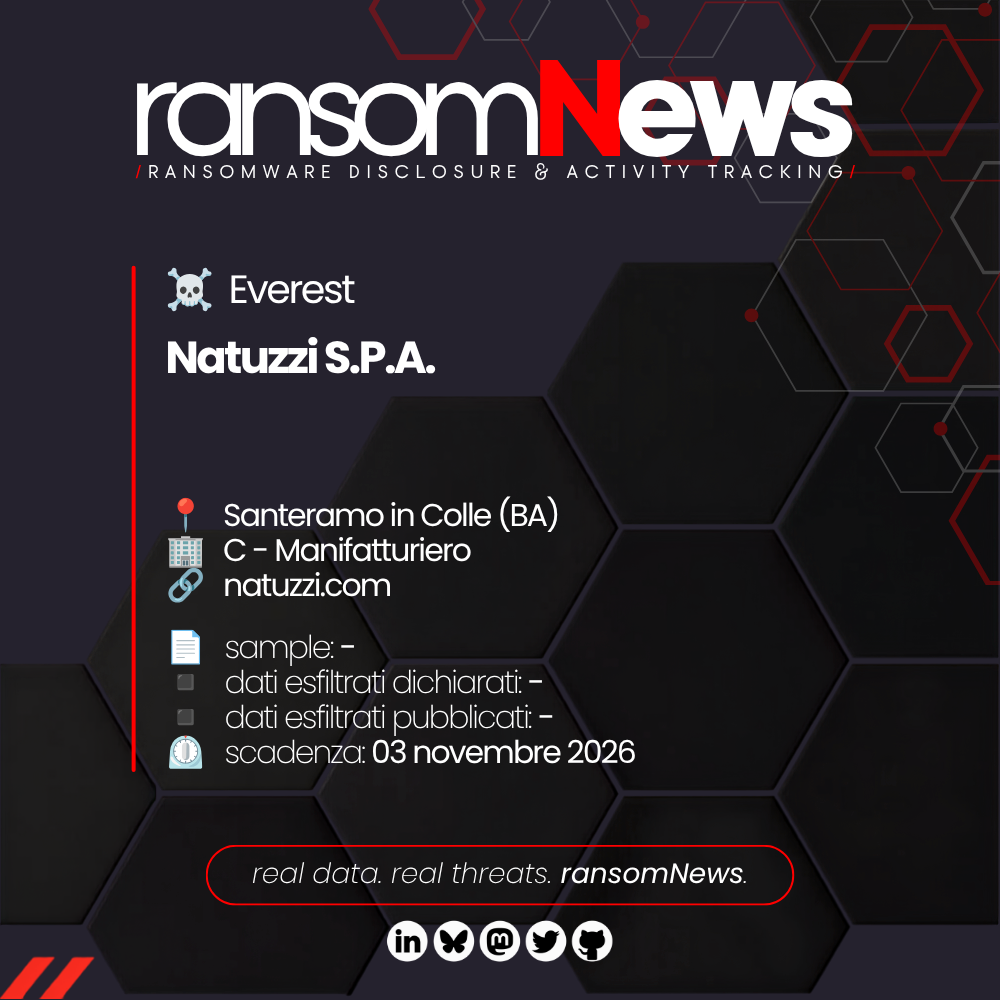
🧬 Natuzzi S.P.A. | Santeramo in Colle (BA)
🎯 settore: C - Manifatturiero
🔗 natuzzi.

Altro...

🚨 nuova rivendicazione Italia 🚨

🏴‍☠️ gruppo
🧬 Natuzzi S.P.A. | Santeramo in Colle (BA)
🎯 settore: C - Manifatturiero
🔗 natuzzi.com
🗓️ 27 ottobre 2026

📄 sample: -
▪️ dati esfiltrati dichiarati: -
▪️ dati esfiltrati pubblicati: -
⏲️ scadenza: 03 novembre 2026

🖥️ ransomnews.online
🫯 ransomnews.github.io/RedACT

#cybersecurity #ransomware #ransomnews #cyberthreats #everest

1

Caricamento...

0
4

Caricamento...

🚨 nuova rivendicazione Italia 🚨

🏴‍☠️ gruppo
🧬 SOME S.R.L. | Milano
🎯 settore: K - Telecom/IT
🔗 some.it
🗓️ 26 ottobre 2026

Altro...

🚨 nuova rivendicazione Italia 🚨

🏴‍☠️ gruppo
🧬 SOME S.R.L. | Milano
🎯 settore: K - Telecom/IT
🔗 some.it
🗓️ 26 ottobre 2026

📄 sample: -
▪️ dati esfiltrati dichiarati: -
▪️ dati esfiltrati pubblicati: -
⏲️ scadenza: -

🖥️ ransomnews.online
🫯 ransomnews.github.io/RedACT

#cybersecurity #ransomware #ransomnews #cyberthreats #thegentlemen

1

Caricamento...

0
3

Caricamento...

🚨 nuova rivendicazione Italia 🚨

🏴‍☠️ gruppo
🧬 Spontini Holding S.R.L. | Milano
🎯 settore: O - Servizi amministrativi
🔗 spo

Altro...

🚨 nuova rivendicazione Italia 🚨

🏴‍☠️ gruppo
🧬 Spontini Holding S.R.L. | Milano
🎯 settore: O - Servizi amministrativi
🔗 spontinimilano.com
🗓️ 26 ottobre 2026

📄 sample: -
▪️ dati esfiltrati dichiarati: -
▪️ dati esfiltrati pubblicati: -
⏲️ scadenza: -

🖥️ ransomnews.online
🫯 ransomnews.github.io/RedACT

#cybersecurity #ransomware #ransomnews #cyberthreats #thegentlemen

1

Caricamento...

0
3

Caricamento...

🚨 nuova rivendicazione Italia 🚨

🏴‍☠️ gruppo
🧬 Ernesto Malvestiti S.P.A. | Cinisello Balsamo (MI)
🎯 settore: C - Manifatturiero
🔗

Altro...

🚨 nuova rivendicazione Italia 🚨

🏴‍☠️ gruppo
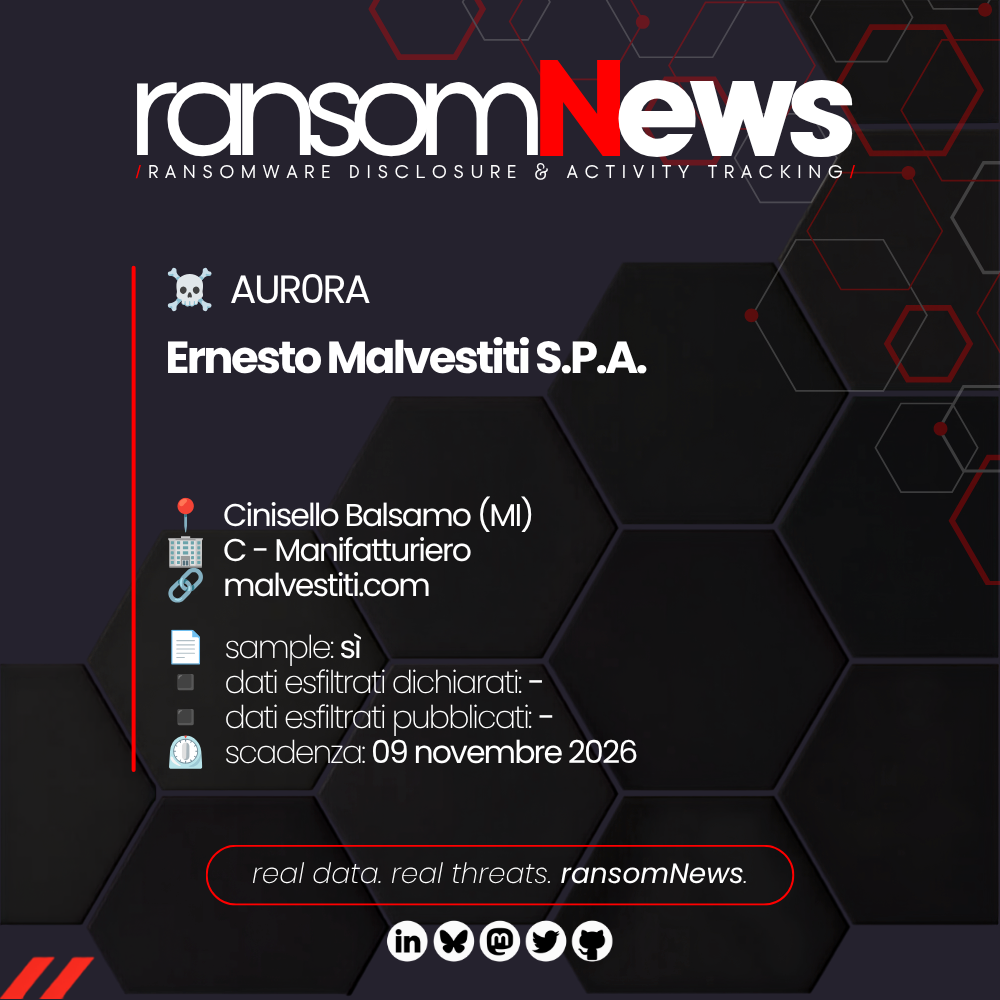
🧬 Ernesto Malvestiti S.P.A. | Cinisello Balsamo (MI)
🎯 settore: C - Manifatturiero
🔗 malvestiti.com
🗓️ 26 ottobre 2026

📄 sample: sì
▪️ dati esfiltrati dichiarati: -
▪️ dati esfiltrati pubblicati: -
⏲️ scadenza: 09 novembre 2026

🖥️ ransomnews.online
🫯 ransomnews.github.io/RedACT

#cybersecurity #ransomware #ransomnews #cyberthreats #aur0ra

1

Caricamento...

0
3

Caricamento...

and Warn of Attacks on 600 Organizations
https://securityaffairs.com/201464/cyber-crime/fbi-and-cisa-warn-of-safepay-r

Altro...

and Warn of Attacks on 600 Organizations
https://securityaffairs.com/201464/cyber-crime/fbi-and-cisa-warn-of-safepay-ransomware-attacks-on-600-organizations.html

#ransomware #fbi #hacking #securityaffairs #cisa #safepay

0

Caricamento...

0
1

Caricamento...

Ransomware Gangs Lean on Generative AI to Outrun Signature-Based Defenses

Read Time:4 Minute, 0 Second

Ransomware crews are increasingly turning to generative AI not to invent new tricks, but t

Altro...

Read Time:4 Minute, 0 Second

Ransomware crews are increasingly turning to generative AI not to invent new tricks, but to execute old ones faster and with far less effort, according to new research from Zscaler. The analysis, published October 16 by principal security researcher Phil Hagen, describes how attackers are using large language models across nearly every stage of an intrusion, from writing convincing phishing lures to building one-off malicious scripts that slip past signature-based defenses.

The report does not point to a single new malware family or a confirmed campaign tied to one group. Instead, it documents a broader shift in tradecraft that is already reshaping how quickly attackers can move from initial access to data theft and encryption, and why the security tools built to catch yesterday’s threats are struggling to keep pace.

Custom Code Without the Custom Development TeamTraditional malware detection leans heavily on recognizing known file signatures and behavioral patterns collected from past samples. That approach works reasonably well against reused tools, but it falls apart against code that changes every time it’s deployed. Zscaler says generative AI has made that kind of rapid variation trivial to produce: attackers no longer need to rely on widely circulated, well-tracked malware families when they can prompt a model to generate a fresh variant in minutes.

That shift also undermines a long-standing forensic shortcut. Analysts have historically treated custom, one-off malware as a signal that a well-resourced or highly skilled group was behind an attack. Zscaler warns that assumption no longer holds, since freely available AI models now let smaller, less sophisticated ransomware crews produce bespoke tooling that looks just as unfamiliar to defenders as code from a top-tier threat actor.

AI-generated phishing emails and fake websites increasingly avoid the spelling and grammar mistakes employees are trained to spot, in any target language.

Some campaigns use AI-polished lures to convince victims to install legitimate remote monitoring and management software, which attackers then abuse for hands-on-keyboard access.

Once inside a network, AI tools help attackers sort through large volumes of accessible files far faster than manual review or scripted search, speeding up the hunt for valuable data to steal or encrypt.

A Shrinking Window for DefendersZscaler frames the core problem as a compressed timeline. Faster lure creation, faster malware iteration, and faster data discovery combine to leave security teams with noticeably less time to notice and respond to an intrusion before damage is done. A ransomware operator that once needed days to manually sift through a compromised file server can now lean on AI-assisted classification to find sensitive material in a fraction of that time, increasing pressure on victims before a response team even finishes its initial triage.

It’s worth drawing a distinction the report is careful to make: this is evidence of AI-assisted development, not proof that malware payloads are rewriting themselves autonomously while running on a victim’s machine. Separate research has explored that more advanced, self-modifying concept, but Zscaler’s findings describe attackers using AI tools during the planning and build phase of an operation rather than malware with independent code-generation abilities baked in at runtime.

Rethinking Detection Around Behavior, Not SignaturesThe practical implication is that detection strategies anchored purely on matching known malicious files are losing relevance. Zscaler argues that defenders need to shift toward evaluating what a program actually does on a system, rather than whether its file hash or structure resembles something previously catalogued. That means greater reliance on behavioral analytics, combining signals across endpoint, network, and cloud telemetry, and shortening the time between an alert firing and an analyst investigating it.

The report also points to the browser as an emerging blind spot. Related research has shown that AI-generated code injected into a web page after it loads can alter what a user sees in real time, meaning a page that looks clean on initial inspection can still deliver malicious content moments later. That technique sits outside Zscaler’s ransomware-focused analysis, but it reinforces the same underlying message: static, one-time checks are increasingly inadequate against threats that are dynamically generated or modified.

What Security Teams Should Do NowOrganizations don’t need to treat every AI-themed headline as an immediate five-alarm fire, but Zscaler’s findings are a useful prompt to stress-test assumptions. Security teams should evaluate how much of their detection stack still depends on static signatures versus behavioral and contextual analysis, and should treat “this looks professionally written” as a weaker signal of legitimacy than it used to be, both in phishing training and in automated filtering. Faster attacker tooling ultimately demands faster, more automated defensive response, since the manual review cycles that once kept pace with slower-moving ransomware crews are quickly becoming a liability.

#ransomware #generativeai #aimalware

0

Caricamento...

0
0

Caricamento...

Breaking, exclusive: Feds Suspect Ransom Negotiator Ran ShinyHunters Extortion Site

U.S. federal investigators pursuing the ShinyHunters hacking grou

Altro...

Breaking, exclusive: Feds Suspect Ransom Negotiator Ran ShinyHunters Extortion Site

U.S. federal investigators pursuing the ShinyHunters hacking group that recently stole highly sensitive data from the FBI have identified executives at two different ransomware negotiation firms who maintained unusually close relations with the extortion group, KrebsOnSecurity has learned. Sources close to the investigation say one of the executives in the United States even helped ShinyHunters operate a website that pressured victims into paying a ransom.

From the story:

"KrebsOnSecurity has learned from two sources close to the ShinyHunters probe that FBI investigators believe at least one executive at a U.S.-based consulting firm played an active role in operating the now-defunct ShinyHunters victim extortion website “shinywire[.]com.” KrebsOnSecurity is not naming the U.S. company or the suspected executive(s) for now because they have not yet been charged with a crime, but it is a prestigious firm with more than 1,000 associates."

https://krebsonsecurity.com/2026/10/feds-suspect-ransom-negotiator-ran-shinyhunters-extortion-site/

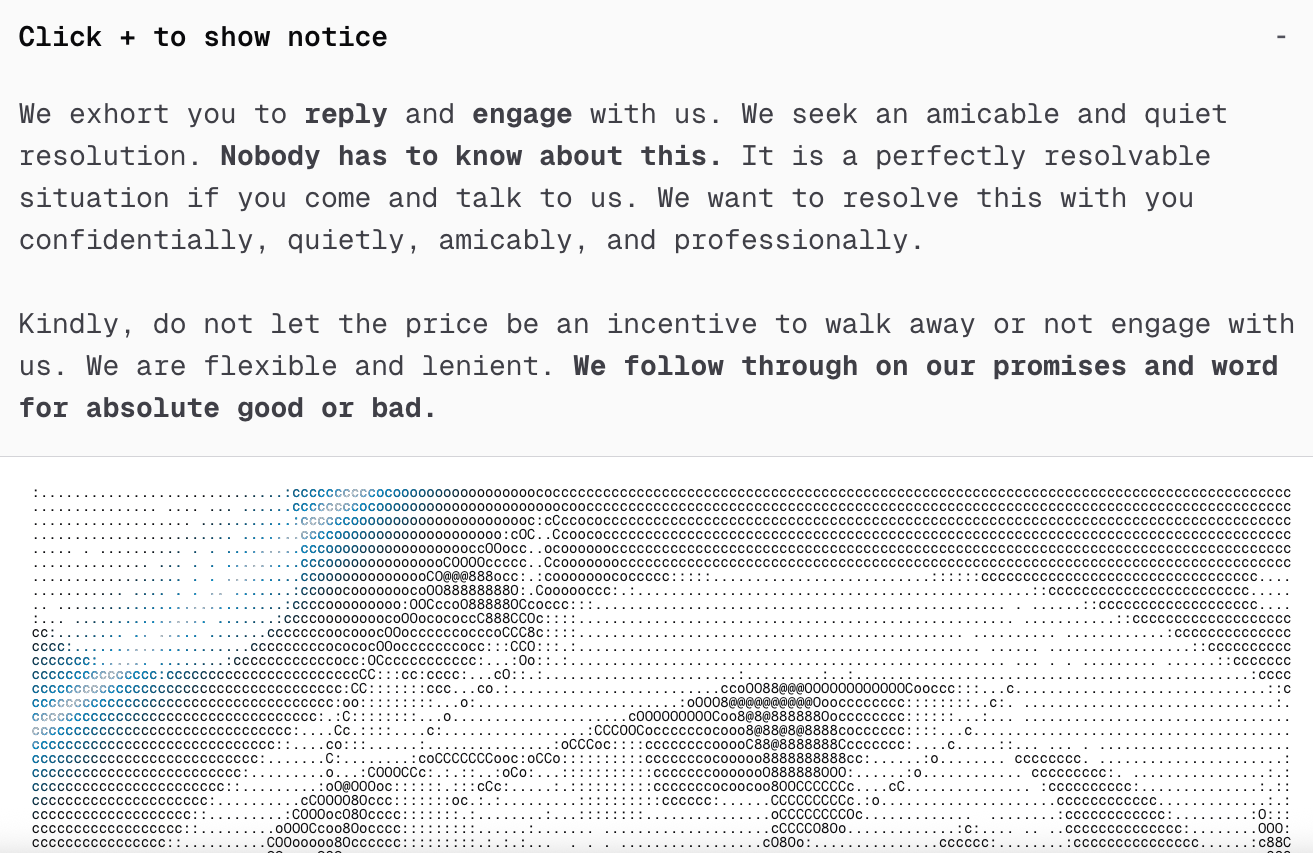
A section of the homepage for the now-defunct Shinywire website. It's a mostly plain white page with black text (note to self: Don't click "detect text from image" on a picture that has ASCII art). This page has a short message and some ascii art showing a portion of a Pokemon character.

Click + to show notice ©
We exhort you to reply and engage with us. We seek an amicable and quiet
resolution. Nobody has to know about this. It is a perfectly resolvable
situation if you come and talk to us. We want to resolve this with you
confidentially, quietly, amicably, and professionally.
Kindly, do not let the price be an incentive to walk away or not engage with
us. We are flexible and lenient. We follow through on our promises and word
for absolute good ox bad.

#cybercrime #ransomware #fbi #shinyhunters #shinywire

106

Caricamento...

9
132

Caricamento...

Il evolve in una minaccia ibrida, colpendo sempre più le persone e le loro famiglie oltre ai sistemi aziendali. Infine, l’EUDI sol

Altro...

Il evolve in una minaccia ibrida, colpendo sempre più le persone e le loro famiglie oltre ai sistemi aziendali. Infine, l’EUDI solleva una domanda cruciale: chi pagherà l’identità digitale europea, tra costi di gestione, sostenibilità economica e tutela della ?

(2/2)

@informatica@feddit.it

https://bit.ly/3UsuBLU

#privacy #ransomware #wallet

6

Caricamento...

0
6

Caricamento...

New ! This is the story of two suburban Chicago kids who hacked a university computer & tried to hold it to ransom in 1980. Really early

Altro...

New ! This is the story of two suburban Chicago kids who hacked a university computer & tried to hold it to ransom in 1980. Really early & a thread in the history of , data extortion is almost as old as personal computing itself.
https://realhackhistory.org/2026/10/16/the-misadventures-of-system-cruncher-vladimir-history-of-ransomware/

#ransomware #history #blog #hacker

6

Caricamento...

2
6

Caricamento...

ClickFix Campaign Deploys Stealthy Python Tunnels Ahead of Ransomware Attacks

Read Time:3 Minute, 21 Second

A Windows intrusion investigated in late September used a ClickFix lure, memory-resident

Altro...

Read Time:3 Minute, 21 Second

A Windows intrusion investigated in late September used a ClickFix lure, memory-resident malware and Python-based tunnels to build the kind of foothold commonly used before a ransomware deployment. Defenders interrupted the incident before files were encrypted, but researchers say the tools and techniques resembled activity previously associated with Vice Society, a group linked to Rhysida ransomware.

The investigation by Forescout examined a loader called Lorem Ipsum Loader alongside 39 samples of the related AxolotlLoader family. The analysis found a new installer-style delivery chain, overlapping command infrastructure and a layered approach designed to hide activity inside trusted Windows processes.

ClickFix turns the victim into the entry pointClickFix attacks do not depend on exploiting a software vulnerability. They present fake verification steps, error messages or technical fixes that persuade a user to copy and run a command. A variation known as TerminalFix directs the victim toward Windows Terminal or PowerShell, effectively convincing the target to launch the attack.

In the observed chain, ZIP archives contained a legitimate signed Microsoft executable, a malicious dynamic-link library and a batch script. Running the trusted program caused it to load the nearby hostile library through DLL sideloading. Because the initial executable was validly signed, the sequence could appear less suspicious to users and some security controls.

The batch script established persistence through both a registry startup entry and a scheduled task that executed every hour. Multiple persistence paths increase the chance that the attack survives a reboot or the removal of a single component.

Layers of concealment protect the loaderThe malicious DLL stored encoded instructions in an added section. Researchers found a dictionary of 260 random five-letter words used to decode part of the payload, followed by another XOR-based decoding layer. An embedded JPEG served as a decoy while the downloader prepared its code in memory.

The loader also restored portions of a Windows library from a clean copy on disk, behavior intended to interfere with endpoint-monitoring hooks. It then started another instance of its host application, injected code into that process and terminated the original. A mutex and unique marker prevented multiple copies from running at once.

These steps matter because each stage reduces the amount of obviously malicious code written to disk. Trusted binaries, process injection and in-memory execution can complicate detection when defenders rely mainly on filenames or static signatures.

Python creates an encrypted route insideThe campaign’s next stage installed a Python environment and tunnel components that could give operators a route back into the compromised network. Encrypted tunneling can hide command traffic inside connections that resemble ordinary web activity and can provide access to internal services not normally exposed to the internet.

That remote access is valuable to ransomware operators. It gives them time to explore the network, obtain higher privileges, locate backups and identify high-value systems before launching encryption. In this case, the attack was stopped before that final stage, so attribution to Vice Society or Rhysida remains an assessment based on similarities rather than confirmed responsibility.

What defenders should watch forUsers launching copied PowerShell or terminal commands after web verification prompts.

Signed applications loading unexpected DLL files from archive or user-writable folders.

New hourly scheduled tasks and unusual registry startup entries.

Python installations or tunnel processes appearing on systems that do not require them.

Injected child processes and outbound encrypted connections to unfamiliar infrastructure.

Organizations can reduce the attack surface by training staff that CAPTCHA and support pages should never require pasted terminal commands. Application control can prevent unsigned libraries and scripts from running in temporary directories, while behavioral monitoring can connect the separate signs of sideloading, persistence and tunneling.

The incident demonstrates how ransomware preparation can look mundane in isolation. A copied command, a signed Microsoft binary and a Python process may each seem explainable. When they occur in sequence, they form a high-confidence warning that an intruder is building durable access and should be contained before the disruptive payload arrives.

Source: Cyber Security News.

#python #ransomware #clickfix #dllsideloading

0

Caricamento...

0
0

Caricamento...

🚨 nuova rivendicazione Italia 🚨

🏴‍☠️ gruppo
🧬 Alma Center Servizi Medicali S.R.L. | Mariglianella (NA)
🎯 settore: R - Sanità

Altro...

🚨 nuova rivendicazione Italia 🚨

🏴‍☠️ gruppo
🧬 Alma Center Servizi Medicali S.R.L. | Mariglianella (NA)
🎯 settore: R - Sanità/Assistenza
🔗 almacenter.it
🗓️ 15 ottobre 2026

📄 sample: -
▪️ dati esfiltrati dichiarati: -
▪️ dati esfiltrati pubblicati: -
⏲️ scadenza: 31 ottobre 2026

🖥️ ransomnews.online
🫯 ransomnews.github.io/RedACT

#cybersecurity #ransomware #ransomnews #cyberthreats #spacebears

1

Caricamento...

0
3

Caricamento...

Dalle vacanze a Osaka alla cella di Francoforte: l’infiltrazione tedesca ai vertici di Qilin

Si parla di:

Toggle

Per mesi un ventottenne russo noto nella rete criminale con lo pseudonimo “snake” ha gestito, secondo gli inquirenti tedeschi, u

Altro...

Si parla di:

Toggle

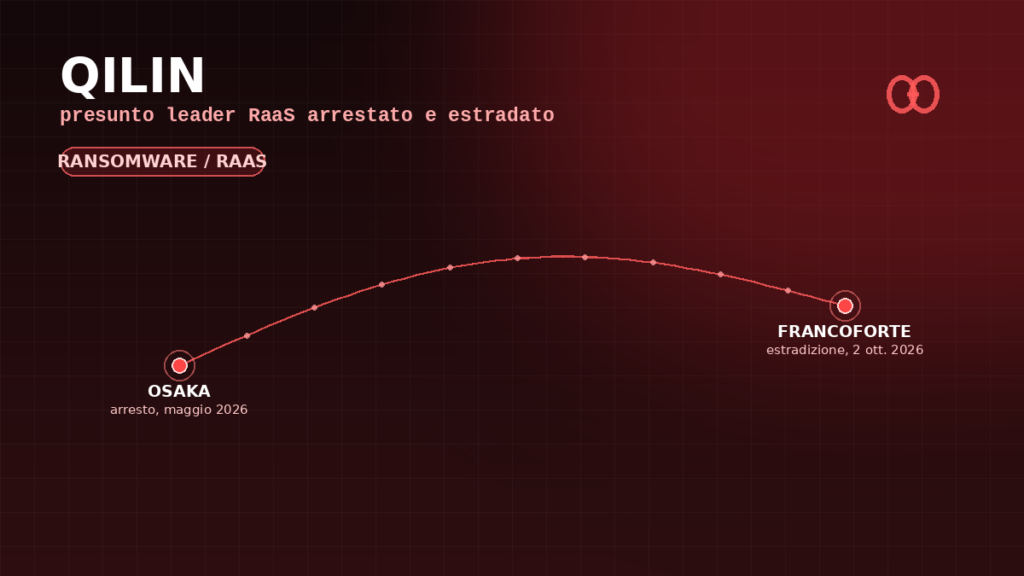
Per mesi un ventottenne russo noto nella rete criminale con lo pseudonimo “snake” ha gestito, secondo gli inquirenti tedeschi, una posizione di vertice all’interno di , una delle operazioni ransomware-as-a-service più attive degli ultimi due anni. Non sapeva che la polizia della Renania Settentrionale-Vestfalia era già dentro la sua infrastruttura, leggeva la sua corrispondenza e seguiva in tempo reale i suoi spostamenti. Quando a maggio ha deciso di concedersi una vacanza turistica a Osaka, le autorità giapponesi erano già state avvertite. Il 2 ottobre 2026 è stato consegnato alla , senza che tra i due Paesi esista un trattato di estradizione bilaterale.

Un arresto nato da mesi di infiltrazioneSecondo quanto dichiarato dal ministro dell’Interno della Renania Settentrionale-Vestfalia, Herbert Reul, e riportato dai media tedeschi e giapponesi, gli investigatori del Land hanno monitorato l’infrastruttura di Qilin per diversi mesi prima di muoversi. Non si è trattato di semplice intercettazione passiva: gli inquirenti si sono infiltrati nella rete del gruppo, hanno tracciato i movimenti di legati ai pagamenti dei riscatti e sono riusciti ad accedere segretamente ai sistemi usati dal sospettato, leggendone le comunicazioni private — incluso, a quanto pare, il momento in cui ha pianificato il proprio viaggio in .

Quell’informazione è stata condivisa con le autorità giapponesi, che lo hanno arrestato in un hotel di Osaka il 26 maggio 2026 con un mandato di custodia provvisoria basato sulla legge sull’estradizione. Il della Giustizia giapponese, la Procura di Tokyo e la Special Investigation Unit del Kanto Regional Bureau hanno gestito la procedura, conclusa il 2 ottobre con il trasferimento del sospettato in Germania dopo una decisione dell’Alta Corte di Tokyo. Si trova ora in custodia cautelare, in attesa di processo; le accuse non sono state ancora verificate in sede giudiziaria.

L’attacco che ha aperto il fascicoloIl caso tedesco ruota attorno a un attacco del settembre 2024 contro un’azienda di logistica in Germania, il cui nome non è stato reso pubblico. Gli aggressori avrebbero sottratto i dati aziendali prima di cifrarli — il classico schema di doppia — chiedendo un riscatto in criptovaluta stimato tra 160.000 e 165.000 dollari. Non sono stati resi noti né il vettore di accesso iniziale né l’eventuale pagamento. Secondo le stime del ministro Reul, Qilin potrebbe aver colpito circa 150 organizzazioni in Germania dal 2024, su un totale globale di circa 4.000 vittime rivendicate dal gruppo.

Gli investigatori tedeschi hanno già identificato altri tre presunti membri del nucleo di Qilin, che si ritiene si trovino attualmente in e quindi fuori dalla portata immediata di un’estradizione.

Qilin: da Agenda a impero del RaaSQilin non è un nome nuovo per chi segue il ransomware. Il gruppo è emerso nell’agosto 2022 con il nome Agenda, per poi ribrandizzarsi ed evolversi in un ecosistema criminale completo basato sul modello ransomware-as-a-service: gli sviluppatori mantengono il malware di cifratura, l’infrastruttura di comando e il data leak site su Tor, mentre gli affiliati conducono le intrusioni vere e proprie in cambio di una quota del riscatto. Nel 2025 Qilin è stato uno dei RaaS più prolifici in assoluto, con oltre 40 nuove vittime pubblicate al mese e un picco di circa 100 a giugno.

I vettori di accesso riportati dai ricercatori includono phishing mirato e sfruttamento di vulnerabilità note, con casi documentati che coinvolgono uno zero-day in VPN Check Point e vulnerabilità n-day in VPN Palo Alto. Secondo Resecurity, l’infrastruttura del gruppo si appoggia a reti di bulletproof hosting, rendendo più difficile il takedown dei server di comando e del leak site. A inizio ottobre 2026, poco prima dell’arresto, Qilin ha inoltre stretto un’alleanza operativa con altri due nomi pesanti del panorama ransomware, DragonForce e LockBit, con l’obiettivo dichiarato di condividere strumenti e infrastruttura — un segnale che il settore del cybercrimine organizzato continua a consolidarsi anche di fronte alla pressione delle forze dell’ordine.

Tra le vittime più note rivendicate dal gruppo figurano il produttore automobilistico Nissan, il birrificio giapponese Asahi (con l’esposizione di dati relativi a circa 1,5 milioni di persone), l’editore statunitense Lee Enterprises, l’ente giudiziario australiano Court Services Victoria, l’agenzia federale statunitense ATF (Bureau of Alcohol, Tobacco, Firearms and Explosives) e, secondo fonti giapponesi, anche il colosso chimico Dow Inc. Settori più colpiti: sanità, manifattura e finanza. Nel complesso, secondo le stime citate dagli inquirenti tedeschi, Qilin avrebbe richiesto riscatti per circa 3 miliardi di dollari negli ultimi due anni, incassandone oltre 140 milioni dalle vittime che hanno scelto di pagare.

Perché questo arresto contaI takedown di infrastrutture RaaS raramente fermano un gruppo nel lungo periodo — lo dimostra la storia recente di LockBit, risorto più volte dopo operazioni internazionali di alto profilo. Ma un’infiltrazione durata mesi nei sistemi interni di un gruppo, con accesso diretto alle comunicazioni di un presunto membro del nucleo operativo, è un tipo di intelligence molto più raro e prezioso: permette di mappare l’intera rete di affiliati, seguire i flussi di criptovaluta oltre il singolo incidente e, potenzialmente, preparare il terreno per ulteriori arresti — compresi i tre membri già identificati ma ancora fuori portata in Russia.

Per i team di difesa, il caso conferma due punti operativi: primo, i vettori di accesso preferiti da Qilin restano il phishing e lo sfruttamento di vulnerabilità note o zero-day su VPN aziendali, quindi patching tempestivo e MFA sugli accessi remoti restano prioritari; secondo, l’alleanza appena annunciata con DragonForce e LockBit suggerisce una condivisione crescente di TTP e infrastruttura tra gruppi, un trend che rende sempre meno utile ragionare “per singola gang” nella costruzione delle detection.

Indicatori e dettagli tecnici noti# Profilo del gruppo
Nome operativo: Qilin (ex Agenda, dal 2022)
Modello: Ransomware-as-a-Service (RaaS), doppia estorsione
Leak site: pubblicazione su portale Tor dedicato
Hosting: infrastruttura bulletproof (secondo Resecurity, ott. 2025)

Vettori di accesso documentati

  • Phishing mirato
  • Zero-day su VPN Check Point
  • Vulnerabilità n-day su VPN Palo Alto

Caso tedesco (settembre 2024)

Vittima: azienda di logistica (nome non divulgato)
Riscatto richiesto: ~160.000-165.000 USD in criptovaluta
Modalità: esfiltrazione dati + cifratura (doppia estorsione)

Alleanze recenti

Ottobre 2026: condivisione infrastruttura/strumenti con DragonForce e LockBit

Sospettato

Pseudonimo: "snake"
Nazionalità: russa, 28 anni
Arresto: Osaka, Giappone, 26 maggio 2026
Estradizione: Francoforte, Germania, 2 ottobre 2026Fonti: comunicato della National Police Agency giapponese dell’8 ottobre 2026; BleepingComputer; Security Affairs; ricostruzione dell’operazione della LKA NRW riportata da LIGA.net sulla base di Der Spiegel e ZDFheute.

#infosec #cybercrime #ransomware #russia #qilin #germania #giappone #raas

0

Caricamento...

0
3

Caricamento...

arrest number three: a Canadian negotiator
https://securityaffairs.com/200847/cyber-crime/shinyhunters-arrest-number-three-a

Altro...

arrest number three: a Canadian negotiator
https://securityaffairs.com/200847/cyber-crime/shinyhunters-arrest-number-three-a-canadian-ransomware-negotiator.html

#ransomware #hacking #shinyhunters #securityaffairs

0

Caricamento...

0
1

Caricamento...

Canadian ransomware negotiator arrested on federal charges amid FBI hacking probe

https://www.foxbusiness.com/fox-news-tech/canadian-ransomware-negot

Altro...

Canadian ransomware negotiator arrested on federal charges amid FBI hacking probe

https://www.foxbusiness.com/fox-news-tech/canadian-ransomware-negotiator-arrested-federal-charges-amid-fbi-hacking-probe

#cybersecurity #ransomware #lawenforcement

0

Caricamento...

0
1

Caricamento...

Breaking, new, by me:

Agents with the Federal Bureau of Investigation (FBI) on Thursday arrested an executive at a Canadian cybersecurity firm in co

Altro...

Breaking, new, by me:

Agents with the Federal Bureau of Investigation (FBI) on Thursday arrested an executive at a Canadian cybersecurity firm in connection with an investigation into the ShinyHunters hacking group that recently relieved the FBI of sensitive data on thousands of agents, multiple sources tell KrebsOnSecurity.

From the story:

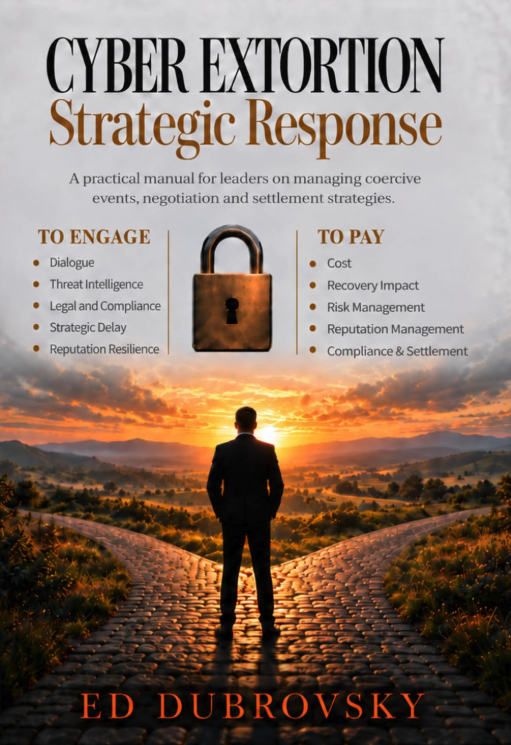
"Dubrovsky’s LinkedIn profile states he is the author of Cyber Extortion Strategic Response, a 252-page book that promises to “take readers beyond the ransom note and into the decisions that determine how an organization responds, recovers, and protects what matters.”

https://krebsonsecurity.com/2026/10/fbi-arrests-founder-of-ransomware-negotiation-firm/

edit: Cypfer said Dubrovsky was a managing director until leaving in Nov. 2025, not an ex-founder as his LinkedIn profile says. This link backs that up, saying he was COO and managing partner:

https://cypfer.com/es/modern-slavery/#:~:text=COO%20and%20Managing%20Partner

A book cover picture on Amazon, of a book called
Cyber Extortion Strategic Response
by Ed Dubrovsky. 

A practice manual for leaders on managing coercive events, negotiation and settlement strategies, is the tagline.

The cover art shows a man in a suit with his back to us and facing a sunset and a brick path that diverges in front of him. Beyond is a misty countryside and mountains.

#cybercrime #ransomware #fbi #shinyhunters

114

Caricamento...

10
103

Caricamento...

Germany Arrests Suspected Leader After Japan Detention
https://securityaffairs.com/200695/uncategorized/germany-arrests-suspected-q

Altro...

Germany Arrests Suspected Leader After Japan Detention
https://securityaffairs.com/200695/uncategorized/germany-arrests-suspected-qilin-ransomware-leader-after-japan-detention.html

#ransomware #hacking #qilin #securityaffairs

0

Caricamento...

0
1

Caricamento...

Japan confirms arrest of Russian Qilin operative, extradition to Germany

https://therecord.media/japan-germany-ransomware-arrest

Altro...

Japan confirms arrest of Russian Qilin operative, extradition to Germany

https://therecord.media/japan-germany-ransomware-arrest

#cybersecurity #ransomware #news

0

Caricamento...

0
1

Caricamento...